Loading...
Please wait for a bit
Please wait for a bit
Click any word to translate
Original article by Jakub Krupa
… and on that note, it’s a wrap for today!
Italian prime minister Giorgia Meloni has conceded defeat in a two-day referendum on judiciary reforms, saying she will respect the voters’ decision – but branding it “a lost chance to modernise Italy” (16:50, 17:00).
With 95% votes now counted, nearly 54% of the voters backed the No campaign, rejecting the contentious proposals (18:05).
The unexpected defeat weakens Meloni politically, as she was hoping to press ahead with an electoral law that could give her coalition a comfortable win in next year’s general election (15:23).
In other news,
Hungary’s embattled prime minister Viktor Orbán hosted the “Patriots’ Grand Assembly” in Budapest, bringing together a number of far-right leaders from across Europe (18:11).
Earlier today, the European Commission said it would seek “a clarification” from the Hungarian government after media reports alleging that the country’s foreign minister Péter Szijjártó had been leaking confidential EU discussions to his Russian counterpart, Sergei Lavrov (12:23).
Orbán attempted to get on the front foot as he ordered a probe into what he called a wiretapping of Szijjártó’s phone (13:02).
Hungary’s Orbán and his government face a tricky parliamentary election next month, with a number of nationalist leaders lining up to endorse him ahead of the vote (11:41, 12:03).
Elsewhere, France’s local elections, closely watched for clues to next year’s presidential vote, have given parties of the centre a welcome and unexpected lift as the far right and radical left fell some way short of their ambitions.
If you have any tips, comments or suggestions, email me at jakub.krupa@theguardian.com.
I am also on Bluesky at @jakubkrupa.bsky.social and on X at @jakubkrupa.
Meanwhile, Hungary’s embattled prime minister Viktor Orbán hosted the “Patriots’ Grand Assembly” in Budapest, bringing together a number of far-right leaders from across Europe, including Czech Republic’s Macinka, France’s Le Pen, Italy’s Salvini, the Netherland’s Wilders, and Spain’s Abascal.
After the meeting, a number of leaders posted their endorsements of Orbán ahead of next month’s closely watched parliamentary election in Hungary, with polls suggesting he could lose power after 16 years in office.
Le Pen said she was “very honored to come today to support” Orbán, claiming that “everywhere on the continent, our movements represent hope for millions of Europeans.”
Wilders posted a selfie with the embattled prime minister, noting his presence in Budapest, with a heart emoji for the Hungarian capital.
Abascal stressed the importance of sovereign nation states instead of the transnational bodies such as the European Union.
The Hungarian election is set to take place on 12 April.
Europe correspondent
Elsewhere, France’s local elections, closely watched for clues to next year’s presidential vote, have given parties of the centre a welcome and unexpected lift as the far right and radical left fell some way short of their ambitions.
The 35,000 municipal ballots often focus on local survival and their outcomes do not always reflect national voting patterns, but they do show trends in popularity and suggest what kind of alliances can be struck in a fragmented political landscape.
The far-right National Rally (RN), either of whose likely candidates in the 2027 race – Jordan Bardella or Marine Le Pen – could, polls suggest, succeed Emmanuel Macron as France’s next president, multiplied its number of councillors by 13 in Sunday’s second-round vote.
The party held on to Perpignan and captured smaller southern towns including Carcassonne, Menton and Cannes. It also claimed victory in France’s resolutely conservative fifth city, Nice, through its ally, the breakaway rightwinger Éric Ciotti.
But the RN failed to seize its most coveted target, Marseille, the country’s second largest city, or several others that it had high hopes of winning, including Toulon and Nîmes, puncturing a growing air of invincibility.
in Rome
Italian voters have rejected an overhaul of the country’s judiciary pushed by the prime minister, Giorgia Meloni, an outcome expected to tarnish her reputation and make winning next year’s general election more challenging.
In a two-day referendum, 54.63% of voters said “No” to the reforms to reorganise the judiciary compared with 45.37% for the “Yes” camp.
“The Italians have decided and we respect this decision,” said Meloni as the results came through on Monday afternoon. “We will move forward, as we always have done, with responsibility, determination and respect towards the Italian people and Italy.”
Meloni’s far-right government has proved unusually stable for Italy and since coming to power in October 2022 the prime minister has cultivated good working relations with many European leaders and Donald Trump.
Her Brothers of Italy party, which has neofascist roots, leads in polls at about 30%, while Meloni rides high in personal opinion polls.
But this aura of invincibility is now damaged, said analysts. “Her standing is going to suffer,” said D’Alimonte. “She’s going to be a weaker prime minister.”
With 95% of the votes now counted, 53.78% of the voters rejected the government’s reform.
Daniele Albertazzi, a professor of politics at the UK’s University of Surrey told AFP it was a “bad, bad result” for Meloni.
“It means she has lost the Italian electorate on a major issue in her manifesto, and one of the key proposals of the right... for the past 30 years,” he said.
It is the first such setback for Meloni, who has led an uncharacteristically stable coalition government since October 2022 and faces parliamentary elections next year.
“If the centre-left gets its act together, this is going to help them. Because it means that her image as unbeatable is not there any more,” Albertazzi said.
In her brief social media clip, Meloni said:
“Sovereignty belongs to the people, and Italians have expressed themselves clearly today. The government has done what it promised: advanced a justice reform that was in our manifesto.
We supported it to the fullest and then put the choice back to the citizens, the citizens have decided, and we, as always, respect their decision.
There is clearly still regret for a missed opportunity to modernise Italy, but this does not change our commitment to continue working with seriousness and determination for the good of the nation and to honor the mandate entrusted to us.
We will move forward as we always have: with responsibility, determination, and above all, with respect for Italy and its people.”
Italian prime minister Giorgia Meloni has just conceded defeat in the referendum, saying she will respect the voters’ decision – but branding it “a lost chance to modernise Italy.”
“We will move forward, as we have always done, with responsibility, determination, and respect for the Italian people and for Italy,” she said.
More soon.
The latest Rai projection – based on 73% ballots counted – shows the No vote still firmly ahead with 53.6% of the vote, and the Yes trailing at 46.4%.
Rai’s data, via Consorzio Opinio Italia poll, shows that 88.8% of the voters of Meloni’s Fratelli d’Italia party voted in favour of the proposed changes, with 11.2% against.
More than 80% of the voters of Lega and Forza Italia also backed the reform.
But the opposition forces were seemingly strongly “on message,” with as many as 90% of the Democratic Party’s voters rejecting the proposal, and 87% of those supporting the Five Star Movement.
The poll also shows that the youngest voters – those aged 18 to 34 – decisively rejected the reform by 61% to 39%. The 35–54 bracket was also narrowly against the change (53:47). Meanwhile, the oldest group of voters (55+) was split essentially in half, with a tiny advantage for the ‘yes’ side (51:49).
Updated
Picking up on that point, former PM Renzi told Radio Leopolda that “when the people speak, the government must listen,” as he drew on his personal experience of resigning from the post.
But in comments reported by Corriere della Sera, he sounded warning about complacency or ignoring the political signal of today’s result.
Sky TG24 reported that a number of demonstrations calling for Meloni’s resignation (don’t count on it) were expected to take place across Italy this afternoon, including in Rome, Milan, Naples, Turin and Bologna.
Meanwhile, Giuseppe Conte, the leader of the opposition Five Star Movement, hailed the result of the vote posting a social media:
“We did it, long live the constitution!”
Updated
While Giorgia Meloni has firmly ruled out resigning over the result, avoiding the fate of former premier Matteo Renzi, whose tenure ended abruptly after a failed 2016 constitutional referendum, a loss will nonetheless leave her vulnerable, analysts told Reuters.
The timing of the contest proved challenging for Meloni, with Italians harbouring a clear dislike of her ally, US president Donald Trump, and fearful that the US-Israeli war on Iran will drive up already high domestic power prices, the agency said.
Victory in the referendum would have likely emboldened the prime minister to press ahead with other significant constitutional changes, such as making the post of prime minister directly elected, Reuters noted.
The likely rejection by voters leaves her weakened domestically as she grapples with a stagnant economy and complex international headwinds. It could also weaken her standing in Europe, where previously she was seen as unexpectedly resilient and enduring.
And as we are getting more partial results, the Sky TG24 broadcaster has just called the vote for “No.”
You can follow the official results here as they come in.
Rai’s second projection – updated with votes from 37% polling stations – suggests the gap widens even further with No campaign now projected to get 53.9%, and Yes at just 46.1%.
Taking actual results from the first 12% of the polling stations that reported first, Rai is now projecting the final result to be 46.9% for yes, and 53.1% for no.
But, but, but these numbers will obviously change as we get more actual results, and it’s still very early days.
in Rome
Exit polls on Monday appeared to suggest Italy’s prime minister has narrowly lost a contentious referendum on judicial reform.
The pollsters said the No camp, supported by a significant proportion of the Italian opposition, had gained between 49% and 53% of the vote compared to 47% to 51% for the government-based Yes camp.
Turnout in the two-day referendum reached a record-breaking 58.5%, according
to data from the Italian interior ministry, contradicting pre-ballot forecasts that turnout would be low.
Defeat would be a blow to Meloni, who was hoping to press ahead with an electoral law that could give her coalition a comfortable win in next year’s general election.
The nature of the proposed judicial reforms was technical and complex, with the referendum campaign mostly filled with inflammatory rhetoric towards the judiciary.
Early turnout data suggest 58.4% of the electorate voted in the referendum.
These numbers are very close – too close for comfort for either side or to call it just yet.
But all three main polls show the ‘No’ campaign – against the proposed changes to the constitution – in the lead in what, if confirmed, would be a big set back for Italy’s Giorgia Meloni.
Updated
SWG poll for La7 broadcaster has the same numbers.
Yes 47-51%
NO 49-53%
Yes 47-51%
NO 49-53%
Consortio Opinio Italia poll for Italian public broadcaster Rai
Yes 48.5%
NO 51.5%
2.2% margin error
Youtrend poll for Sky
In the words of a certain popular Italian journalist: “Here – we – go!”
I will bring you the numbers as soon as we have them.
Updated
According to Italian media, we are expecting as many as three polls: Opinio for Rai, Swg for La7, and Youtrend for Sky.
Three minutes to go.
Updated
in Rome
Here’s a quick reminder of what’s at stake at today’s referendum.
A victory for the yes campaign would usher in changes to how judges and prosecutors are recruited and governed, including separating their career paths, establishing two governing councils selected by lottery and creating a court to handle disciplinary matters.
Meloni says the changes are essential for impartiality, in particular to weed out what she calls the leftwing political “factions” ruling the judiciary.
Opponents claim they will weaken the power and independence of judges and prosecutors, making them more vulnerable to government control in a manner akin to Viktor Orbán’s Hungary.
in Rome
Opinion polls before the blackout period began pointed to a close race in which the no camp, supported by a significant proportion of the opposition, had gained an edge as the debate intensified.
At the end of the campaign, Meloni upped her messaging by accusing judges of undermining her policies to crack down on crime and irregular immigration.
She said rejecting the changes would put public safety at risk because it would mean “more immigrants, rapists, paedophiles and drug dealers being freed”. Speaking at a theatre in Milan last week, she said if the ballot failed “we will find ourselves with even more negligent judges and even more surreal sentences”.
Meloni is riding high in popularity surveys, which is unusual for Italian leaders this long into an administration. If the referendum goes her way, she will prioritise an electoral law that could give her coalition a comfortable win in the general election, which is due next year.
Mattia Diletti, a politics professor at Sapienza University in Rome, said: “If she loses, it will be upsetting because it will be much harder for her to prepare for the elections.”
In the days before the ballot, Meloni turned to an irreverent podcast hosted by a rapper in an attempt to sway younger voters. “The vote is not about Meloni, it is about justice,” she said.
Matteo Bruno, a master’s student in Rome, was unconvinced. “I’m going home to Catania specifically to vote because this is a constitutional reform that might have important consequences for the future of our democracy,” he said.
There is less than 90 minutes before voting closes in Italy, and we are expecting exit polls to be published around that time (2pm UK, 3pm local time).
We will keep an eye on this for you and bring you the latest here.
Meanwhile, Hungarian prime minister Viktor Orbán attempted to get on the front foot after allegations that his foreign minister Péter Szijjártó was leaking confidential EU talks to Russia as he ordered a probe into what he called a wiretapping of Szijjártó’s phone.
“We are dealing with two serious issues: there is evidence that Hungary’s foreign minister was wiretapped, and we also have indications of who may be behind it. This must be investigated immediately,” Orban tweeted on Monday, as reported by Reuters.
A government spokesperson did not respond to a request for comment on whether Szijjártó had informed Russian foreign minister Sergei Lavrov about the content of discussions at EU meetings as alleged (12:03, 12:23), Reuters noted.
On Monday, a Hungarian conservative news outlet Mandiner published a separate report and sound file in which independent investigative journalist Szabolcs Panyi talks with a source and says he gave two phone numbers that Szijjártó used for phone calls to “a state organ of an EU country.”
Szijjártó has been a regular visitor to Moscow in recent years, despite the rest of the EU keeping away from the Kremlin in the aftermath of Russian full-scale aggression on Ukraine.
Hungary continues to block the EU’s €90bn loan to Ukraine and the latest, 20th round of sanctions on Russia.
Writing on his Facebook page, Panyi confirmed the conversation took place.
He said he used the numbers to compare them with information received from the security service of a European country for an investigative piece into information transfer by Szijjártó to Russia, posting what he said was a transcript of one of the minister’s conversations with his Russian counterpart.
in Rome
Meanwhile, Italians voted in huge numbers on the first day of a contentious referendum on judicial form, contradicting turnout expectations.
Some 46.1% had cast their ballot before polling stations closed late on Sunday night, far surpassing turnout at every two-day referendum that has taken place since 2001.
Booths reopened at 7am on Monday and will close at 3pm, with exit polls expected soon after.
The strongest turnout on Sunday came from the northern and central regions, led by the leftwing Emilia-Romagna.
While the nature of the reform is a reorganisation of how judges and prosecutors are recruited and governed, the referendum has become a de facto vote on Giorgia Meloni’s far-right government.
Meloni says the changes are essential for impartiality, in particular to weed out what she calls the leftwing political “factions” ruling the judiciary. Opponents claim they will weaken the power and independence of judges and prosecutors, making them more vulnerable to government control in a manner akin to Viktor Orbán’s Hungary.
Polls before the blackout period began pointed to a close race between the Yes and No camps, with the latter having the edge.
But the high turnout, which could be more advantageous for the Yes camp, has created a nail-biting situation. Whatever the outcome, it will have political consequences.
A win would give the Meloni government a significant boost and reinforce its resolve to push through an electoral law that could give her coalition a comfortable win at next year’s general election.
Equally, a defeat would boost the opposition parties, giving them a platform on which to unite and finally try to build a credible force against Meloni, who continues to ride high in popularity polls.
As you can imagine, reporters – including our very own Jennifer Rankin – are pushing the commission to say a bit more on this as they ask for more details on the bloc’s confidentiality rules, whether the commission president, Ursula von der Leyen, was surprised by the reports, and whether there will be a formal investigation into the claims.
But the commission’s spokespeople are not very helpful, evading the questions they get and repeatedly coming back to their holding statement, so we are unlikely to hear more on this.
The European Commission has just been asked about its response to the Washington Post story and allegations that Hungary’s foreign minister Péter Szijjártó was leaking confidential EU discussions to his Russian counterpart, Sergei Lavrov.
A spokesperson for the commission said the reports were “greatly concerning,” adding:
“The relationship of trust between member states and between them and the institutions is fundamental for the work of the EU.
We expect the Hungarian government to provide the clarification.”
For what it’s worth, Szijjártó said over the weekend that the report was “fake news as always,” and part of a campaign “lies” which he claimed were meant to support the opposition Tisza Party to “have a pro-war puppet government in Hungary.”
Poland’s president Karol Nawrocki is also expected to make a brief visit to Budapest today to meet with the country’s embattled nationalist prime minister Viktor Orbán ahead of next month’s parliamentary election in Hungary.
Nawrocki’s aides argued that the visit would be simply a part of the annual day of Polish-Hungarian friendship going back to 2007, but critics argued it could be seen as an endorsement of Orbán in a sensitive pre-election period.
Earlier today, Nawrocki met with the Hungarian president, Tamás Sulyok, in the Polish town of Przemyśl.
At a joint press conference, he said that Poland and Hungary agreed in their criticism of the EU, including its bureaucracy, and the bloc’s trade, migration and climate policies, but markedly distanced himself from Hungary’s decision to maintain diplomatic links with Russia.
“Just as friends do, in a friendship we must be aware that we do not agree on everything. There are issues where we agree to disagree. For Poland, Vladimir Putin and Russia are an existential threat … Poles love Hungarians, but they hate Putin, who is a war criminal, nothing more. However, nations make their own diplomatic choices,” he said.
Nawrocki had previously cancelled his Hungary trip in December when Orbán visited Putin in Moscow.
Nawrocki’s today’s visit comes just days after a Washington Post report last week, suggesting potential Russian interference with the Hungarian election and alleging that Hungary’s top diplomat Péter Szijjártó was leaking EU discussions to his Russian counterpart.
Poland’s prime minister, Donald Tusk, said on Sunday that he was not surprised by the report.
“The news that Orbán’s people inform Moscow about EU Council meetings in every detail shouldn’t come as a surprise to anyone. We’ve had our suspicions about that for a long time. That’s one reason why I take the floor only when strictly necessary and say just as much as necessary,” he said in a rare social media post in English.
Tusk also criticised Nawrocki for making a trip to Budapest, saying it was “a fatal error and a confirmation of a dangerous strategy to weaken the European Union and strengthen Putin.”
Poland’s foreign minister Radosław Sikorski said in a social media post that “there is no need to make a pilgrimage to Budapest to meet with the prime minister fighting for re-election.”
“Interfering in the election campaign in Hungary does not serve the interests of the Republic of Poland,” he added.
Updated
Europe correspondent
Meanwhile, Donald Trump has endorsed Hungary’s prime minister, Viktor Orbán, who faces his toughest electoral challenge next month since taking power 16 years ago, as Europe’s far-right leaders gather for a “grand assembly” in Budapest.
In a video message, the US president told the national-conservative Cpac Hungary conference in the capital on Saturday that Orbàn, who has been trailing in the polls behind a centre-right rival for more than a year, was a “fantastic guy”.
Trump, who also backed Orbán on social media last month, said he had been a strong leader who had “shown the entire world what’s possible when you defend your borders, your culture, your heritage, your sovereignty and your values”.
“I hope he wins, and I hope he wins big,” Trump said.
Several leading European far-right figures, including Santiago Abascal of Spain’s Vox, André Ventura of Portugal’s Chega, Martin Helme of Estonia’s Ekre and Mateusz Morawiecki of Poland’s Law and Justice party, attended the weekend event.
But there is more to come as they will be joined on Monday by Marine Le Pen of France’s National Rally, Matteo Salvini of Italy’s League and Geert Wilders of the Dutch Freedom party for a “Patriots’ Grand Assembly”, named after their group in the European parliament.
Meanwhile, France is mourning the death of its former prime minister Lionel Jospin, a Socialist who introduced the 35-hour work week and civil partnerships for gay couples, who died aged 88, AFP reported.
Jospin – who was head of government from 1997 to 2002 before losing to the far-right in presidential polls – died on Sunday, the family told the agency.
He had said he had a “serious operation” and had returned home to rest in January, without providing details.
Updated
In an unexpected early morning football reference, Italy’s foreign minister Antonio Tajani also encouraged Italians to vote in the referendum, with a quote from the legendary Yugoslavian football player and later manager Vujadin Boškov “the match ends when the referee blows the whistle.”
“Voting is open today, too, until 3 pm,” he said, posting a picture of himself casting a ballot.
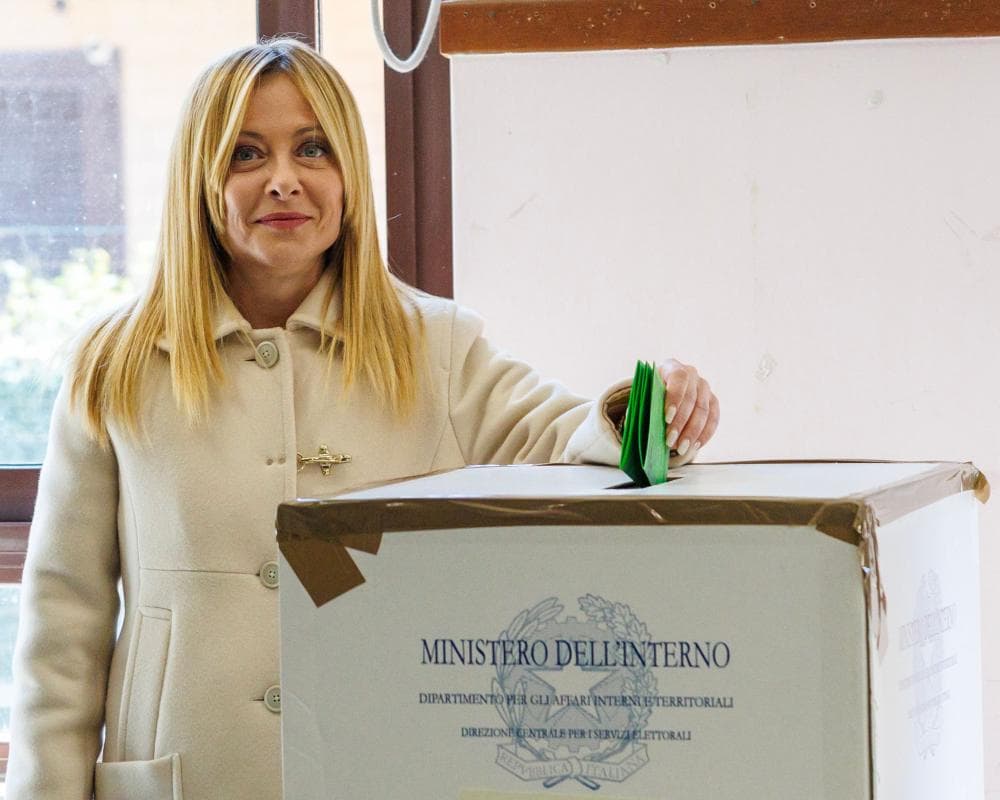
Meanwhile, Italian prime minister Giorgia Meloni has urged Italians to take part in the referendum on the government’s proposals to shake up the organisation of the justice system.
On her social media accounts, she posted a picture posing with a ballot paper, and said:
“Ready to vote. Remember: you have until 3 PM today to get to the polls. Participation is important.”
Defence minister Guido Crosetto also backed her call, urging voters to take part in the referendum.
“There should be no excuse for not going to the polls to vote. Those who don’t go are giving others the opportunity to choose their future. There is no commitment or activity more important than deciding the rules by which we will live,” he said.
It was a big weekend for election watchers around Europe!
Slovenia’s incumbent liberal prime minister Robert Golob claimed victory in parliamentary elections on Sunday, as results put his party just slightly ahead of the populist conservatives led by Trump-ally Janez Janša.
With 99.85% of the votes counted, Golob’s liberal party stood at 28.62% and the conservatives of veteran politician Janša at 27.95%, AFP reported.
The result will come as relief for Brussels as it puts Golob’s party on course to get 29 seats, just ahead of 28 for Janša, and will put the incumbent in a position to lead the tricky exploratory talks to form the next government.
“Since we have received the (people’s) confidence, now we can think about going forward under a free sun,” Golob told his supporters last night, inviting other parties to discuss next steps.
Meanwhile, we also had big elections in France, where the Socialist Emmanuel Grégoire has been elected mayor of Paris, and Marine Le Pen’s far-right, anti-immigration National Rally (RN) failed to take key cities targeted in Sunday’s second round of local elections.
Over in Germany, the chancellor Friedrich Merz’s Christian Democrats won an election in Rhineland-Palatinate, taking control over the state from their coalition partners, Social Democrats.
Early projections after polls closed showed Merz’s CDU at 30.8% of the vote, ahead of the SPD at 26%, pointing to a victory for Merz after his party narrowly lost an election in the neighbouring state of Baden-Württemberg earlier this month, Reuters said.
The two parties are now expected to form a coalition at the state level on the lines of the coalition in Berlin.
Finally, we will be looking at the day two of the national referendum on judiciary reforms in Italy today, with the polling stations open until 2pm UK time (3pm local).
Italy’s electorate will vote yes or no to approving amendments to the country’s post-fascism constitution that would shake up the organisation of the justice system. But what is in essence a ballot on a technical and complex change has morphed into a de facto confidence vote on Meloni’s government before a general election in 2027.
After 12 hours of voting on Sunday, turnout topped 46%, with early suggestions it could help Meloni’s yes campaign. Let’s keep an eye on this today.
Oh, and the Danish election is happening tomorrow, too!
Lots for us to cover.
It’s Monday, 23 March 2026, it’s Jakub Krupa here, and this is Europe Live.
Good morning.