Rockets, gold and the Foreign Legion: can Europe defend its frontier in the Amazon? | Alexander Hurst
Click any word to translate
Original article by Alexander Hurst
Above me, a ceiling of rough wooden branches and tarp. To my right, an officer in the French Foreign Legion types up the daily situation report. In front of me a French gendarme named David is standing in front of a table full of large assault rifles, pointing out locations on a paper map. A generator hums. All around us, splotches of forest dot the hundreds of islands that make up the archipelago of Petit-Saut, a watery ecosystem three times the size of Paris.
Except Paris is 7,000 kilometres away from where I am, in Guyane, or French Guiana, a department of France in South America, just north of the equator.
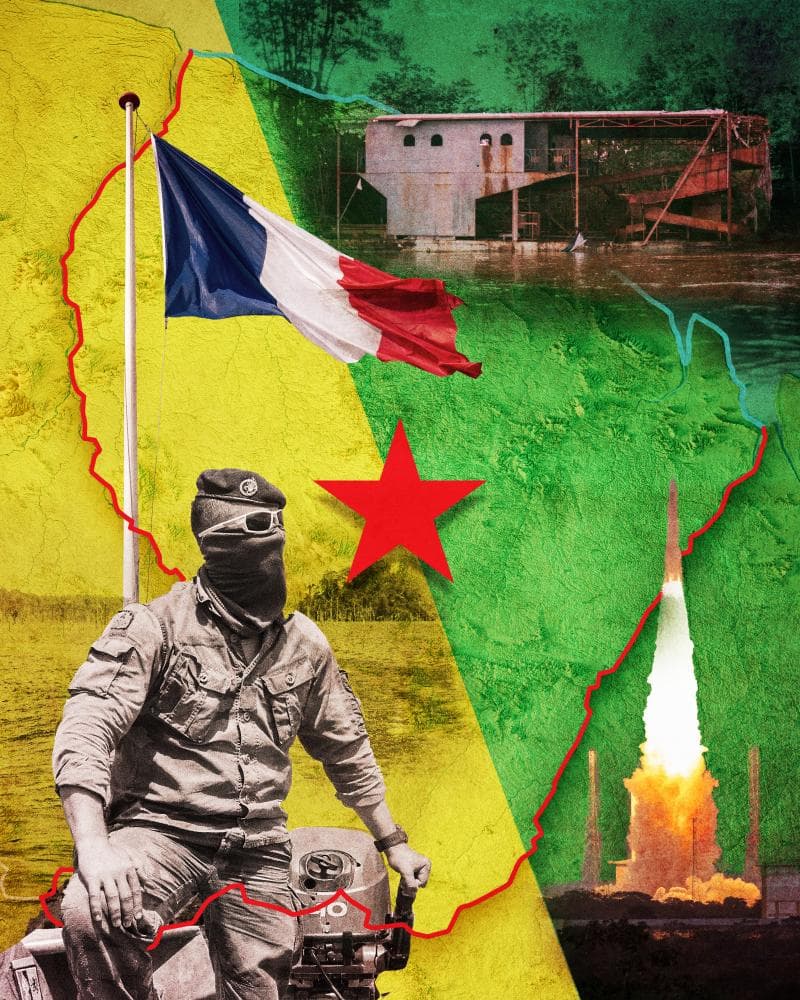
The size of Portugal but with a population of only 300,000, French Guiana sends deputies to the Assemblée Nationale, votes for the French president and prices things in euros. Administratively, it is no different from Brittany, but this region is home to France’s longest land border – with Brazil – and Europe’s only space rocket launch site.
The legacy of European colonisation of the “new world” means that France and the European Union are directly implicated in the fate of one of the world’s most critical havens for biodiversity.
Here, in this unlikely fragment of the EU in the Amazon, global crises converge into a paradox: a microcosm of humanity’s failure to deal with the climate crisis and protect biodiversity, despite possessing all the data we need.
From French Guiana’s Atlantic coast, the European Space Agency (ESA) launches satellites capable of observing the heating of the planet, the destruction of its forests, the collapse of its ecosystems. But what they see most clearly is the gap between what we know and what we do.
Beneath the tree canopy of the Amazon rainforest, illegal gold mining has produced an ecological crisis that is poisoning French citizens. Yet even after two decades and nearly €1bn spent on the deployment of an armed mission involving the Foreign Legion, France cannot bring this activity to an end.
The obstacle? A river called the Maroni, France’s border with Suriname, which cuts through sovereignty like a machete, leaving one of the most powerful countries in the world hamstrung. On one side, French and EU health and safety law; on the other, a toxic mining supply chain that operates just out of reach, and with impunity. Fortress Europe? Not here, not by a long shot.
* * *
‘This is what we’re after,” David says, handing me a small plastic bottle with a yellow cap. When I grasp it, my hand drops from the weight: mercury is more than 13 times as dense as water. Banned since 2006, because of both the environmental and neurological damage it causes, the toxin is the primary reason why 200 gendarmes and 600-700 soldiers have been deployed in a controversial €55m-a-year military operation across French Guiana relaunched as Opération Harpie in 2008 by Nicolas Sarkozy, then president. The legionnaires, soldiers and gendarmes (French military-style police) are stuck in a loop of “seek, chase, seize, repeat” with small, often-armed groups of garimpeiros – economically desperate, mostly Brazilian, gold prospectors, who use enormous quantities of mercury in pursuit of their dreams of one day striking it rich.
It takes me two hours by car from Cayenne, the capital, and then over an hour in a pirogue, a canoe-like vessel with an outboard motor, to arrive at Avant Poste 51 (AP-51), a makeshift jungle camp on one of the islands of Petit-Saut. This is where a detachment of two gendarmes and a dozen legionnaires from the 13ème DBLE string their hammocks every night. Now, I’m observing as they plan tomorrow’s mission.
Yesterday, the garimpeiros heard the patrol boat’s motor and fled before the soldiers could get there, David tells me. To avoid that happening again, tomorrow morning he wants to go ahead quietly in a kayak, with the pirogue following a few minutes later. He looks around for feedback from the small group standing around me. They comprise the camp commander, a stocky Frenchman who tells me to call him Chief Nuri; Pavel, the legionnaire boat pilot or piroguier; a lieutenant in the gendarmerie and the other gendarme posted to AP-51. Operating on French soil, the legionnaires can only act with gendarmes present.
“If we find a mining site, take my picture with whatever we seize,” Nuri says to me.
I tell him that Harpie’s command have warned me not to photograph the faces of the famously secretive legionnaires – these men from anywhere and everywhere who, while in service with the French Foreign Legion, have no other nationality but the Legion itself.
Legio Patria Nostra, as goes the motto of the oft-mythologised, elite military unit that has a history of being deployed to difficult places. The 13ème demi-brigade de Légion étrangère (DBLE) in particular, from its formation as part of the Free French forces in 1940, to Indochina in the run-up to the Vietnam war, Algeria in the 1950s and 1960s, and more recently the Sahel when Mali requested French assistance against jihadist groups in the desert in 2013.
“To hell with that,” Nuri says. “I didn’t give the Legion the rights to my image. Take my picture. But not now, not when I’m sweaty and wearing Crocs.”
The French army lieutenant, on the other hand, is definitely not wearing Crocs. His boots are polished, and the knots holding up his hammock are the expert kind with a name. He exudes order and discipline that contrast with the surprisingly laid-back nature of the legionnaires. We’re not to be messed with, their vibe seems to say. And so, to a certain point, we do as we please.
With the sun beginning to set on the camp, there is just enough time left to clumsily string up my own hammock, shower in the lake (“All my men shower in the lake, so you too, no exceptions,” the lieutenant tells me) and eat dinner (chicken in a thin stew, cooked by two legionnaires from Nepal). During the night, a low rumble cuts the air like the forced breath of something possessed. In another era, I would think demons stalked the forest from somewhere across the reservoir lake. “Howler monkeys,” the lieutenant says, his hammock a few feet away, the knots perfect, his boots hung upside down on two wooden posts.
There’s a humidity in French Guiana that seeps into everything – wood, concrete, skin. Morning beneath the tree canopy is already hot, and the night-time howler monkeys have been replaced with a low-level shriek: the high treble of whistling frogs and a cascade of insects.
“L’hygiène, c’est important,” the lieutenant – clearly a stickler even in these unsanitary conditions – insists again as he steps away from his hammock to brush his teeth, his southern French accent as punchy as his obvious scepticism towards the knots I’m now fumbling to untie.
By the camp’s dock, the legionnaires are loading bottles of drinking water into the pirogue. At the lieutenant’s insistence, they’re all wearing their standard-issue life vests – though by the end of the day, everyone, including me, has thrown them off because it’s just too hot. I climb in and we depart, trailing the kayak. “Drink, even if you don’t feel thirsty,” David tells me. Half an hour later, the pirogue nears the target spot; David and a legionnaire get in to the kayak and row away. Ten minutes later, another pirogue approaches in the distance, sees us, does a hasty about-face, and runs.
Pavel guns the motor, but the other boat, with only three people on board, is lighter and faster. Eventually we find it, half-hidden and overturned, the remains of the garimpeiros’ would-be lunch bobbing in the water. As the legionnaires jump out of the pirogue to give chase on land, the lieutenant hands me a bulletproof vest and warns me to not break away from the single-file line. Several French soldiers have died since Harpie began in 2008, including two during a clash with miners in 2012, and another while crossing river rapids this year. And in 2022, the Guardian journalist Dom Philips was murdered, alongside indigenous rights advocate Bruno Pereira while reporting on mining, poaching and drug-trafficking in the Javari valley, in the Brazilian Amazon.
In the jungle, there is no path. Someone at the front has a machete. Towards the back of the line, I sweat, stumble, try to keep up with the sometimes-run, sometimes-scramble. It’s pushing past 30C, which feels like even more in the humidity and the vest. Over an hour later, we’re back at the overturned pirogue. The legionnaires flip it over, confiscate the motor, tow it to a marsh, where we leave the miners’ boat and two soldiers – just in case the garimpeiros circle back. Then we are off to a different island to search on foot for the same group of prospectors. But for hours, there’s nothing more but a ceaseless sun and the overturned boat, which the legionnaires puncture holes in and sink.
Returning to camp in the boat, I try to find out more about just who joins the French Foreign Legion in the 21st century, and why. Some are talkative, others are extremely guarded. The Legion has a reputation, at any rate, for taking people seeking to escape an old life and gain a new one.
One of the Nepalis tells me he saw a documentary, and that the money is good. Another says the Legion was more accommodating of a hand injury than the Gurkhas. Paulo, a Brazilian, hit his time limit in the Forças Armadas do Brasil and wanted to keep working as a soldier, but won’t say much more. A legionnaire from Mali would rather tell me about the chilli peppers he’s planted at AP-51 than previous missions he’s been on. As for Chief Nuri, he’ll stay in the Legion as long as he can, he says.
By the time we get back to AP-51, it’s near evening. I’ve had six litres of water, but despite thinking I’ve adhered to David’s morning advice, I have a headache anyway. I almost make it out with my dignity intact, but just before boarding the pirogue that will take me back to normal life, heatstroke drops me to my knees and I puke. “Don’t vomit in the pirogue,” the lieutenant says. I cringe.
* * *
The first French settlers of la France équinoxiale, as they called the colony, arrived in 1503. The colony then changed hands multiple times, with the Dutch bringing the first slaves in 1676 during a brief period of control. The French Revolution abolished slavery a century later in 1794, Napoleon brought it back in 1802 and the Second Republic reabolished it for good in 1848, freeing some 13,000 people in French Guiana.
For a century, the territory was used by France as a prison colony, or dumping ground for politically inconvenient citizens. Captain Alfred Dreyfus was incarcerated in the notorious penal settlement of Devil’s Island, off the coast of Kourou, in 1895 after being convicted of treason. The ex-convict Henri Charrière’s 1969 account of brutality in the same jail in Papillon, a bestselling book later made into a film starring Steve McQueen, seared it into the consciousness of a generation. Perhaps the fame of the Île du Diable is why so many – including Jean Castex, the former French prime minister – still mistakenly think that French Guiana is an island. (The Cayenne-born jazz legend Henri Salvador probably did his birthplace no geographic favours when he released Dans mon Île in 1957.)
The first, fevered gold rush engulfed the region in 1858, and 170 years on the prospectors’ extraction method has barely changed. They dredge sediments from riverbeds or boreholes, pump in water and add mercury, which binds to gold particles and forms an amalgam, which sinks. Then they sift out the pieces of amalgam, burn away the mercury to discard the slurry, and reveal a nugget of pure gold. Mercury vapour enters the atmosphere and the contaminated mud enters the water system and the food chain, causing serious health problems, and development issues in infants and children.
Today illegal prospectors still number between 6,000 and 7,000, working across roughly 600 mining sites. In the eight months since AP-51 (one of many such camps) was established, the gendarmes and legionnaires have sufficiently suppressed illegal mining activity that it’s become tough to find. For Harpie’s commanders, “success” is in having “stabilised” mining at these levels, despite gold tripling in price since 2018.
Others are less convinced. In 2020, a member of the French parliament representing the territory led an inquiry into why the illegal gold panning situation was still “such a disaster”, despite Sarkozy’s insistence nearly a decade earlier that stamping it out was a “national priority”. After a visit to the region a year later, a parliamentary delegation criticised the “insufficient” means allocated to enforcement.
Far from Paris’s political squabbles, a question hangs heavier than mercury. With economic incentives to mine anywhere and everywhere, what kind of ecological devastation would there be without Harpie? But success and failure is also tallied in the real and present impact from mercury and mining – on the jungle, the river and the people who rely on both.
* * *
Aimé Césaire, a poet from Martinique and member of the French parliament, and Gaston Monnerville, the Guyanais grandson of a slave and former president of the French Senate, were among decolonisation activists who campaigned in the first half of the 20th century, not for independence for French Guiana, but for full status as a part of France.
When the territory became a full French “department” in 1946 (along with Martinique, Guadeloupe and Réunion), it was the realisation of that long-held goal. In 2010, 70% of voters rejected a shift towards greater autonomy. And attachment to EU membership is stronger here than it is in most of France’s other regions.
But income levels in the Amazonian department are only half of what they are in the “Hexagon”, the six-sided shape of France that sits on the European continent. This is roughly comparable to the ratio between the poorest and wealthiest US states, or between Paris and its most economically depressed banlieue.
And often, the attitude from Paris towards French Guiana can feel like that of the core to the periphery: exacerbated by present-day plans to build, in this former prison colony, a new detention facility to house high-security inmates from metropolitan France.
Within French Guiana, the core is the coast, where 90% of the population lives. In the Haut-Maroni region in the interior, the inhabitants are largely Bushinengue – the descendants of escaped slaves who fled Dutch and French plantations and established isolated, free communities deep in the jungle along the Maroni River. It feels like the periphery.
* * *
From the window of Air Guyane Express’s Czech-built, 15-seat turboprops, the Amazon rainforest looks like an enormous head of broccoli. Endless and indivisible. Except every now and then there appears a rust-coloured scar on its face: a pockmark of deforestation where the garimpeiros, the prospectors, have clearcut and savaged the earth, leaving it polluted and desolate.
There are no roads to Maripasoula, a town of 8,000 on the Maroni River, but it has an airport. Getting farther south to Taluen, to find out how the Wayana community – one of French Guiana’s five original Amerindian populations – is affected by illegal gold mining means a journey by pirogue. This tough geographic reality shows up in prices: a bottle of water costs twice as much as in the capital, Cayenne.
A Wayana man in a baseball cap waits at the river, next to a silvery pirogue. “Al-Qaida,” he says, hand outstretched, grin on his face, bemusement on mine. It is a nickname, I learn later, from his time in the French army, in Afghanistan.
Once again, the sun blisters everything – but before I can burn too much, Marie Trémolet from the World Wildlife Fund arrives, along with two local fish-farming consultants and Aïmawale Opoya, the chief of Taluen, the largest Wayana town.
Dry season has just begun, which means the water level in the Maroni is beginning to drop. In 2024, climate change made parts of this already shallow, rapids-filled river temporarily impassible, leaving the Wayana pincered between the macro polluting effects of carbon and the micro effects of mercury. Of the two, they feel the impact of the mining most keenly. “The garimpeiros have polluted everything,” says Aïmawale. “The rivers, the forest, the game, the fish.”
Only a few minutes downriver from Maripasoula, nature erupts. Awara palms with their thick spikes. Iridescent blue flashes of morpho butterflies beneath the canopy. The red eyes of black caiman crocodiles that glower back flashlight beams in the night. Home to 1,800 tree species, 96% of French Guiana is rainforest. In fact, Maripasoula, Taluen and a host of other towns lie within the protected area of the Parc Amazonien de Guyane, the EU’s largest national park, which stretches across 34,000km2 – an expanse bigger than Belgium. When the reserve was created in 2007 with the agreement of French Guiana’s Indigenous populations, it was with the understanding that making this “protected land” would bring illegal mining to an end.
Every now and then, Aïmawale and “al-Qaida” gesture towards the shore, pointing out signs of gold panning. Here, you can see and taste the destruction mercury wreaks in the Maroni River and the criques sprawling around it in the rusty, metallic quality it imparts to the water. As we swerve from one side to the next to navigate the river, I begin to understand why Operation Harpie is necessary, but sisyphean. The problem is that on the Suriname bank of the river, all of this happens in the open, unenforced. The equipment, the mercury, the sifting through and jettisoning of earth.
The commercial supply points on the Surinamese side – there are 120 “storefronts” run by Chinese shopkeepers along the river, according to a 2023 estimate – make no effort to hide. Red metal walls and droopy porches overhanging the river, where groups of thin, bare-chested men sit drinking beer and liquor. Video displays show grids of rectangular video feeds from an assortment of security cameras. Rows of prepackaged foodstuffs sit alongside plastic goods made in China, with mining materials stuffed into corners. “The mercury is usually in a back room, out of sight,” Marie tells me. The storefronts don’t just sell equipment and purchase gold, they have recently moved into a “sharecropping” arrangement, taking a percentage of everything mined.
From the pirogue, the Maroni looks murky with mining contamination. “Before, fish was the major part of our diet,” Aïmawale says. “Now, when it rains, the river looks like milk. We can’t let our children bathe or swim in that …”
Wayana communities have to venture further and further to find clearer water and fish that they hope are less contaminated. Sometimes, they brave the indignity of buying processed foods or chicken from the Chinese storefronts. It’s a situation that leads to “a fair amount of diabetes, hypertension, and otherwise poor health”, says Lisa Michard, a nurse who has worked at Taluen’s health clinic. If a new fish-farming project for Taluen goes well, fish will maintain its place in the Wayana diet, but in a way that is tragic adaptation, rather than a real solution.
* * *
In Taluen, we string our hammocks in the dimming light, my knots as amateur as ever. The first night we are served chicken; the second, fish. When we see the pot of fish, Marie and I exchange a glance and a grim half-laugh at the irony, though we know a single meal is relatively innocuous. Shortly after I arrived in Taluen, eight French cities, including Paris, announced that their public schools would no longer serve tuna in lunchrooms out of concern for mercury levels. As for the Wayana, the French regional health authority’s recommendation is to restrict fish consumption to no more than once a month.
In 2024, Linia Opoya, who is married to Aïmawale, brought a lawsuit against the French government, alleging that France had failed its legal duty to protect citizens and the environment. The health problems that plague the community range from learning disabilities to memory loss, concentration problems, damaged eyesight, pins and needles in the limbs, and a loss of physical strength, she says.
Later, in Taluen’s communal tukusipan, Patrick Touenké, chief of all the Wayana, gets visibly frustrated when I ask him about the mining. “We’ve been talking about the mining situation forever and nothing changes,’ he says, with the tukusipan’s maluwana – an intricately painted disc that maps Wayana cosmology – looking down from above him. 2009 was the last time the Wayana confronted the miners directly, with barricades on the river. That was just after the French government launched Harpie, which Aïmawale – who has himself participated in Harpie missions in the past as a reservist in the gendarmerie – calls “insufficient”.
Linia goes further. “Harpie destroys the miners’ equipment, then two days later the miners are back,” she says. For three or four days after a mission, the water clears up, and then the miners resupply on the Surinamese side of the river and restart. What’s needed are regular patrols of the river, she says, and a permanent Harpie presence in the area – something like AP-51.
“I grew up drinking from the river,” Linia reminisces – a relationship with the natural surroundings that her 15-year-old son will never know. Even if all gold mining stopped tomorrow, experts from the national park told me, each contaminated Amazon waterway would take 200 years to return to its former state.
On my final night in Taluen, as I adjust my body in my hammock, something cuts through the quiet, the peace, the calm, the wisp of the Milky Way. Not a howler monkey this time, but an insect. It sounds almost precisely like a buzzsaw.
* * *
A burst of light in the dark. I watch, as 5km from the viewing site, the Ariane 6 rocket lifts off, steadies, streaks upwards above its launchpad. Twenty seconds after the earth seems to exhale a new sun, the sound hits – as if the air itself were ripping. The Ariane 6 programme represents Europe’s independent access to space, and this particular rocket carries a meteorological satellite over a decade in the making: Metop-SGA1. Primarily a weather satellite, SGA1 also carries a compact moral proposition, a collection of sensors called Sentinel-5, designed to see what human beings have become so good at ignoring. Methane slithering out of oil and gas fields, carbon dioxide stewing above continents, the exhaust of our species.
It was Charles de Gaulle who decided to build a spaceport in Kourou in 1964, to replace France’s former launch site at Hammaguir, in the Algerian desert. With Algerian independence approaching, Kourou, another former penal settlement, offered advantages: at the equator, the Earth’s rotation naturally assists a rocket’s boosters, and provides both a launch trajectory over open ocean rather than inhabited land and stable weather conditions. Now jointly managed by the French space agency and ESA, the spaceport anchors thousands of jobs directly and indirectly, and accounts for at least 15% of the departments’s GDP. In 2021, this is where the ESA sent the James Webb space telescope – which astronomers are using to hunt for new planets and look further back in time, by seeing fainter and more distant light than anything else on or of the Earth – into orbit around the sun.
Near Kourou, at Paracou research station, researcher Ariane Mirabel stands in front of a towering tree with a buttressed trunk. This arbre cathédrale has been tagged, measured, and will be measured again every one, two or five years, just like 70,000 other trees on various plots of land at Paracou. It’s the most extensive tree-identification and tracking project in the world, and ESA satellites need the data to estimate the quantities of carbon stored in the forest.
This rainforest that I’ve seen from the air and from pirogues, whose humidity I’ve felt on foot, is part of the Guiana Shield – a swathe of the Amazon that stretches from Colombia to French Guiana and northern Brazil, and which is crucial to moistening, lifting and steering the atmospheric “rivers” that form over the Atlantic and move south to the Andes. The portion of forest that lies in French Guiana is among the least disturbed by human activity in the world, explains Mirabel, in part because of how few people live there.
What the canopy data says about the immense Amazon rainforest is grim. A year ago things were dire, but perhaps bending towards hope. The EU had been leading the way in emissions reductions; China, long a source of emissions growth, was also the driver of the energy transition towards wind and solar; and in the US, the Biden administration had finally shifted national policy in support of real progress.
Cop30 brought negotiators to Belém, to the edge of a rainforest under assault in every imaginable way: carbon emissions, clearcutting for soy and cattle, access roads for drilling sites, poaching, logging, illegal mining. On our current climate crisis trajectory, in the near future the Amazon will cross a tipping point and dry out into a savannah. That would cause the forest to release nearly a decade’s worth of carbon, turn millions of square kilometres into a probable fire plain, unleash new potential pandemics and devastate South American agriculture.
The Earth and its forests inhabit a timescale beyond our own, and so none of us – not our children, our grandchildren, or their grandchildren – will ever see this reversed. Forget recreating any of this, says Mirabel, when “we don’t even understand how the existing forest fully works”.
From Sentinel-5’s elliptical circuit 832km above the Earth, borders look meaningless. On the ground, they’re anything but. For years, France has sung the refrain of “strategic autonomy” to its European neighbours, insisting that the EU acquires the ability to act with full independence in any number of domains, including space. Ariane 6 is a key component of this – autonomous access to space at a time when Donald Trump’s war against renewables and on behalf of fossil fuels is a war on our ability to even know. At a time when his administration is preparing to order that Nasa terminate the US government’s only satellites purposefully designed to measure greenhouse gases, the EU, which spends €12bn a year on space, has an additional responsibility to collect and safeguard climate data, says Simonetta Cheli, ESA’s director of Earth observation.
ESA can track methane plumes, calculate carbon stored in the forest, or even spot the clearcut scar of a mining site – but nobody seems able to put a stop to the 20 pirogues a day that, Linia Opoya says, pass by Taluen loaded with mining equipment. Sovereignty is double-edged: in Kourou, France invokes it at both a national and European level every time a satellite lifts off and into orbit. On the banks of the Maroni, the same principle impedes France from tackling a problem that stretches from one sovereign space into another. On the other hand, is France, with the full weight of the EU behind it, really incapable of putting a stop to the mining supply chain violating one of its borders and putting its citizens at risk?
During its most recent overflight, the Parc Amazonien, which draws 70% of its personnel from Amerindian communities, observed 176 mining sites – the highest number yet – within its territory. “On one side, we have a powerful, cooperative neighbour, and on the other side, a narco state,” says Yann Saliou, deputy director of the park. Without cooperation from Suriname, he continues, ending mining along the Maroni would require a gendarme behind every tree.
For decades we’ve had the data, and the best recommendations of scientists; we know that we’re destroying something that exists beyond our brief human timescale. From high above and far away, the world is blue and green. On the ground, we attribute enormous value to a shiny metal with little intrinsic utility, while being systematically incapable of valuing and protecting the ecosystems that sustain us. If conflicting sovereignty can’t be coordinated across a waterway often narrow enough to hurl a stone from one side to the other, what chance is there that the view from 832km up – no matter how precise – will save what is already slipping away?
Alexander Hurst writes for Guardian Europe from Paris. His memoir Generation Desperation will be published in January 2026