How cyclones and monsoon rains combined to devastate parts of Asia – visual guide
Click any word to translate
Original article by Graham Russell and agencies
Tropical cyclones have combined with heavy monsoon rains to lay waste to swathes of Asia, killing more than 1,300 people and leaving many more homeless.
Parts of the Indonesian archipelago have been particularly hard hit by flooding that began about a week ago, killing 604 people and leaving 464 missing. Nearly 300,000 people have been displaced and nearly 3,000 houses damaged, including 827 that were flattened or swept away.
In the Indonesian island of Sumatra, videos circulating on social media showed people scrambling across crumbling barricades, flooded roads and broken glass to get their hands on food, medicine and fuel. Some were wading through waist-deep flood waters to reach damaged convenience stores.
A police spokesperson, Ferry Walintukan, said regional police had been deployed to restore order. “The looting happened before logistical aid arrived,” Walintukan said. “[Residents] didn’t know that aid would come and were worried they would starve.”
In Sri Lanka, the death toll from floods and landslides triggered by Cyclone Ditwah stands at 355, with 366 missing. The country’s disaster management centre said more than 1.3 million people across the country had been affected by the record rains.
It is the worst extreme weather to hit Sri Lanka in two decades, and officials said the extent of damage in the worst-affected central region was only just being revealed as relief workers cleared roads blocked by fallen trees and mudslides.
The heavy rains that often sweep through the region at this time of year have been exacerbated by the rare formation of two tropical cyclones – Koto and Senyar – which have helped fuel the rains by bringing in more moist, warm air.
Indonesia’s meteorology agency said the formation of Senyar in the strait of Malacca was a “rare” event, although one that had become more frequent in the past five years. “Indonesia’s location near the equator theoretically makes it less prone to the formation or passage of tropical cyclones,” said Andri Ramdhani at Indonesia’s meteorology, climatology and geophysics agency. Areas very close to the equator usually lack the Coriolis force that enables storms to develop.
Human-caused climate breakdown has increased the occurrence of the most intense and destructive tropical cyclones (though the overall number per year has not changed globally). This is because warming oceans provide more energy, producing stronger storms. Extreme rainfall is more common and more intense because of human-caused climate breakdown across most of the world.
The devastation in Sri Lanka was caused by Cyclone Ditwah, which formed over the Bay of Bengal and made landfall on Wednesday, combining with the north-east monsoon season to bring disastrous rains.
Low-lying areas flooded over the weekend, prompting authorities to issue evacuation orders for those living along the banks of the Kelani River, which flows through Colombo into the Indian Ocean.
Thousands of police and military personnel are distributing food, clearing roads and moving trapped families to safety. Nearly 148,000 people have been displaced from their homes and are housed in temporary shelters.
President Anura Kumara Dissanayake, who declared a state of emergency to deal with the disaster, vowed to build back with international support. “We are facing the largest and most challenging natural disaster in our history,” he said in an address to the country. “Certainly, we will build a better nation than what existed before.”
The rains have subsided across Sri Lanka but low-lying areas of the capital, Colombo, remained flooded on Sunday, sparking a major relief operation.
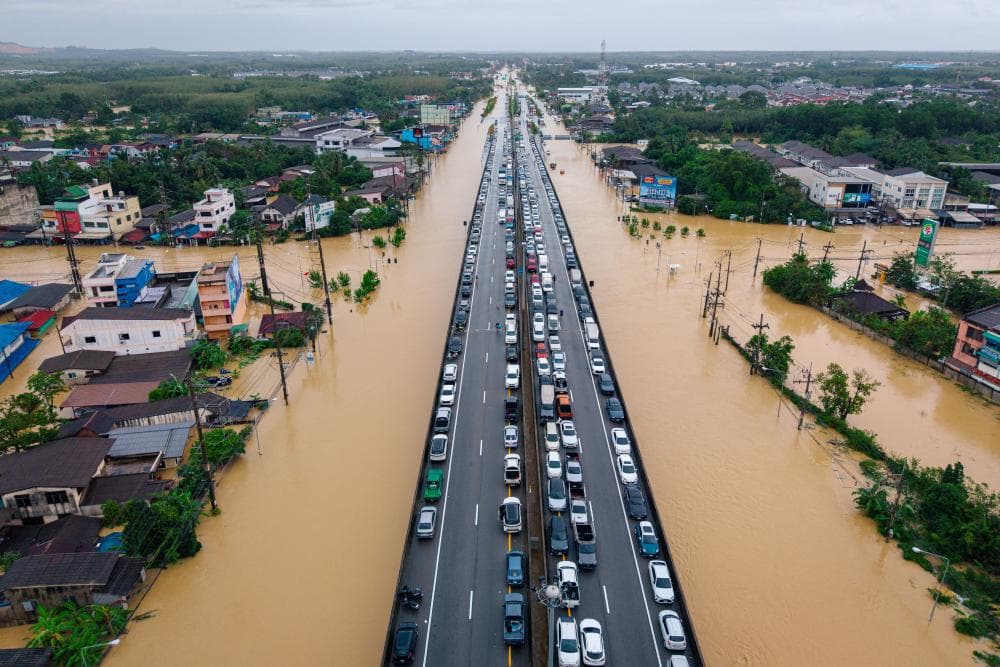
Thailand’s ministry of public health said 170 people had died as of Sunday, after some of the worst flooding in a decade.
Songkhla province had the highest number of fatalities at 131. Hat Yai, the largest city in Songkhla, received 372mm (14.6in) of rain on 21 November, its highest single-day tally in 300 years, amid days of heavy downpours.
Authorities have been working to deliver aid and clear the damage, and have offered compensation of up to 2m baht (£47,000) for households that have lost family members. But there has been growing public criticism of Thailand’s flood response, and two local officials have been suspended over their alleged failures.
The rains from Koto killed three people in Vietnam, authorities said on Sunday, after two boats sank amid strong winds and high seas along the flood-hit central coast.
Heavy rains have lashed central areas of Vietnam in recent weeks, flooding historic sites and popular holiday destinations and causing hundreds of millions of dollars in damage.
Vietnam’s weather bureau has forecast rains of up to 150mm (6in) on Tuesday and Wednesday in regions that have only just recovered from historic floods.
In Malaysia, two people were killed after floods left stretches of northern Perlis state underwater. There are still about 18,700 people in evacuation centres, according to the country’s national disaster management agency.
With Associated Press, Agence France-Presse and Reuters