Loading...
Please wait for a bit
Please wait for a bit
Click any word to translate
Original article by Fiona Harvey Environment editor
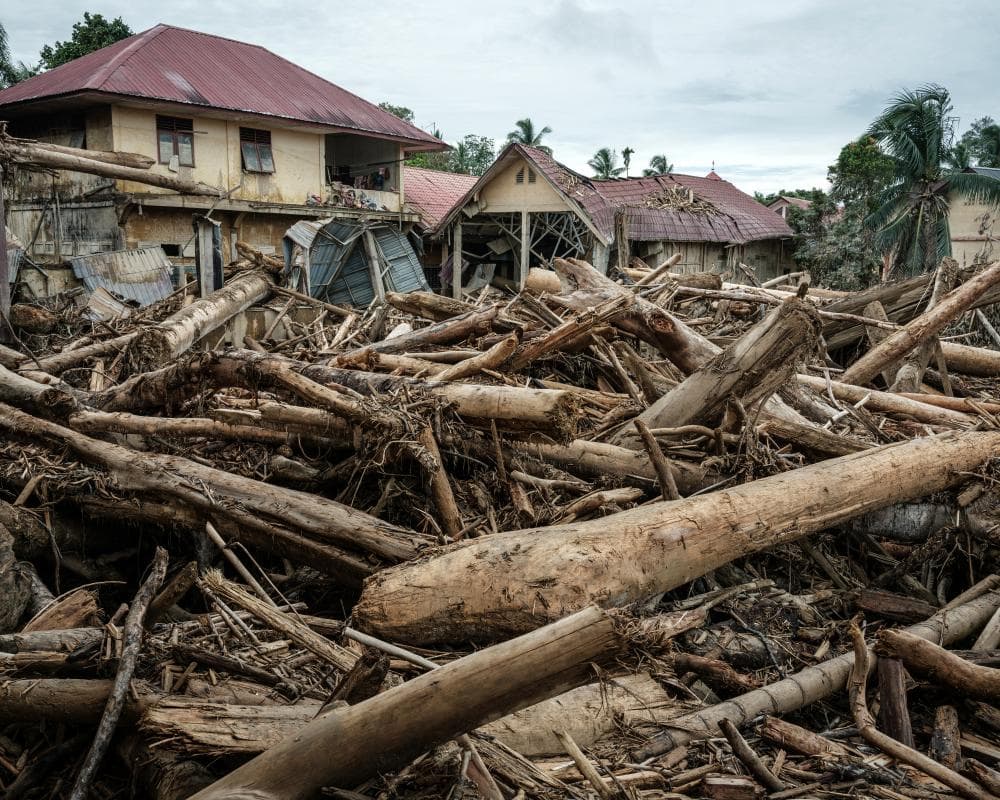
Cyclones and floods in south-east Asia this autumn killed more than 1,750 people and caused more than $25bn (£19bn) in damage, while the death toll from California wildfires topped 400 people, with $60bn in damage, according to research on the costliest climate-related disasters of the year.
China’s devastating floods, in which thousands of people were displaced, were the third most expensive, causing about $12bn in damage, with at least 30 lives lost.
The 10 worst climate-related disasters of 2025 amounted to more than $120bn in insured losses, according to an annual report from the charity Christian Aid.
The true losses are likely to be much higher, as only the insurance costs could be reliably measured. The human costs, in lives, displacement and lost livelihoods, are uncounted.
Devastating events such as these are often grouped together as “natural disasters”, as if they were simply the consequences of normal weather variation. But this is a misperception, according to the report’s authors.
Joanna Haigh, emeritus professor of atmospheric physics at Imperial College London, said damaging events were increasing in frequency and intensity owing to the human-made climate crisis. “The world is paying an ever-higher price for a crisis we already know how to solve. These disasters are not ‘natural’ – they are the inevitable result of continued fossil fuel expansion and political delay,” she said.
While the economic cost of disasters is often accounted as greater in developed countries, where people and businesses can afford insurance, the true toll in developing countries can be much higher. Mohamed Adow, director of the Power Shift Africa thinktank, said: “While wealthy nations count the financial cost of disasters, millions of people across Africa, Asia and the Caribbean are counting lost lives, homes and futures. In 2026, governments must stop burying their heads in the sand and start responding with real support for people on the frontlines.”
The top 10 list is far from the whole of the damage to the planet: a further 10 major extreme weather events that each came in at less than $1bn in damage were also examined in the report, and many less costly examples did not make either list.
The report also highlighted the series of typhoons in the Philippines, where more than 1.4 million people were displaced, and $5bn incurred in damages.
All regions of the world were hit, as disasters piled up through the year. Drought in Iran threatens the 10 million inhabitants of Tehran with evacuation. Floods hit Democratic Republic of the Congo in April, then Nigeria followed in May, with 700 deaths. Floods in India and Pakistan killed more than 1,860 people, cost about $6bn, and affected more than 7 million people in Pakistan alone.
In the developed world, record-breaking fires raged across the Iberian peninsula, droughts hit Canada, and there were record heatwaves in Scotland.
At this year’s UN climate summit, Cop30 in Belém in November, rich countries agreed to triple the amount of finance available to help poor countries adapt to the impacts of extreme weather. But the tripling, expected to reach $120bn by 2035, will still be nowhere near enough to fund all the protection needed in developing countries.
The bill for extreme weather damages will continue to rise until the world slashes greenhouse gas emissions and phases out fossil fuels, added Christian Aid’s chief executive, Patrick Watt.
“These climate disasters are a warning of what lies ahead if we do not accelerate the transition away from fossil fuels,” he said. “They also underline the urgent need for adaptation, particularly in the global south, where resources are stretched and people are especially vulnerable to climate shocks.”
At Cop30, an attempt to start work on roadmaps for countries to phase out fossil fuels was relegated to the status of a voluntary initiative, rather than a compulsory task for all countries. However, work will begin on it this year, led by Cop30 host Brazil, and at a special conference on fossil fuels to be held by Colombia in April, expected to be attended by the more than 80 countries supporting the roadmap effort.