Loading...
Please wait for a bit
Please wait for a bit
Click any word to translate
Original article by Hannah Ellis-Petersen in Delhi and Shah Meer Baloch in Islamabad
Pakistan’s leaders had almost lost hope. After more than two weeks of frantic negotiations, phonecalls and diplomatic summits to try to end the US-Israeli war with Iran, it looked like the conflict might instead be escalating into Islamabad’s worst nightmare.
In a cabinet meeting held at about 5pm on Tuesday, Pakistan’s prime minister, Shehbaz Sharif, was morose. “We should brace ourselves for the impact of the war,” he told his cabinet ministers. “The situation has really become very bleak. The chance of peace has become dim.”
Earlier that day, any hope of a ceasefire looked diminished. Israeli strikes had devastated an Iranian gas plant and Iranian strikes had struck a critical Saudi Arabian petrochemical complex, prompting fears it would push the Gulf country closer to joining the war. Furious at what they saw as a “dangerous escalation”, Pakistan’s military top brass released an unusually damning public statement against Tehran, accusing it of “spoiling” efforts at peace.
Meanwhile in Washington, Donald Trump’s rhetoric had escalated to new levels of hysteria, as he threatened that Iran’s “whole civilisation will die tonight” – including bombing power plants and bridges – if they did not agree to his demands for a ceasefire, with a deadline set for the end of the day.
For Pakistan’s government and its military, the country’s de facto rulers, helping to mediate an end to the war was not simply a matter of prestige; its economy, defence, national security and sectarian harmony depended on it. A freshly signed defence pact with Saudi Arabia meant that if Riyadh chose to enter the war, they would be dragged into it too. “We were in a very fragile situation and desperate for negotiations to begin,” said one Pakistani official.
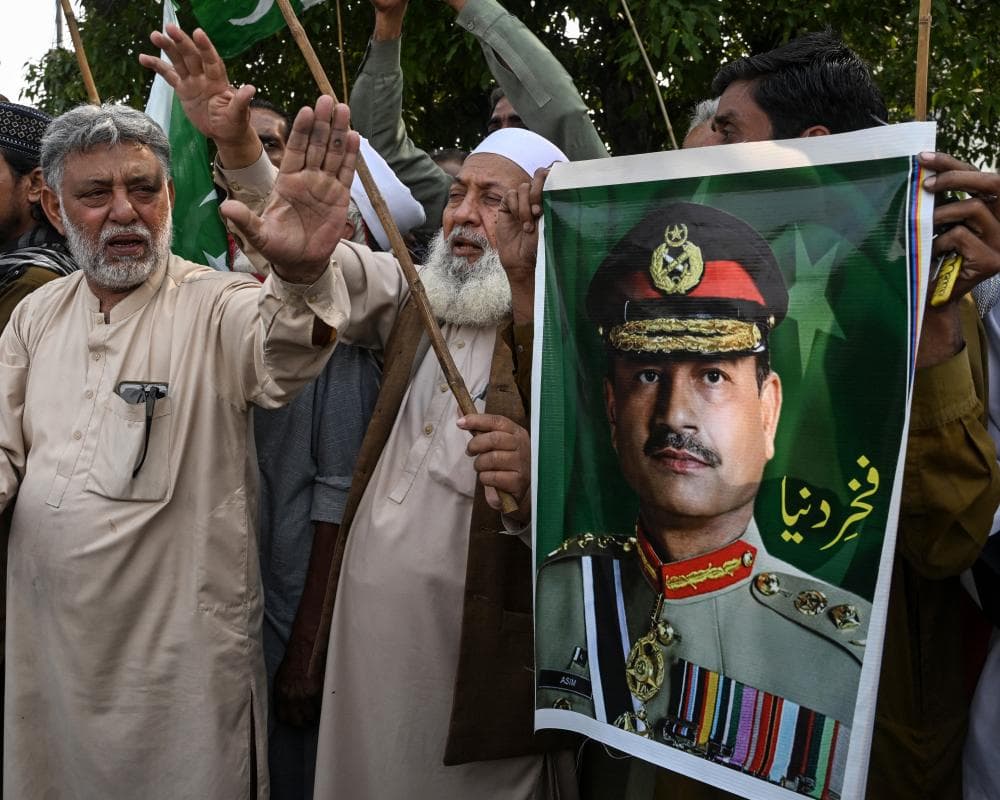
Behind the scenes, Asim Munir, the powerful army chief, and Asim Malik, the country’s head of army intelligence and national security adviser, carried on working the phones. Munir occupied a uniquely advantageous position as a peace broker, boasting both a strong personal rapport with Trump and a longstanding relationship with Iran’s Revolutionary Guards.
In a typically bullish press conference in the White House on Wednesday, the US secretary of defence, Pete Hegseth, would later claim Iran had “begged” for the ceasefire.
Pakistani officials, however, have a different version of events. Both sides wanted an end to the fighting, they said, but the push for a ceasefire had come primarily from Trump, who was “trapped” in a war he had thought “might not go beyond three days”.
Over several hours, calls went back and forth – primarily involving Munir and Malik, with Trump, his secretary of state, Marco Rubio, the vice-president, JD Vance, and the US special envoy Steve Witkoff on one side, and senior Iranian ministers including Iran’s parliamentary speaker, Mohammad Bagher Ghalibaf, and foreign minister, Abbas Araghchi, on the other. Sharif also made calls to the Iranian side and to Saudi Crown Prince Mohammed bin Salman.
Until Tuesday evening, Iran remained “reluctant” to commit to any ceasefire, according to accounts, having little trust that the Trump administration was not simply using talks as a guise for the US and Israel to regroup and then strike again.
But this time, said officials, there was a new key player involved, one who wielded crucial influence with the Iranians: China, previously “reluctant” to get too entwined in a messy war that was visibly weakening Trump, was quietly taking a different tact as the toll of the war on its own economy grew.
Just over a week earlier, Pakistan’s foreign minister, Ishaq Dar, had flown to Beijing to discuss ways to secure peace in the Middle East and to ask for a bigger commitment from China to help end the conflict.
In a marked shift, Pakistani officials claimed China had been persuaded by “friendly countries” to make a pivotal leap into Tuesday’s negotiations. “Pakistan had to involve China to convince Iran to go for a ceasefire,” said one official.
By 8pm, Sharif held a much more optimistic meeting with his cabinet. “A ray of hope has emerged for negotiations and a ceasefire,” he said, adding that Munir was leading a breakthrough.
According to accounts, China directly encouraged Iran to accept a ceasefire, promising to act as a guarantor of Iran’s safety in any talks. Among the assurances offered by China was that Iranian leaders would not be assassinated if they travelled for negotiations.
“We were the mediator, not the guarantor,” said one Pakistani official. “The main role was played by China. They became a guarantor of the ceasefire and pledged that the US would standby the agreement and that talks would go smoothly in Islamabad. They told Iran to accept this deal.”
Pakistani officials claimed the US was aware and comfortable with China’s intervention. Trump appeared to later confirm this account in an interview, where he said he believed China had persuaded Iran to negotiate.
By 4am in Islamabad, the seemingly impossible had been secured. A – temporary, fragile – ceasefire deal was agreed by both the US and Iran. Michael Kugelman, south Asia fellow at the Atlantic council, described it as Pakistan’s “biggest diplomatic win in years”.
On Wednesday, Sharif hailed the ceasefire as a “shining moment” in Pakistan’s history and a “first step” towards peace. He pledged that peace talks involving both the US and Iran would go ahead in Islamabad on Friday, with apparent preparations in place for them to be held at the city’s Serena hotel. An Iranian source confirmed that Tehran intended to send Ghalibaf and Araghchi as its negotiators.
Pakistani officials have privately expressed fears that Israel and the United Arab Emirates could still try to “sabotage” the peace process, especially as Israel has said Lebanon is not part of the ceasefire deal and trade through the strait of Hormuz remains largely blocked.
Kugelman said Pakistan had “defied many skeptics and naysayers that didn’t think it had the capacity to pull off such a complex, high-stakes feat”, adding: “What matters the most is it helped avert a potential catastrophe in Iran.”