Loading...
Please wait for a bit
Please wait for a bit
Click any word to translate
Original article by Shah Meer Baloch in Islamabad
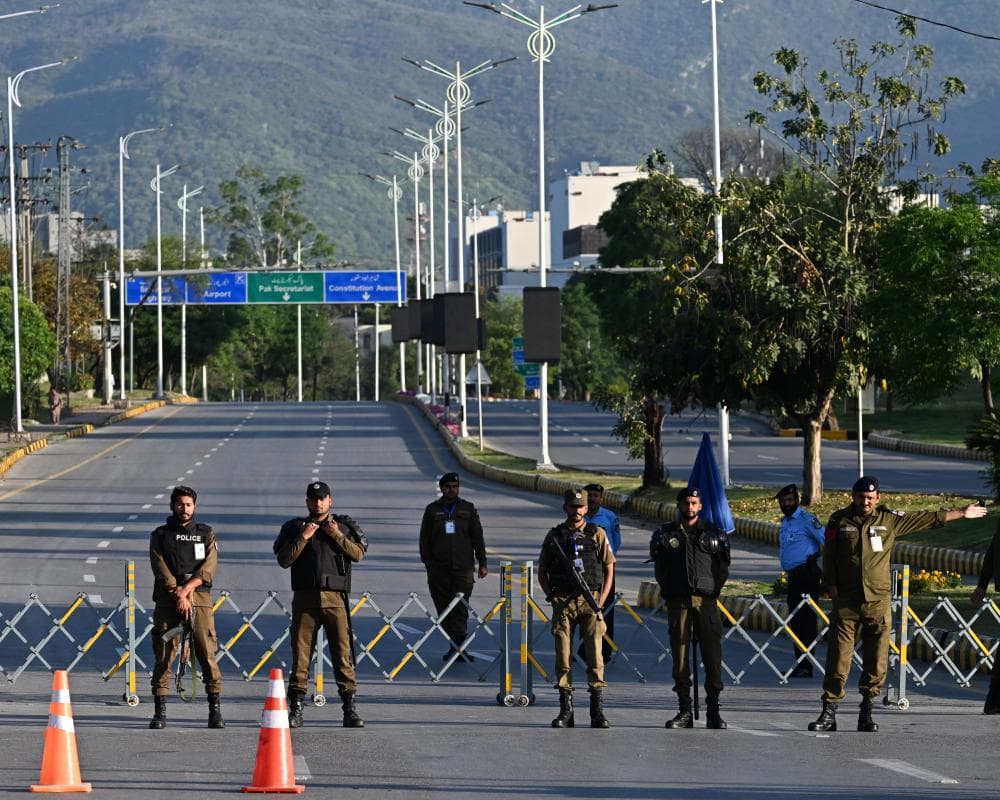
Across Islamabad, there is lockdown. The streets of the Pakistani capital have been empty for days, shops have been shuttered and public transport closed down. Officials and office workers have been told to work from home, while labourers have found themselves deprived of work. The only visible figures are those in army and police uniforms lining the roads.
For many, it feels like a return to the pandemic. Yet the cause is not a virus but Islamabad’s status as the venue for US-Iran talks that hold the promise of an end to war in the Middle East, with stringent security measures imposed on the city as it awaits the two delegations.
Yet as uncertainty reigns over whether the negotiations will even take place, anger has been rising. For people, the draconian and seemingly indefinite restrictions have become a source of frustration and economic strife.
Many workers in Islamabad and neighbouring Rawalpindi unable to afford to rent a flat were unceremoniously kicked out of their hostel accommodation on Saturday, after a government order, and tens of thousands had to hurriedly find a place to say.
Day after day, with the promised talks failing to materialise, and the city’s lockdown repeatedly extended, many are questioning how long they will be kept away from their livelihoods.
Areej Akthar, a health officer at Pakistan Institute of Medical Sciences, a government hospital in Islamabad, was among thousands forced out of their rooms. “Saturday was chaotic,” she said. “I am lucky enough that my village is a three-hour drive away. But many people [who] were from distant cities and province[s] had to beg their colleagues, friends and relatives to allow them to stay until the US-Iran negotiations took place.”
As the delays in the talks have dragged on, Akthar’s frustration has mounted. The closure of public transport means she is unable to get back to the city. “It is like we are living in a cage,” she said. “We can’t go back to work. Many like me can’t afford to rent a flat, that’s why we live in hostels.”
Many residents also complained that the lockdown is also worsening the economic impact of the war on ordinary citizens.
Since the US and Israel began bombing Iran in late February, and Tehran retaliated by closing the strait of Hormuz – the shipping route for a fifth of the world’s oil and gas – Pakistan has been among one of the countries worst affected by the energy crisis. Power cuts of up to seven hours have been imposed due to a shortage of fuel while many restaurants in the capital had to close due to a lack of cooking gas.
The restaurants that had remained open have now been forced to close their doors, while taxi drivers have reported a 50% cut in their earnings.
Muhammad Zubair, 45, a daily wage labourer said he was not able to work for the past six days, and was growing hungrier by the day.
Sitting on the pavement in Islamabad, Zubair was dismissive that acting as a host for high-profile talks was good for the people of Pakistan. “A lockdown means no work and no work means no food. The government does not care about the poor. We need work to feed our children.”
The government announced that exams for more than 1,200 civil servant candidates would be shifted to Lahore, more than 230 miles (370km) away. Yasir Mushtaq said he was not sure he could afford to travel to reach the exams. “I have to borrow money,” he said. “It is worse for female candidates. Many females can’t travel alone without parents accompanying them. Some are thinking of skipping their exams.”
A senior official said it felt as if the whole country had ground to a halt as they waited for decisions in Washington and Tehran. “We are all under a lockdown and it feels like we are back to coronavirus days.”