Loading...
Please wait for a bit
Please wait for a bit
Click any word to translate
Original article by Chris Michael in Crans-Montana and Rory Carroll
The new year had passed its first hour and the party in Le Constellation was in full swing with revellers dancing to thumping hip-hop. Dawn was far off and the teenagers and twenty-somethings were in no hurry to leave the bar. It was, after all, New Year’s Day.
Outside, darkness draped Crans-Montana, a ski resort in the Swiss Alps with a reputation for posh luxury. Le Constellation, however, had few pretensions: a cavernous venue with TV screens on the top floor to watch sport, and a basement with low lighting, loud music and a dancefloor.
It attracted a young crowd, including under-18s, mainly from Switzerland and continental Europe, and early on Thursday morning hundreds thronged the venue to see in 2026. Many would not live to see the sunrise.
Investigators are still investigating the cause of the horror that began at 1.30am.
Two witnesses said a bartender carried a female member of staff on his shoulders who was holding a champagne bottle that contained a lit sparkler, or flare, near the wooden ceiling above the bar area. An unverified photo posted on social media showed a white flame coming from a magnum of champagne. Others speculated that charcoal for shisha pipes may have spilled.
Whatever the origin, flames began to lick across the ceiling of the basement bar. Video posted on social media, also unverified, showed people, silhouetted by fire, hastening through the venue while music continued to play. Some patrons used sweaters to try to extinguish flames, a witness said.
The blaze turned into what Swiss officials called an embrasement généralisé, a term for a fire that releases combustible gases that can ignite violently, triggering what English-speaking firefighters call a flashover or backdraft.
Le Constellation became an inferno.
“The whole ceiling was in flames and the fire spread really fast. It happened in seconds,” two survivors, identified as Emma and Albane, later told the French network BFMTV.
The conflagration was so sudden that some thought it was an explosion. Screams and cries filled the basement as people tried to escape. Many surged towards a door leading to a narrow flight of stairs. Others smashed windows that turned black and opaque.
Axel Clavier, a 16-year-old from Paris, felt as if he was suffocating. He used a table to push a plexiglass pane out of its casing, allowing him to flee the “total chaos”, he told Associated Press.
From the street, people rushed to help. “I thought that my little brother was inside so I came and I tried to break the window to help people to exit,” one man told the BBC. He saw people “burning from head to foot, no clothes any more”.
Some witnesses likened the scene to a horror film. Dominic Dubois described an appalling spectacle as flames engulfed the venue. “You could see the orange, the orange, yellow, red,” he told Reuters.
Police reached the scene at 1.32am, two minutes after reports of smoke.
Bystanders and first responders worked together to pull people from oven-like temperatures into the cold outside, Dubois said. “One of the priorities was to get everyone warm ... the curtains of the restaurant were used.”
A UBS bank branch opened to offer refuge, he said. “All the tables were pushed aside and people entered and it was warm in there, there was more light as well, so the triage was down there.”
All through the night convoys of fire engines, police vehicles and about 40 ambulances raced to Crans-Montana, a picturesque area of snowy peaks and pine forests transformed into what may be one of the worst disasters in Switzerland’s recent history. About 10 helicopters joined the response.
As news spread, parents and other relatives of those who had been inside the bar made their way to the scene.
“There were people screaming, and then people lying on the ground, probably dead,” Samuel Rapp, 21, a local resident, told Reuters. “They had jackets over their faces.” Rapp said he had seen videos showing revellers trampling each other to escape. “People were shouting, ‘help me, please help us’.”
Dozens of the injured, many in serious condition, swiftly filled hospitals in the Valais canton. More than a dozen were taken to Zurich university hospital, 150 miles to the north. A hospital in Lausanne that treated 22 patients said ages ranged from 16 to 26. Hospitals in neighbouring countries are expected to treat some victims.
About 40 people died and 115 were injured, the Valais canton police commander, Frédéric Gisler, told a news conference, adding that the community was devastated. There was no detail given about the ages or nationalities of the dead.
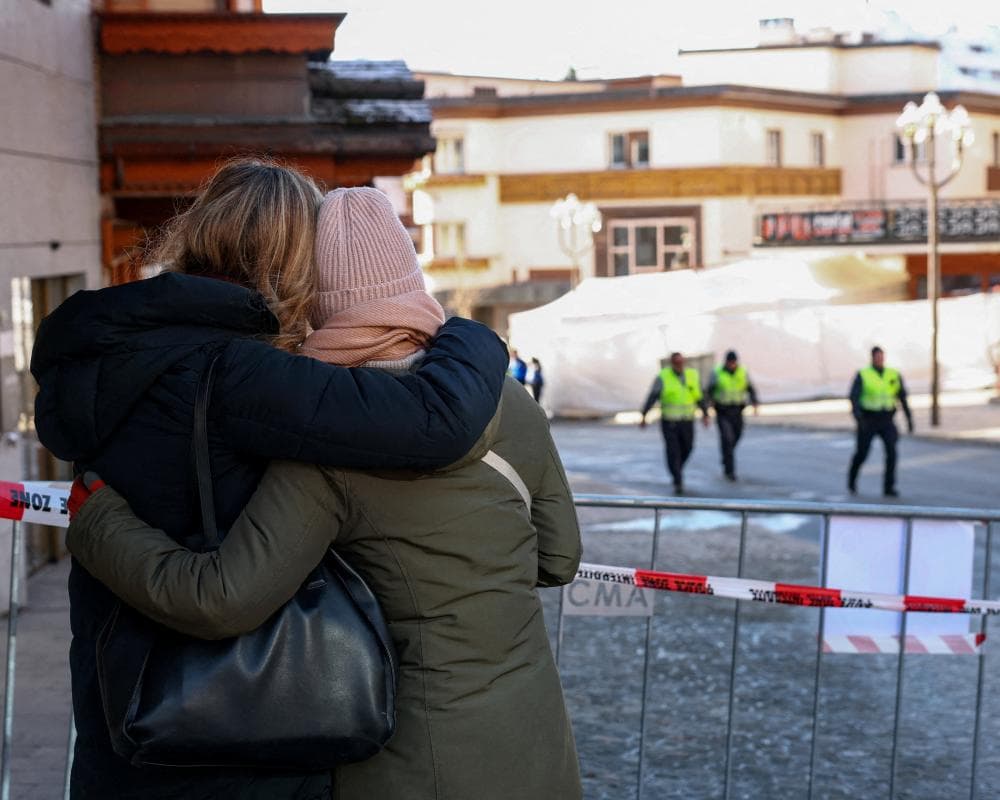
By 1pm bright sunshine lit up incongruous scenes in the centre of Crans-Montana: fake reindeer and Christmas decorations amid emergency vehicles, posters for new year parties amid huddles of hushed bystanders.
Switzerland’s president, Guy Parmelin, visited the scene, where forensic teams worked behind white screens. Families were still awaiting news of loved ones, he said. “Some don’t yet know if their children have died.”
Switzerland will fly flags at half-mast for five days, Parmelin said. “What was meant to be a moment of joy has turned the first day of the year in Crans-Montana into a day of mourning affecting the entire country and beyond.” Many of the dead were young people with “projects, hopes and dreams”, he said.
Valais canton’s attorney general, Beatrice Pilloud, rejected arson or terrorism as probable causes of the fire. “At no moment is there a question of any kind of attack,” she told reporters. Asked about emergency exits in the bar, she said it was too early to draw conclusions. There had been no arrests and there were no suspects, she said.
As darkness fell across Crans-Montana on Thursday evening, blotting out its view of the Matterhorn mountain, shock and disbelief hovered over the town.
Le Constellation was an institution, a bar that served mainly locals, not tourists. Unlike many other bars and clubs, it often had no cover charge and so attracted young people.
Dozens of local teenagers, some in tears, gathered by the police cordon and laid flowers. The impromptu vigil drew Milica Lazic, who said she had heard no news about a friend who worked at the bar.
Tourists continued to shop, ski and eat at restaurants. “I don’t think it means they don’t care, but they don’t know anyone involved,” said Ernesto Perila, 56, a cafe owner. “Life goes on, the world continues. I don’t think badly of anyone for that.”
In the chill air, forensic teams, cloaked by the screens, continued their work.