Loading...
Please wait for a bit
Please wait for a bit
Click any word to translate
Original article by Angelique Chrisafis in Paris
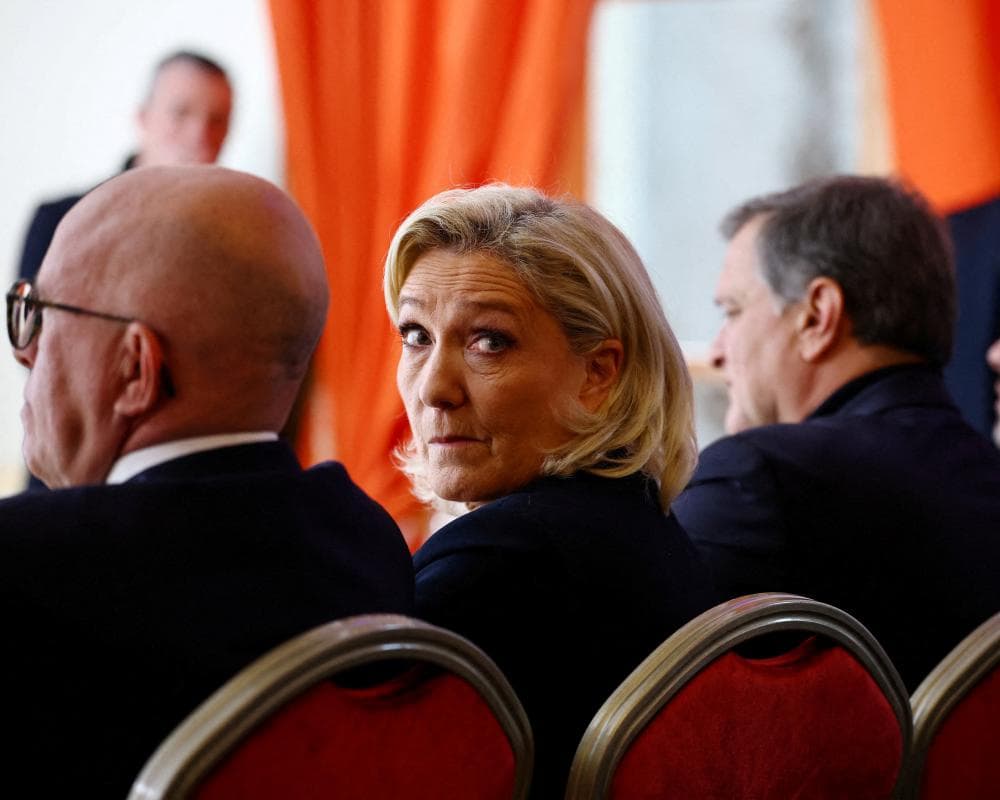
The French far-right party leader Marine Le Pen will face a fresh trial on appeal on Tuesday over the embezzlement of European parliament funds in a case that will determine whether or not she can run in the 2027 presidential election.
Le Pen, 57, who leads the far-right, anti-immigration National Rally (RN), was considered to be a contender for next year’s election until she was barred from running for public office last March after being found guilty of an extensive and long-running fake jobs scam.
Le Pen appealed, alongside 10 of the 24 party members who were convicted last year, and now faces a new trial which will run until 12 February.
The verdict and sentence, expected before the summer, will determine Le Pen’s political future and whether she can make a fourth presidential attempt next year. If not, she would be replaced by her young protege and party president, Jordan Bardella, 30.
Bardella appears to have benefited from Le Pen’s legal drama. Polling by Verian for Le Monde and L’Hémicycle published over the weekend found that 49% of French people thought Bardella had the greatest chance of winning the election, compared with 18% for Marine Le Pen.
An Odoxa poll last autumn found that Bardella would win the presidency no matter who his opponent in the second round was.
Analysts have cautioned that, with candidates from across the political spectrum yet to be decided, it is too early for a clear picture of how the 2027 election race may shape up.
Le Pen has said she is innocent and still wants to lead France. She has attacked what she called a “tyranny of judges” who wanted to stop her running in a presidential race she said she could otherwise win.
She told La Tribune Dimanche last month: “There was a time when you could take a bullet. Now you can take a judicial bullet. In reality, that means your death.”
But she has also recently begun speaking of Bardella as a clear alternative if she can no longer run for president, telling the newspaper: “Jordan Bardella can win in my place.” She said whatever the outcome, her party would dominate and its “ideas will survive”.
Judges last year ruled that Le Pen was “at the heart” of a carefully organised system of embezzlement from 2004 to 2016.
Taxpayer money allocated to members of the European parliament to pay their assistants based in Strasbourg or Brussels was instead siphoned off by the party, which was then called Front National, in order to pay its own party workers in France.
The staff in France had no connection to work undertaken at the European parliament. The loss to European funds was estimated at €4.8m (£4.2m).
Le Pen was found guilty last March and given a five-year ban from running for office, effective immediately. She received a four-year prison sentence, with two of those years suspended and two to be served outside jail with an electronic bracelet. She was also ordered to pay a €100,000 fine.
There has been speculation about what length of sentence Le Pen may receive if she is found guilty on appeal, and whether she could still run for president.
The five-year ban on running for office that is in place now began on 31 March 2025. If an appeal court sentenced her to a one or two-year ban on running for office, this will have ended by March 2027, allowing her in theory to run for president in April 2027, the expected date for an election.
The RN’s choice of presidential candidate will depend on the verdict of the appeal, so will not be announced until this summer at the earliest.
Le Pen’s sentence prompted anger among political figures on the international populist right. Donald Trump called it a “witch-hunt” by “European leftists”.
The German magazine Der Spiegel reported that Trump officials had held internal discussions about sanctioning French prosecutors and judges who had been involved in last year’s trial and sentencing of Le Pen. The US state department denied this, calling it a “fake story”.
Peimane Ghaleh-Marzban, the president of the Paris judicial court, said last week that any move against a French judge would “constitute an unacceptable and intolerable interference in the internal affairs of our country”.
Maud Bregeon, the French government spokesperson, aid last week that there was no proof of any international interference but that the government would remain vigilant.