Loading...
Please wait for a bit
Please wait for a bit
Click any word to translate
Original article by Sam Jones in Madrid
Spain’s largest train drivers’ union has called a three-day nationwide strike to demand measures to guarantee the safety of railworkers and passengers after two deadly crashes this week killed at least 46 people, including two drivers.
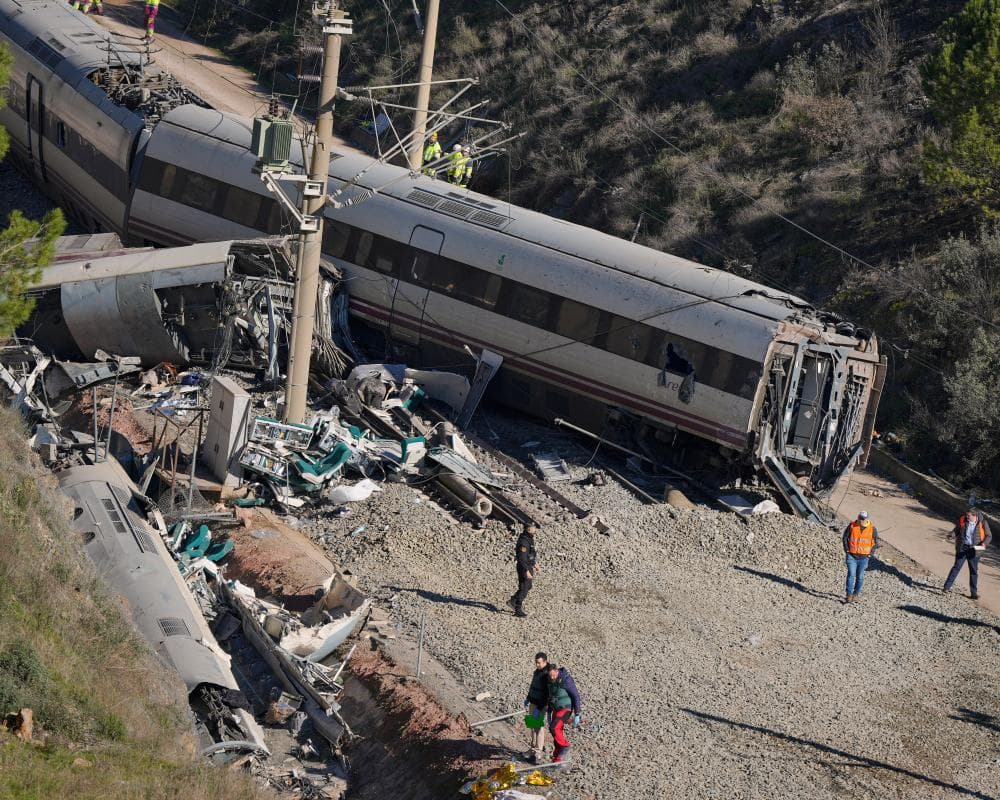
The death toll from Sunday’s collision between two trains near the Andalucían town of Adamuz rose from 43 to 45 on Thursday afternoon after two more bodies were recovered from the crash site. On Tuesday, a driver was killed and 37 people injured when a train was derailed by the collapse of a retaining wall near Gelida in Catalonia.
A number of people were also lightly injured on Thursday when a commuter train in the south-eastern region of Murcia crashed into a crane. Authorities said the incident was caused by “the intrusion … of a crane not belonging to the railway operation”, and the train was not derailed or overturned.
The accidents in Adamuz and Gelida led the Spanish railway drivers’ union Semaf to announce industrial action. They have also prompted a stoppage by drivers that has shut down Catalonia’s regional rail services, affecting about 400,000 travellers.
The union said three days of strikes would be held from 9 to 11 February, saying the action was “the only legal avenue left for workers to demand the restoration of safety standards on the railway system and, consequently, guarantee the safety of both railway professionals and passengers”.
Semaf called for the relevant authorities to ensure people’s safety by addressing the “numerous reports” on poor track conditions it said had gone “unanswered and inactive for months, or even years”.
It added: “The serious accidents in Adamuz and Gelida, both of which resulted in people losing their lives, represent a turning point in demanding that all necessary actions be taken to guarantee the safety of railway operations.”
Spain’s transport minister, Óscar Puente, said he understood drivers’ concerns but hoped the strikes could be averted, and he said the stoppage in Catalonia needed to end. He has stressed that the two accidents were “completely unrelated”. The Gelida incident is thought to have been caused by heavy rainfall.
“This is a very difficult week,” he told Catalunya Ràdio on Thursday morning. “We need to remain calm and get this where it needs to be. Two terrible incidents have occurred in a very short space of time, and I believe that is significantly impacting the morale of the train drivers. I hope the situation will be resolved soon.”
Investigators are continuing to examine the crash site in Adamuz and the wreckage of the two trains. The accident happened at 7.40pm on Sunday when a high-speed train travelling from Málaga to Madrid derailed, crossing on to another track where it hit an oncoming train travelling from Madrid to Huelva.
Media reports suggest investigators are focusing on a 30cm (12in) crack in the track at the accident site.
“There’s an initial point where the derailment is believed to have occurred,” Puente told the radio network Cadena Ser on Monday night. “Now we have to determine if it’s the cause or the consequence. It’s not a trivial matter, and it won’t be quick or easy. We’ll have to send the track to the lab; we have to determine what happened. At this point, nothing can be ruled out.”
Puente said marks had been found on the wheels of the first five carriages of the high-speed train, and on the wheels of other trains that had travelled along the same stretch of track before the derailment.
“The question now is how those marks appeared,” the minister told the TV channel Telecinco. “Was there something on the tracks, or was the track itself beginning to break down? At this point, it’s not possible to draw any conclusions about what caused those marks.”
Spain’s efforts to mourn the dead have been marred by familiar political squabbles. A spokesperson for the far-right Vox party said the Adamuz tragedy was proof of the decline of the country’s once-great rail services.
“All Spaniards can see with their own eyes that it’s not safe to travel and that the damage is getting worse by the day,” Pepa Millán said, adding: “Spaniards are scared to get on a train.”
Vox’s leader, Santiago Abascal, has attempted to link the Adamuz accident to the series of corruption allegations that have enveloped the socialist-led government. “Corruption destroys confidence in our institutions,” he said. “And corruption kills.”
The conservative People’s party (PP) called for Puente, who has made numerous media appearances over the past few days, to provide “absolute transparency”.
“The minister has a knack for talking,” said the PP infrastructure spokesperson, Juan Bravo. “But it’s time for him to offer explanations and not spend two hours saying nothing.”
The government’s spokesperson, Elma Saiz, said Abascal’s comments were abhorrent. “Given the two tragic nights we’ve just endured, with dozens of injured still hospitalised and not all the bodies recovered, Abascal’s attitude is despicable,” she said. “Using tragedy and fear to generate chaos and distrust is an anti-democratic and inhumane act.”