Loading...
Please wait for a bit
Please wait for a bit
Click any word to translate
Original article by Amy Hawkins and agencies
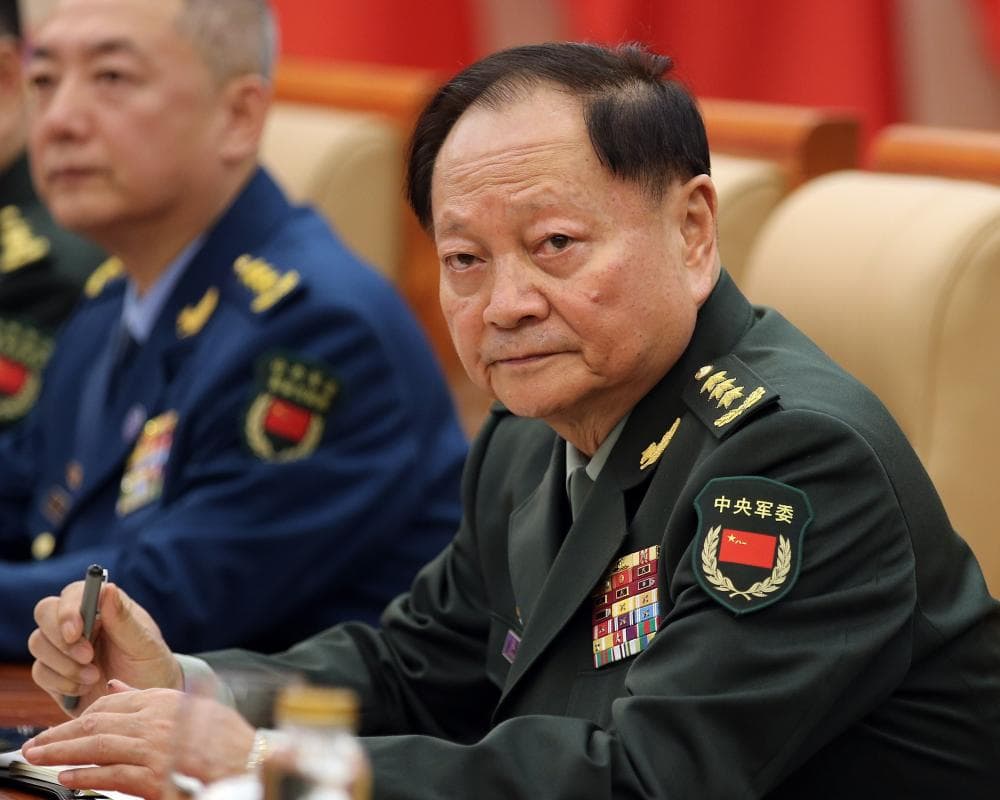
China’s military leadership is in turmoil after its most senior general – a close ally of Xi Jinping – was placed under investigation for “suspected serious violations of discipline and law”.
Zhang Youxia is the joint vice-chairperson of the Central Military Commission (CMC), the ruling body of China’s People’s Liberation Army (PLA). Second only to Xi in the military command structure, Zhang has long been seen as the Chinese president’s closest military ally.
The defence ministry announced on Saturday that Zhang and Liu Zhenli, chief of staff of the CMC’s joint staff department, were under investigation.
An editorial published in the army newspaper Liberation Army Daily on Sunday said that Zhang and Liu “seriously betrayed the trust and expectations” of the Communist party and the CMC, and “fostered political and corruption problems that undermined the party’s absolute leadership over the military and threatened the party’s ruling foundation”.
The Wall Street Journal reported that Zhang was accused of leaking information about the country’s nuclear weapons programme to the US and accepting bribes for official acts, including the promotion of an officer to defence minister, citing people familiar with a high-level briefing on the allegations.
The Guardian was unable to independently verify the reports.
Zhang is also a member of the elite politburo of the ruling Communist party and is one of just a few leading officers with combat experience. Aged 75, Zhang was retained in the military leadership by Xi past the normal age of retirement, indicating a high level of trust in the general that he has now purged.
The military was one of the main targets of a broad corruption crackdown ordered by Xi in 2012. That drive reached the upper echelons of the PLA in 2023 when the elite Rocket Force was targeted.
The scalping of a figure as senior as Zhang in Xi’s anti-graft campaign raises questions about the stability of China’s military leadership at a moment when it is under scrutiny from western observers about its readiness and willingness to launch an assault on Taiwan, which could bring it into conflict with the US in the Indo-Pacific.
Lyle Goldstein, director of the Asia programme at Defense Priorities, a foreign policy thinktank, said the purge “raises larger issues about political stability in a rising, nuclear superpower”.
“It could be seen by many as reflecting poor judgment about some of [Xi’s] prior appointments,” Goldstein said.
Of the seven men appointed to the CMC at the 20th party congress in 2022, only two remain untouched by anti-corruption investigations: Xi himself, and Zhang Shengmin, the CMC’s anti-graft officer.
The co-vice chair of the CMC, He Weidong, was expelled from the party and PLA in October last year for corruption.
Foreign diplomats and security analysts are watching developments closely, given Zhang’s closeness to Xi and the importance of the commission’s work in terms of command as well as the PLA’s ongoing military modernisation and posture.
While China has not fought a war in decades, it is taking an increasingly muscular line in the disputed East China Sea and South China Sea, as well as over the self-ruled island of Taiwan, which is claimed by China. Beijing staged the largest military exercises to date around Taiwan late last year.
The Singapore-based China security scholar James Char said the military’s daily operations could carry on as normal despite the purges.
“China’s military modernisers will continue to push for the two goals Xi has set for the PLA – namely, 2035 to basically complete its modernisation and 2049 to become a world-class armed forces,” said Char, a scholar at the S Rajaratnam School of International Studies.
Eight top generals were expelled from the Communist party on graft charges in October 2025, including He Weidong. Two former defence ministers were also purged from the ruling party in recent years for corruption. The crackdown is slowing procurement of advanced weaponry and hitting the revenues of some of China’s biggest defence firms.
Born in Beijing, Zhang joined the army in 1968, rising through the ranks and joining the CMC in late 2012 as the PLA’s modernisation drive gathered pace.
He fought in Vietnam in a brief but bloody border war in 1979 that China launched in punishment for Vietnam invading Cambodia the previous year and ousting the Beijing-backed Khmer Rouge.
Zhang was sent to the frontlines to fight the Vietnamese and was quickly promoted, according to state media. He also fought in another border clash with Vietnam in 1984 as the conflict rumbled on.
“During the battle, whether attacking or defending, Zhang Youxia performed excellently,” the official China Youth Daily wrote in a 2017 piece entitled These Chinese generals have killed the enemy on the battlefield.
Some China scholars have noted that Zhang emerged from the conflict an avowed moderniser in terms of military tactics, weapons and the need for a better trained force.