Loading...
Please wait for a bit
Please wait for a bit
Click any word to translate
Original article by Patrick Wintour Diplomatic editor and Andrew Roth Global affairs correspondent
The threat of war between the US and Iran appeared to loom closer after Donald Trump told Tehran time was running out and that a huge US armada was moving quickly towards the country “with great power, enthusiasm and purpose”.
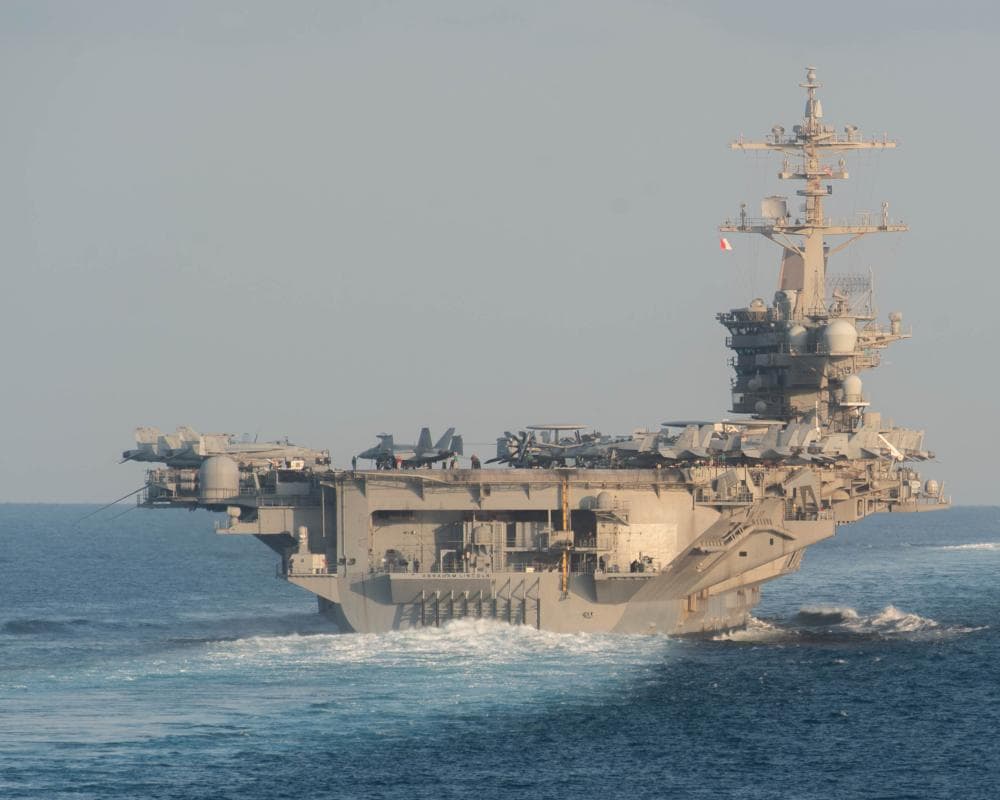
Writing on social media, the US president said on Wednesday that the fleet headed by the aircraft carrier USS Abraham Lincoln was larger than the one sent to Venezuela before the removal of Nicolás Maduro earlier this month and was “prepared to rapidly fulfil its missions with speed and violence if necessary”.
Trump said: “Hopefully Iran will quickly ‘Come to the Table’ and negotiate a fair and equitable deal – NO NUCLEAR WEAPONS – one that is good for all parties. Time is running out, it is truly of the essence!
“As I told Iran once before, MAKE A DEAL! They didn’t, and there was ‘Operation Midnight Hammer,’ a major destruction of Iran. The next attack will be far worse! Don’t make that happen again.”
It was the starkest indication yet from Trump that he intends to mount some kind of military strike imminently if Iran refuses to negotiate a deal on the future of its nuclear programme. The post also reflects a remarkable shift in the White House’s stated rationale for sending a carrier strike group to the region, moving away from outrage over the death of protesters as to the fate of Tehran’s nuclear programme.
Trump urged Iranians to keep protesting earlier this month, telling them “help is on its way”, but he later backtracked on the grounds that “the killing has stopped”.
There is speculation that he actually held back because he did not have enough military assets in the area, Gulf States had urged restraint and Israel had counselled it needed more time to prepare for likely reprisals from Iran.
Activists say more than 30,000 people were killed during the recent unrest.
The US secretary of state, Marco Rubio, told the Senate on Wednesday that thousands had been killed and said the Iranian government was “probably weaker than it has ever been” since the 1979 revolution.
Iranian missiles and drones could still pose a threat to US personnel in the region though, he said, and the US carrier strike group would carry out its mission “with speed and violence” if necessary.
About 30,000 US military personnel were “within the reach of an array of thousands of Iranian one-way UAVs and Iranian short-range ballistic missiles that threaten our troop presence,” Rubio said. “We have to have enough personnel in the region … to defend against that possibility.”
Trump would also maintain the “preemptive defensive option” of striking Iran if there were indications that it was planning an attack on US troops, he said. “They certainly have the capability because they’ve amassed thousands and thousands of ballistic missiles that they’ve built.”
European diplomats had been expecting a crisis to develop over the weekend and detected signs of Israeli nervousness about the scale of possible Iranian reprisals.
In a social media post written in Hebrew, Ali Shamkani, a senior adviser to the Iran’s supreme leader, Ali Khamenei, said: “Any military action by America, from any source and at any level, will be considered the beginning of a war, and the response will be immediate, comprehensive and unprecedented, directed at the aggressor, at the heart of Tel Aviv and at all its supporters.”
The Gulf States and Turkey have been speaking to both sides, trying to find common ground between Iran and the US, but Tehran has insisted it will not negotiate under duress, or with preconditions.
Trump’s special envoy, Steve Witkoff, said at the World Economic Forum in Davos that a deal with Iran ought to happen. He told CNBC: “Obviously, the deal has to do with missiles. It has to do with enrichment. It has to do with non-state actor proxies. It has to do with [Iran’s stockpile of nuclear] material.”
It has become clear in recent days that Trump is interested in curbing not just the remains of Iran’s already shattered nuclear programme but also its ability to fire long-range missiles, always seen as the centrepiece of Iranian military projection. In recent weeks Trump has also suggested Khamenei must leave the world stage, a demand Iran will reject.
Asked by Sen John Cornyn about the potential for a change of regime in Iran, Rubio said: “You’re talking about a regime that’s been in place for a very long time ... So that’s going to require a lot of careful thinking, if that eventuality ever presents itself.
“I don’t think anyone can give you a simple answer to what happens next in Iran if the supreme leader and the regime were to fall.”
Some will see the sudden escalation of the threat as a useful piece of distraction at a time when Trump is under domestic political pressure over the violence administered by homeland security officers in Minnesota.
The Iranian mission at the UN in New York said: “The last time the US blundered into the wars in Afghanistan and Iraq, it wasted $7tn, and over 7,000 American lives were lost. Iran stands ready for dialogue based on mutual respects and interests but if pushed it will defend itself and respond like never before.”
Iran’s foreign minister, Abbas Araghchi, said he was not prepared to negotiate under threats but he was willing to talk without preconditions, terms he had relayed via numerous intermediaries to Witkoff.
In the last 24 hours, Araghchi or the Iranian president, Masoud Pezeshkian, have spoken to diplomats from Saudi Arabia, Qatar and Egypt.
All three Arab states will be feverishly exploring ways to reopen talks without Iran having to accept a preconditioned result. They were critical in persuading Trump to hold back from mounting an attack three weeks ago, but Trump now has greater flexibility of military options and seems more focused on a nuclear deal rather than punishing Iran for the bloody suppression of street protests.
There is deep suspicion in Tehran about talking to the US since the two sides were in the middle of talks last June when Israel was given clearance by the US to mount an attack on Iran designed to decapitate its leadership and destroy its civil nuclear sites.
Hakan Fidan, the Turkish foreign minister, urged the US to detach its wider demands about Iran’s missile programme and support for militia in the region from the nuclear file. He said he thought that if Witkoff insisted on putting all items on to the table at once, Iran would not respond.
Trump has insisted that Iran abandon its domestic nuclear enrichment programme, permit UN nuclear inspectors to return and hand its stockpile of highly enriched uranium to a third party, most likely Russia.
Iran has always held out against abandoning its domestic capacity to enrich uranium but has been willing to set rigid limits on its stockpile.
Since the last round of negotiations ended with an Israeli and US attack killing 1,000 people and severely damaging its key nuclear sites, Iran has been weakened further by a plunging currency and rampant inflation.
With the nuclear sites already damaged, the key targets in any attack would likely be Iran’s leadership. June’s attack revealed Israel had near total dominance of the skies above Iran.
Almost all the Gulf states, fearful of Iranian reprisals, have said they are not willing to allow the US to use their airspace or bases to mount an attack on Iran.
Iranian officials said: “We will target the same base and the same point from which air operations against us are launched, and we will not attack countries because we do not consider them to be enemy countries. We will increase our level of defence readiness against the US military buildup to the highest level. If the Americans want negotiations without pre-determined outcomes, Iran will accept it.”