Loading...
Please wait for a bit
Please wait for a bit
Click any word to translate
Original article by Jennifer Rankin in Brussels and Kiran Stacey
The EU has listed Iran’s Islamic Revolutionary Guard Corps (IRGC) as a terrorist organisation, ending years of division over the issue in response to the regime’s brutal repression of protesters.
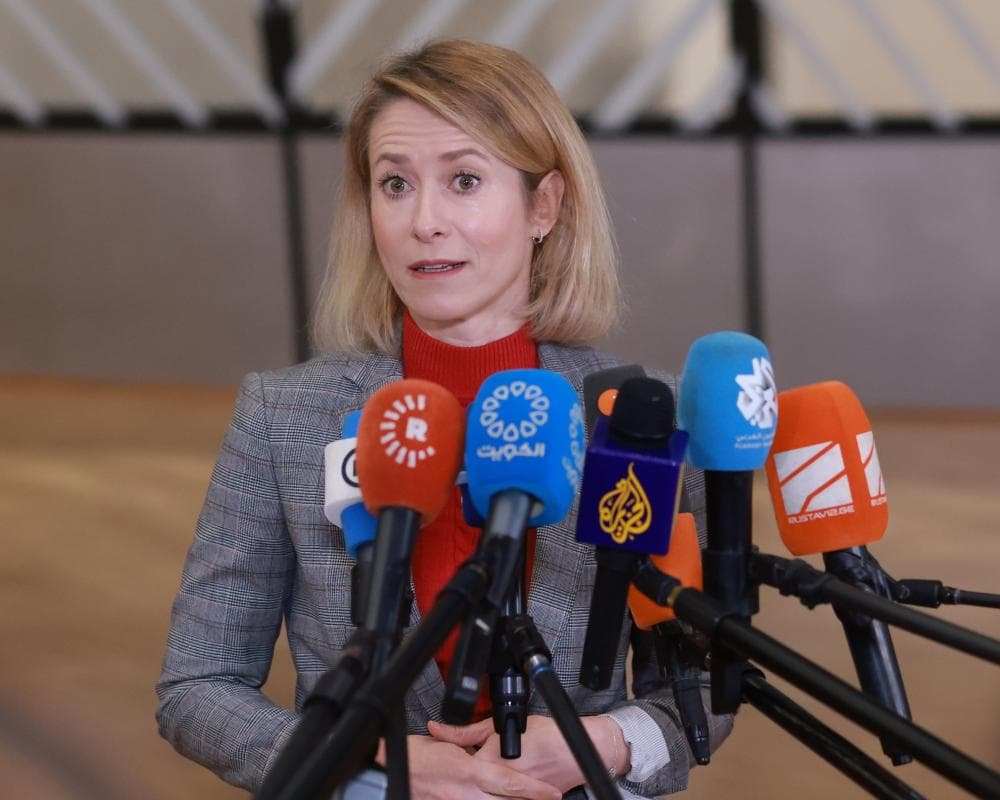
“Repression cannot go unanswered,” said Kaja Kallas, the EU’s foreign policy chief, on Thursday. The paramilitary organisation has played a significant role in suppressing demonstrations in Iran. “Any regime that kills thousands of its own people is working toward its own demise,” she wrote on X.
Hannah Neumann, chair of the European parliament’s delegation for relations with Iran, said the IRGC listing was a “long-overdue political signal that massive violence and transnational repression will no longer go unanswered”.
She said in a statement: “This listing is not merely symbolic. It carries very concrete legal consequences: assets are frozen, and any financial or material support becomes a criminal offence.”
The EU also added 15 Iranian government officials and six organisations to its sanctions list for their role in “serious human rights violations” in the repression of protesters. The listings included Iran’s minister of the interior, Eskandar Momeni, and several IRGC commanders, senior police and law enforcement officers, an EU statement said.
Entities facing sanctions include the Iranian Audio-Visual Media Regulatory Authority and several software companies involved in censoring activities, such as trolling campaigns on social media, spreading misinformation and disinformation and disrupting internet access.
The latest additions mean the EU has sanctioned 247 individuals and 50 entities over human rights violations. Separate restrictions (asset freezes and travel bans) have been imposed on Iranian people and organisations aiding Russia’s war on Ukraine.
The long-discussed EU listing of Iran’s Islamic Revolutionary Guard Corps came after Donald Trump told Tehran to negotiate a deal on the future of its nuclear programme or face a possible military strike. He announced on social media that a “massive armada” was on the way ready to fulfil its mission “with speed and violence if necessary”.
The Axios website reported that the Trump administration would host senior defence and intelligence officials from Israel and Saudi Arabia this week for talks on Iran.
Trump held back from threatened military strikes on Iran earlier this month, after calls from the Gulf states for restraint and warnings from Israel that it needed more time to prepare for likely reprisals.
Russia, which has deepened ties with Iran since the start of its full-scale invasion of Ukraine, warned on Thursday against any “destabilising” military action in the region. Dmitry Peskov, the Kremlin spokesperson, said: “Any forceful actions can only create chaos in the region and lead to very dangerous consequences in terms of destabilising the security system throughout the region.”
More than 30,000 people may have been killed in the latest wave of repression in Iran, according to some estimates. Human rights groups say a “revenge” campaign has been unleashed by the regime, with doctors and healthcare workers facing death sentences for treating badly injured protesters.
The EU terror designation of the IRGC became possible after France dropped its long-held opposition. Jean-Nöel Barrot, the French foreign minister, wrote on X: “The unbearable repression of the peaceful uprising of the Iranian people cannot go unanswered.”
France, along with other member states, had resisted the designation of the Iranian regime’s state body, fearing it would damage diplomatic channels and the interests of French citizens in the country.
Belgium had similar qualms, but its government last year included support for the EU listing in the coalition agreement. Belgium’s foreign minister, Maxime Prévot, said on Thursday his country continued to advocate for the terror designation “particularly in light of the atrocities and repression that have been observed in recent weeks”.
On Thursday, Tehran’s top diplomat criticised the EU’s decision to designate the IRGC a terrorist organisation as a “major strategic mistake”. In a post on X, Abbas Araghchi, the Iranian foreign minister, wrote: “Several countries are presently attempting to avert the eruption of all-out war in our region. Europe is instead busy fanning the flames.” Iran is facing off with the US, which has moved a strike force to the Middle East.
Established after the 1979 Islamic revolution, the Islamic Revolutionary Guard Corps is an elite paramilitary force loyal to the country’s supreme leader, Ayatollah Ali Khamenei. It is separate to the regular army, with 150,000 ground troops and its own navy and air force.
It was listed a terrorist organisation by the US in 2019 during the first Trump administration, by Canada in 2024, and by Australia in 2025.
The EU’s decision renews pressure on the British government, which has not proscribed the IRGC but has kept open the option to do so in the future.
Yvette Cooper, the British foreign secretary, has promised to draw up new legislation to be able to proscribe state organisations such as the IRGC without having to designate them as a terrorist organisation under existing laws.
Cooper told MPs earlier this month: “The scale of the truly brutal, horrendous actions in Iran means that we should stand together in condemnation of that action, and in the action that we need to take in concert with our allies, including on further sanctions and further immediate pressure on the regime.”
A spokesperson for the prime minister’s office said on Thursday: “We welcome those announcements by the EU, which will further hold the Iranian authorities to account for the violence and brutality shown against peaceful protesters.”
The UK Foreign Office views a decision on proscription as largely symbolic given the extensive sanctions already in place and is concerned such a move might trigger the expulsion of British diplomats in Tehran. The IRGC is already subject to asset freezes and other sanctions in the UK.