Loading...
Please wait for a bit
Please wait for a bit
Click any word to translate
Original article by Nicola Davis Science correspondent
The Bayeux tapestry has survived myriad perils, from cathedral fires to its potential destruction for use as wagon covers. Now, with the embroidery about to be displayed in a blockbuster London exhibition, experts must contend with a host of more insidious dangers.
The arrival of the tapestry at the British Museum in the small hours of Friday morning was a historic moment – albeit less dramatic than the landing of William the Conqueror it portrays.
Unloaded from a large yellow lorry to a hushed audience of staff and diplomats, the 70-metre-long (230ft) embroidery was back in its country of origin for the first time in almost 1,000 years.
But getting it to the UK, putting it on display, and understanding its secrets have required some very modern science.
To be transported, the work first had to be removed from display at its home at the Bayeux Tapestry Museum in Normandy, France, then mounted on a folding screen called a paravent, which was then padded.
“The tapestry is essentially folded back on itself in a concertina-type way,” said Prof Michael Lewis, the curator of the Bayeux tapestry exhibition at the British Museum.
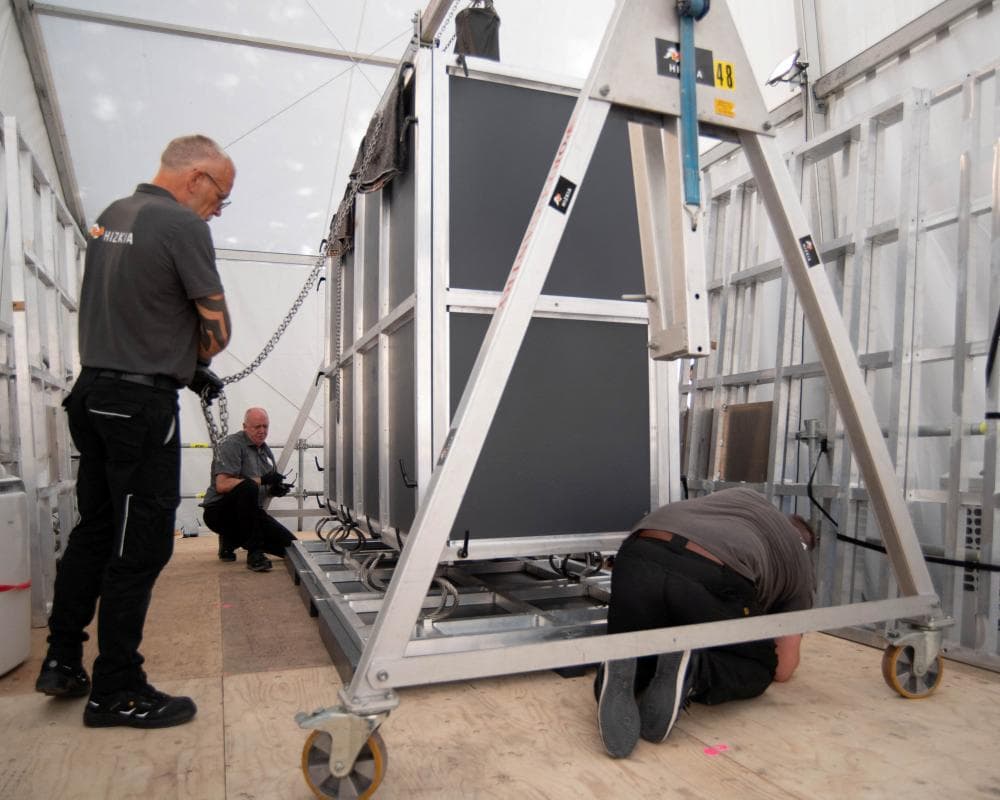
The transportation system involved complex engineering, with temperature and humidity being carefully controlled. This was achieved using an inner crate built around the paravent, with a second outer crate, composed of wire-rope isolators to tackle shocks and vibrations, and an aluminium frame.
To ensure the crates and lorry could transport the fragile work safely, experts carried out two dry runs earlier this year.
“We had two previous tests: one that just came over the Channel with another paravent which had a kind of replica tapestry inside … and then one that did the whole trip to the British Museum,” Lewis said. “And the purpose of that was to monitor the vibration levels on the tapestry.”
But it is not only getting the embroidery to the UK that has required technical skills; displaying it also relies on science and innovation.
According to the Bayeux Tapestry Museum – which has loaned the embroidery while the museum undergoes a renovation – light, dust, insects, mould, and temperature changes are among the factors that can imperil the work.
To prevent the materials from deteriorating, the tapestry will be housed in a custom-made case – believed to be the longest ever constructed – with temperature and humidity again being carefully controlled.
Lewis noted the work would be shown under low light levels, and exposed to a limited number of hours of light a day. When visitors are not present, the lights will be turned off and the case covered.
Lewis said the removal of the tapestry from its previous casing had also opened up the opportunity for fresh scientific analyses, adding that while non-invasive techniques have been possible while it has been on display, its materials can now be studied up close for the first time since the early 1980s.
Lewis said such studies would only take place when the tapestry returned to France next year, where it is expected to undergo restoration work. Possible topics for research include investigating whether the linen cloth is made from flax, gleaning insights into the type of sheep the wool came from, and identifying different batches of dyed wool in the embroidery.
“That might help us understand the phases through which the Bayeux tapestry was produced,” he said, noting that such studies – together with analyses of the stitching itself – could help to resolve the question of whether the nine pieces of linen that comprised the work were made in the same workshop or not.
“There’s lots of science that potentially could be done,” said Lewis. “It’s not going to happen in London, but it’s something that we’re thinking about for the future as well.”