Loading...
Please wait for a bit
Please wait for a bit
Click any word to translate
Original article by Jennifer Rankin in Brussels
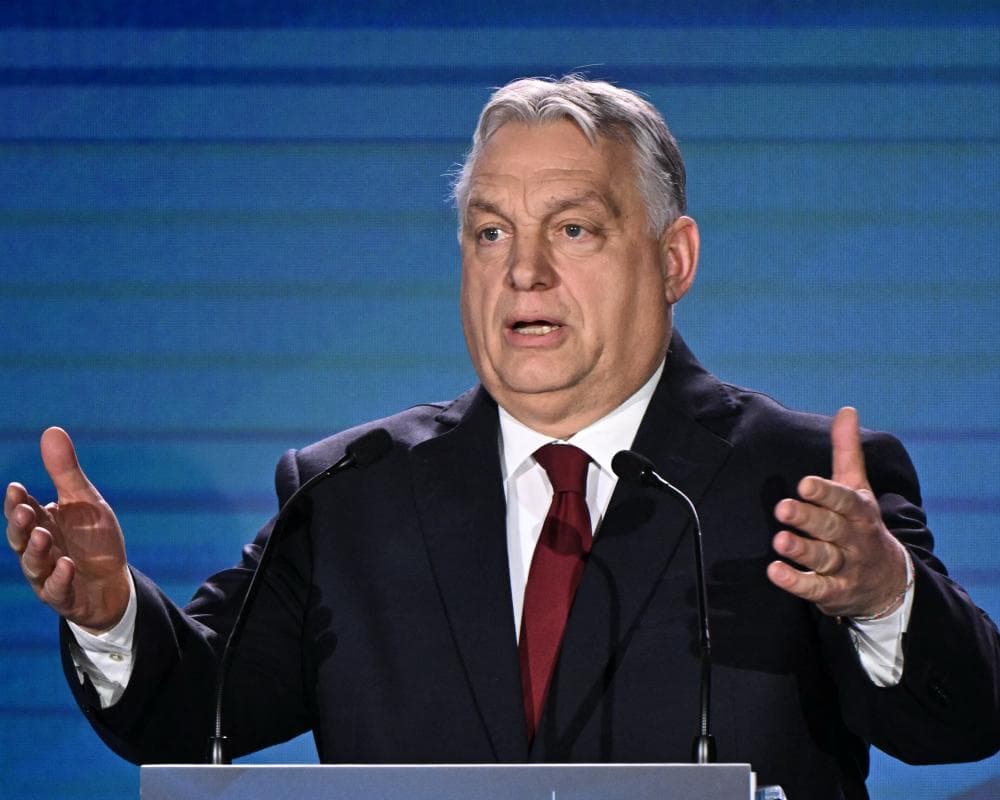
EU leaders have failed to convince Viktor Orbán, Hungary’s prime minister, to drop his opposition to a vital €90bn (£78bn) loan for Ukraine. They have accused him of betrayal and acting in bad faith but have not persuaded him to budge.
In an unusual sign of public anger on Thursday, several leaders made plain their irritation with Orbán, who refused to sign off on the loan agreed last year because of a dispute with Kyiv over a damaged oil pipeline.
Arriving at an EU summit, Kaja Kallas, the bloc’s foreign policy chief, said she was not optimistic about a solution before the Hungarian elections on 12 April, when Orbán faces the most serious challenge to his 16-year rule.
Hungary had agreed to the loan and was now “taking [its] agreement back”, Kallas said, adding that Orbán was not acting in good faith, a foundational principle of the EU treaty. “The question for us is how can we really force the implementation of the agreement we made in December?” she said.
Orbán and his ally Robert Fico, Slovakia’s prime minister, refused to sign a European Council statement “look[ing] forward” to the release of funds for Ukraine. Two EU sources said they did not expect a shift from Hungary at the summit. “Orbán didn’t move in the Ukraine session,” said one.
EU leaders agreed in December that 24 member states would take out a €90bn loan for urgently needed military aid and government support for Ukraine. Hungary, Slovakia and the Czech Republic approved the idea with the crucial caveat that they did not have to contribute to the loan. It was a hard-fought plan B after an alternative option of tapping Russia’s frozen assets for the funding failed to win the required unanimity.
Orbán’s reneging on his agreement has infuriated EU leaders because it undermines EU decision-making at a moment when Ukraine is running out of money. EU officials want the first tranches of cash to be available to Kyiv from early April.
Petteri Orpo, Finland’s prime minister, said Orbán was using Ukraine “as a weapon” in his election campaign, adding: “I think that he betrayed us and we need to find a solution how to go forward.”
Bart De Wever, the prime minister of Belgium, who blocked the option to freeze Russia’s assets, played a central role in orchestrating the loan deal, including negotiating with Orbán. He said: “It’s unacceptable to decide with the leaders and then after say: ‘But I’m not ready to execute what I decided.’”
António Costa, the European Council president, told leaders – in Orbán’s presence – that Hungary’s behaviour was “unacceptable”, according to an EU official. Costa used the same word to describe comments by Volodymyr Zelenskyy, the Ukrainian president, who, while speaking about Orbán, said he would “give this person’s address to our armed forces”. The remark prompted a rare rebuke from EU officials.
Arriving at the summit, Orbán showed no sign of compromise. He said: “We would like to get the oil which is ours from the Ukrainians and which is … blocked by the Ukrainians. I will never support any kind of decision here which is in favour of Ukraine [as long as] the Hungarians are not able to get the oil which belongs to us.”
The dispute centres on the Soviet-era Druzhba pipeline, which brings Russian oil to Hungary and Slovakia via Ukraine. Ukraine said the pipeline had been damaged in a Russian air attack, but Orbán has accused Kyiv of stalling on repairs.
Hungary and Slovakia’s Kremlin-friendly governments are also blocking the EU’s 20th package of sanctions against Russia, which was meant to have been agreed by the fourth anniversary of the full-scale invasion of Ukraine last month. The EU statement, adopted by 25 member states on Thursday, calls for the “swift adoption” of that package and further pressure on Russia.
This week Zelenskyy agreed to accept EU financial and technical support to repair the pipeline. But the decision does not appear to have swayed Orbán, who is running an anti-Ukraine, anti-EU election campaign. It depicts his centre-right opponent, Péter Magyar, as an agent of Brussels and Kyiv, who wants to drag Hungary into the war in Ukraine.
Arriving at his first EU summit as prime minister of the Netherlands, Rob Jetten said: “It is obvious that Ukraine needs our full support to win this war against Russian aggression. There has been decision-making here on the European level so I expect everyone to respect that.”
Zelenskyy, who addressed the leaders via video link, said before the summit he hoped the EU would stand by its promise. “We are really counting on the countries and the EU to find ways to resolve this issue,” he said on Wednesday.
The Ukrainian president told EU leaders this week that Ukraine was “undertaking all possible efforts to repair the damage and restore operations” to the pipeline.
Hungary and Slovakia are the only two EU countries that benefit from Druzhba, having secured a temporary exemption from the EU’s import ban on Russian oil, introduced after the full-scale invasion of Ukraine.
The summit in Brussels was meant to be dedicated to fine-tuning a long-term agenda to revitalise Europe’s waning competitiveness against the US and China. But it has been overshadowed by the dispute with Hungary and the war in the Middle East, which has sent energy prices soaring and increased the strain on the transatlantic relationship.