Loading...
Please wait for a bit
Please wait for a bit
Click any word to translate
Original article by Amy Hawkins in Weifang
The towns that are the bulwark of China’s energy security can, at a moment of global crisis, appear deceptively quiet. Trucks carrying oil trundle along wide-open highways that have little traffic, while a few boarded-up shops in crumbling low-rise buildings hint at a long-forgotten local buzz.
A ramshackle noodle shop serving hand-pulled ribbons of dough was empty at lunchtime, save for a few construction workers and a teacher watching videos on Douyin, the social media platform, with his meal.
But its boss wasn’t worried about low footfall. Peak time was midnight, he said, when nearby oil refinery workers finish their shifts and rush out of the gated factory complexes nearby, which employ thousands of people.
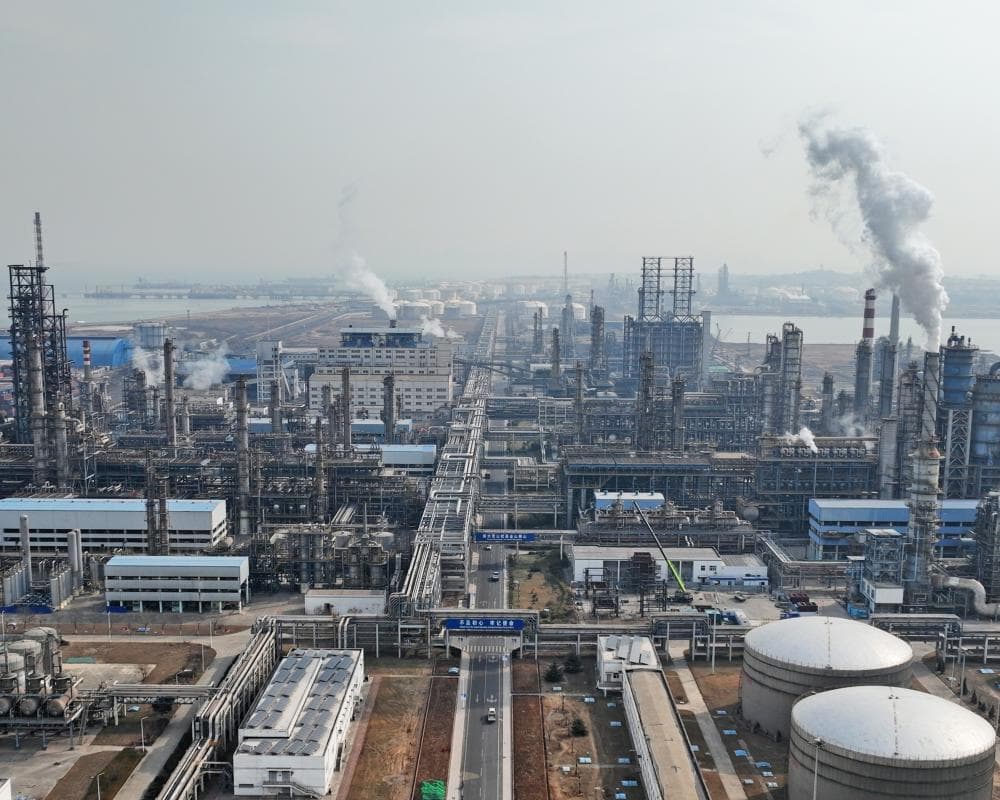
The oil-refining industry in Shandong, a province in north-east China, is immense. But unlike other parts of the country, where the sector is dominated by large, state-owned companies, Shandong’s industry is fuelled by independent “teapot” refineries, so called because of their diminutive appearance. Operating on razor-thin margins, they survive by buying cheap crude wherever they can and turn it into petrol and diesel for neighbouring provinces. Shandong’s teapots account for about a quarter of China’s total refining capacity.
Oil refining has become vital to China’s economy as the rest of the world, and Asia in particular, reels from an energy crisis in which schools have closed in Pakistan, a national emergency has been declared in the Philippines and oil prices have soared to record highs.
Oil represents less than a fifth of China’s energy mix. But it is nevertheless vital to the economy, particularly the transportation sector. The Shandong teapots, in towns such as Weifang, are now essential to keeping China’s economy stable.
The crisis was caused by the US-Israel strikes on Iran on 28 February, which unleashed chaos in the Middle East and prompted Tehran to in effect close the strait of Hormuz, a vital waterway through which about a fifth of the world’s oil and gas flows.
But one type of oil has continued to sail across the seas: Iranian. It is overwhelmingly going to China, which buys more than 80% of Iranian crude. Figures from Kpler, a data intelligence company, show that China’s imports of Iranian crude are running at about 1.6m barrels a day, compared with 1.4m barrels a day in 2025. Muyu Xu, a senior crude oil analyst at Kpler, said: “We are not seeing any disruption to Iranian oil flows.”
China’s state-owned refiners are cautious about buying Iranian oil because they do not want to be cut off from the US dollar-based international financial system. But the teapots, which cater to a domestic market, have no such qualms.
Erica Downs, a senior research scholar at the Center on Global Energy Policy at Columbia University, said: “The Trump administration has sanctioned a handful of teapots … but that was not changing the flow of Iranian barrels to China. Western sanctions have paved the way for Iran and Venezuela and Russia to become the biggest suppliers to China.”
The boss of a small petrol station in Weifang, a thickset man in his 70s who asked to be referred to as Uncle Wang, said local supplies of diesel and petrol had been stable since the start of the war, although rising prices had reduced his profits to “almost zero”.
“It’s not that [other countries] can’t get oil, it’s that they are too scared to buy it because [Donald] Trump won’t let them. But China isn’t afraid of him,” said Uncle Wang, holding court in his office behind his dusty petrol station. In the corner, there is a larger than life jade-coloured figurine of a frog biting down on a gold coin, a symbol of prosperity.
But now that the whole world is desperate for oil – and the US has eased sanctions on Iranian and Russian crude – the Shandong teapots are paying significantly more for their raw material. According to data from Kpler, Iranian light crude was about $11 cheaper a barrel than Brent crude before the US-Israeli strikes. Now the discount has reduced to as little as $2 a barrel, at a time when Brent prices have soared.
A worker at one of Shandong’s most prominent teapots said he was starting to feel nervous about the war’s impact. “Before the war, profits were OK. After the war started, because the crude oil prices went up so much … clients started buying less,” said the 22-year-old, whose name the Guardian is withholding to protect his identity.
He works on the production line at Luqing Petrochemical, turning crude oil into light plastics that are used in everyday goods such as shopping bags. “These big trucks come here to pick up the goods,” he said, gesturing at haulage vehicles rumbling in the distance, “but now they come less often, so earnings are down.” He expects his monthly salary of 5,000 yuan (£545) to drop to about 4,000 yuan next month.
Luqing, which employs more than 2,700 people, is one of several Shandong teapots that was sanctioned by the US last year for allegedly buying millions of barrels of Iranian oil. The worker said in recent months the company had started pressuring people to quit by cutting their salaries and relocating them to difficult work sites. He fears more cuts could come if the war continues. “I’m quite worried about that because the benefits and treatment here are very good,” he said.
Luqing did not respond to a request for comment.
Workers in Shandong are on the frontline of an economic shock that most ordinary people in China have so far been insulated from. On Monday, the government made a rare intervention into the retail fuel market to reduce a planned increase in the pump prices of petrol and diesel by about 50%. Drivers flocked to fill their tanks before the cost went up.
But the teapot refineries and the thousands of people they employ may not be able to withstand the pressure. If prices keep increasing, some may go bust.
And there are plenty of other economic problems to worry about. “War is short-term,” said Uncle Wang. The bigger threat to his petrol station business came from a domestic trend, he said, not an international one: electric vehicles.
Additional research by Lillian Yang