Loading...
Please wait for a bit
Please wait for a bit
Click any word to translate
Original article by William Christou in Beirut and Julian Borger in Jerusalem
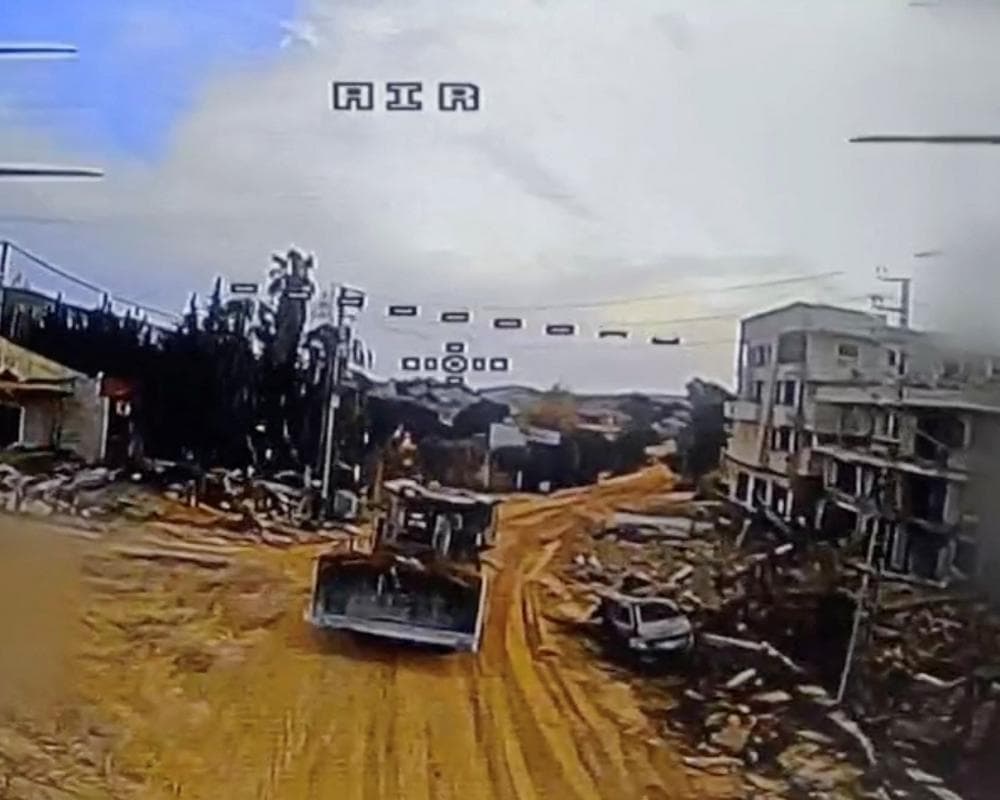
The three Israeli soldiers clustered by a tank heard the noise before they saw its source. By the time they spotted the drone, it was too late. The video feed goes black as the small fibre-optic first-person-view (FPV) drone explodes next to them, killing one soldier and injuring six more.
Footage of the drones hitting Israeli tanks, soldiers and bulldozers in south Lebanon has become increasingly common as Hezbollah puts the weapon at the centre of its guerrilla war against Israel’s occupation of south Lebanon.
They are cheap, disposable and hard to evade. Unlike radio-controlled drones, they are connected to their operators by a kilometres-long fibre optic cable that cannot be jammed by electronic warfare defences. And they are a serious challenge for the Israeli military.
Hezbollah has killed a bulldozer driver, evaded the trophy defence system on the Israeli Merkava tank and continually targeted soldiers with the drones. Their FPV capabilities, in common with FPV radio-controlled craft, allow an operator to pilot the small, explosive-equipped drones directly from their video feeds and detonate them on impact.
An Israeli military official said Israel “recognised the UAV [unmanned aerial vehicle] threat” and that it was working to develop “capabilities for the detection and interception of weapons”. A senior officer was last week tapped to find a solution for Israel, which has also used FPV drones in Lebanon.
For Hezbollah, the drones have proved to be an effective way for the non-state group to inflict harm on a better equipped, better funded army and to raise the cost of Israel’s continued military presence in south Lebanon.
The increasing reliance on the drones since the 17 April Lebanon-Israel ceasefire reflects not only new battlefield tactics, but the new shape of Hezbollah. The group can no longer rely on weapons being transferred from Iran via a land corridor in Syria, and instead must manufacture its own weapons and munitions on a much smaller budget, a source in Hezbollah explained.
“The development is viewed as part of efforts to overcome supply challenges following the disruption of the Syrian supply route after the fall of Bashar al-Assad in late 2024,” the Hezbollah source said.
The group has increasingly turned towards low-cost, locally manufactured drones. Each drone costs about $300-$400 (£220-£295) to manufacture, and is produced using 3D-printing and “commercially available electronic components that can be adapted for dual civilian and military use”, the source said.
The use of the FPV drone also befits Hezbollah’s return to its guerrilla roots, raising the cost of occupation after it failed to stop the Israeli military entering its southern Lebanese heartland in the last war.
The long range of the drones, which are estimated to stretch dozens of kilometres, is forcing Israel to re-evaluate the depth of its buffer zone in south Lebanon. Previous Israeli assessments wanted it to be at least 11km deep, based on the range of guided anti-tank munitions used by Hezbollah, hard-to-intercept weapons that Hezbollah relied on in the last war to harass soldiers and cities in northern Israel.
Israel’s multi-billion dollar Iron Dome defence system has so far proved ineffective at stopping the small drones, and in recent videos, Israeli soldiers have resorted to trying to shoot the aircraft down with their service weapons.
The Israeli military source said intelligence bodies across military branches were conducting research to develop “more effective alert models” and that advanced weapons research and development was being conducted to find a way to counter the new threat.
“Fibre optic cable FPVs can’t be jammed with electronic warfare and it is more difficult to detect them,” explained Rob Lee, a senior fellow at the Foreign Policy Research Institute’s Eurasia programme.
The Israeli military was not alone in its struggle to stop the drones, he said. Countries around the world had made it a priority to develop systems to counter the “Ukraine-style” use of drones that has expanded across global conflicts.
Videos released by Hezbollah show the group becoming more skilled in its use of drones. Footage released earlier in the war showed the UAVs being caught by Israeli tanks’ projectile defence systems, or hitting targets without casualties, but coverage from Hezbollah last week showed one FPV drone heading leisurely towards a tank in Qantara, south Lebanon, while another films from a distance away in order to confirm it hit its target – a tactic borrowed from Ukraine.
Fibre optic drones first began appearing in the Ukraine war in late 2024, used by both sides as an experimental response to radio jamming. Their grim effectiveness quickly became clear, and Russia, having better access to the cabling, made particularly effective use of the weapons. The Hezbollah source acknowledged that the group had watched how fibre optic drones were used to devastating effect in the Ukraine war.
Armed groups and states across the world are now using cheap offensive drones in all kinds in conflict, including in the recent US-Israeli war against Iran.
Footage from FPV drones acts as effective propaganda. Videos of soldiers running terrified in the last moments of their lives in Lebanon have started to proliferate, as they did in Ukraine years earlier. Israel has frequently published footage of FPV drone footage in Lebanon, in one instance showing a lone, exhausted Hezbollah fighter in the southern city of Bint Jbeil covering his face in resignation the moment before a drone killed him.
Hezbollah military media this week released FPV footage spliced between clips of a golden eagle hunting its prey, with inspirational music in the background under the title We Will Hunt You Down.
“The goal in guerrilla warfare is not a quick victory, but rather the gradual attrition of the enemy,” explained the retired Lebanese Brig Gen Mounir Shehadeh, a former Lebanese government coordinator to Unifil, the UN interim force in Lebanon.
“If used intelligently, [FPV drones] are capable of altering the balance of power on the battlefield, especially in asymmetric conflict environments,” Shehadeh said.