Loading...
Please wait for a bit
Please wait for a bit
Click any word to translate
Original article by Angelique Chrisafis in Paris
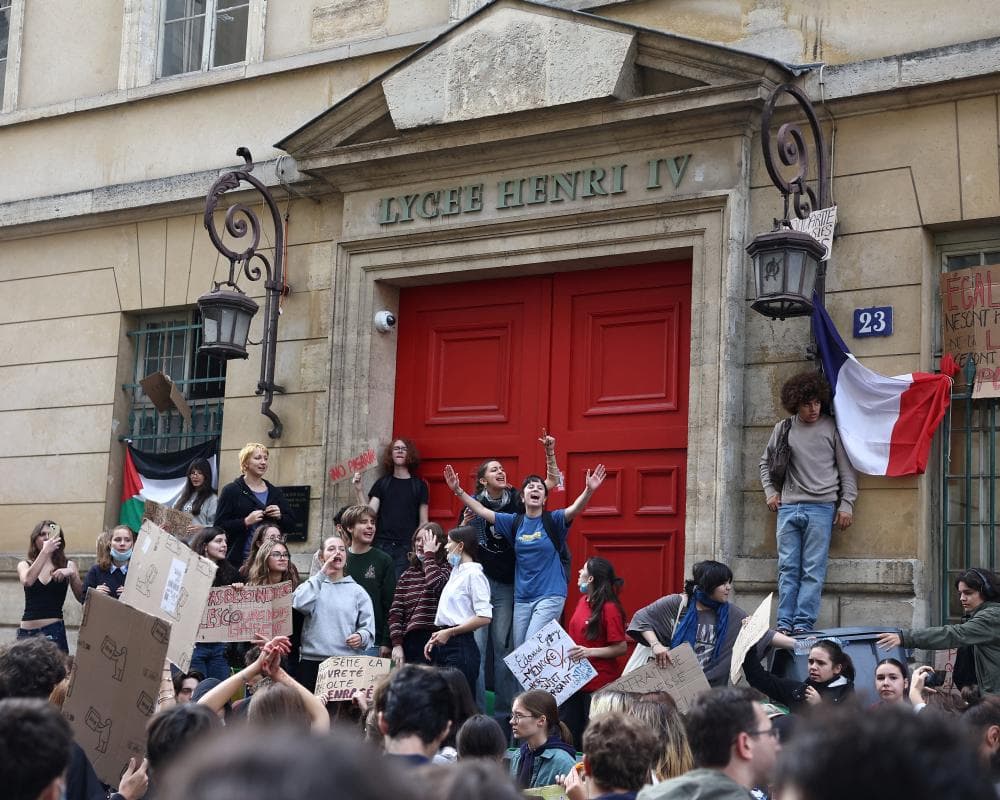
Hundreds of French high schools have been barricaded by teenagers and forced to close and hundreds of people have been injured amid clashes with police in the biggest youth protest movement in decades over the state of French lycées, where 15- to 18-year-olds are taught.
School students say the education system is riven with inequality, that many buildings are in disrepair, class sizes are too big, and there are not enough teachers or funding. The French prime minister has promised to address what he called “legitimate” complaints, including on class sizes, long hours, dilapidated buildings and teacher provisions.
So how bad are French high schools and what are the main problems?
Yes. A child born and schooled in a deprived neighbourhood in France has less chance of escaping their socioeconomic background than in most other developed nations, according to the Organisation for Economic Co-operation and Development.
Éric Charbonnier, a French education analyst at the OECD, said there was a marked gap between the performance of the most advantaged and disadvantaged school students in France. “And often disadvantaged students are in disadvantaged schools,” he said. This has raised issues of the quality of learning being delivered and higher absenteeism of teachers.
Teachers’ unions and sociologists have said children in France are often segregated by their background, postcode and income, with a direct impact on education outcomes.
Some are, namely in certain cities and low-income suburbs. Videos filmed by students and teachers have shown leaks, scurrying rats, holes in walls and ceilings, broken toilets and not enough chairs or tables, meaning teachers have to carry them from classroom to classroom. Some children said they had to learn in class while leaks were pouring into buckets, or move desks to avoid getting wet. Many school classrooms experienced temperatures over 35C (95F) in the heatwaves of last May and June.
Estimates in recent years have pointed to thousands of French schools at all levels, both primary and secondary, in need of repair. These include many 1960s school buildings. French regions are responsible for upkeep of high school buildings, but have asked for higher budgets from the government. A senate report has advised that billions need to be spent in the coming years to renovate and repair schools, as well as to address the impact of the climate crisis.
Yes, and often in urban areas. Charbonnier said: “There are an average of 29 students in French language lessons, compared with 26 across the OECD. However, this average masks substantial differences – particularly between large cities and rural areas.”
Teachers and school students in Paris and its suburbs this week described many high school classes of 36 pupils or more, but in some rural areas it can be fewer. Figures from the French education ministry show class sizes have increased in recent years.
Yes. “In terms of number of instructional hours, France really has more hours than most of the OECD countries,” Charbonnier said. This is true of primary and all levels of secondary education.
Teaching is also squeezed into shorter periods, with 36 weeks of school per year, fewer weeks than the OECD average. High school pupils at barricades have complained of regularly having school days that run from 8am to 6pm, with many gaps during the day. Teachers said this was due to timetable challenges after changes to the baccalaureate that allowed for more individual choice of subject combinations. The French government has undertaken to review the length of school days.
Yes, sometimes. The education ministry has acknowledged that about 10% of teaching hours across the year are not delivered, for various reasons, and that it is urgent to fix this.
The education union SNES-FSU estimated that at least one teacher was lacking in more than half of all public middle schools and high schools at the start of the September school year. On the barricades, protesting students said there were more absent teachers not replaced in schools in low-income areas.
In a question to parliament last year, the MP Bastien Lachaud, from the radical-left party La France Insoumise, asked if the government could confirm 2019 estimations by the parents’ organisation FCPE that school students in Seine-Saint-Denis outside Paris, one of the poorest areas in France, missed 20% of their teaching hours because absent teachers were not replaced – amounting to almost one whole year of missed schooling over a lifetime. In a response, the education ministry said it could not confirm that estimation but said an increasing number of absent teachers were being replaced.
Unions said non-teaching staff could also be lacking, including school nurses and support staff for students with a disability.
No, France actually spends more than many other countries on high schools for children aged 15 and 18, but analysts question how the French government is spending its money and for what outcomes. For example, teachers’ middle and end-career salaries are comparatively low.
Charbonnier said: “France’s expenditure on upper secondary education [lycées – or high schools] is 28% higher than the OECD average, while its spending on the first levels of education, including pre-primary and primary, is 11% below the OECD average.” He said the reason for France’s higher spend on high schools included its large provision of costly vocational programmes, which nevertheless often lack recognition even within France.