Nats boss summoned by UK transport secretary as flight chaos enters second day
Click any word to translate
Original article by Mark Sweney and Gwyn Topham
The boss of the air traffic control provider Nats has been summoned to meet the UK transport secretary as the number of flight cancellations passed 1,900 in a second day of disruption for hundreds of thousands of passengers.
Martin Rolfe, who is facing increasing pressure to resign over a third major stoppage to flights in just over three years, is due to brief Heidi Alexander on Wednesday.
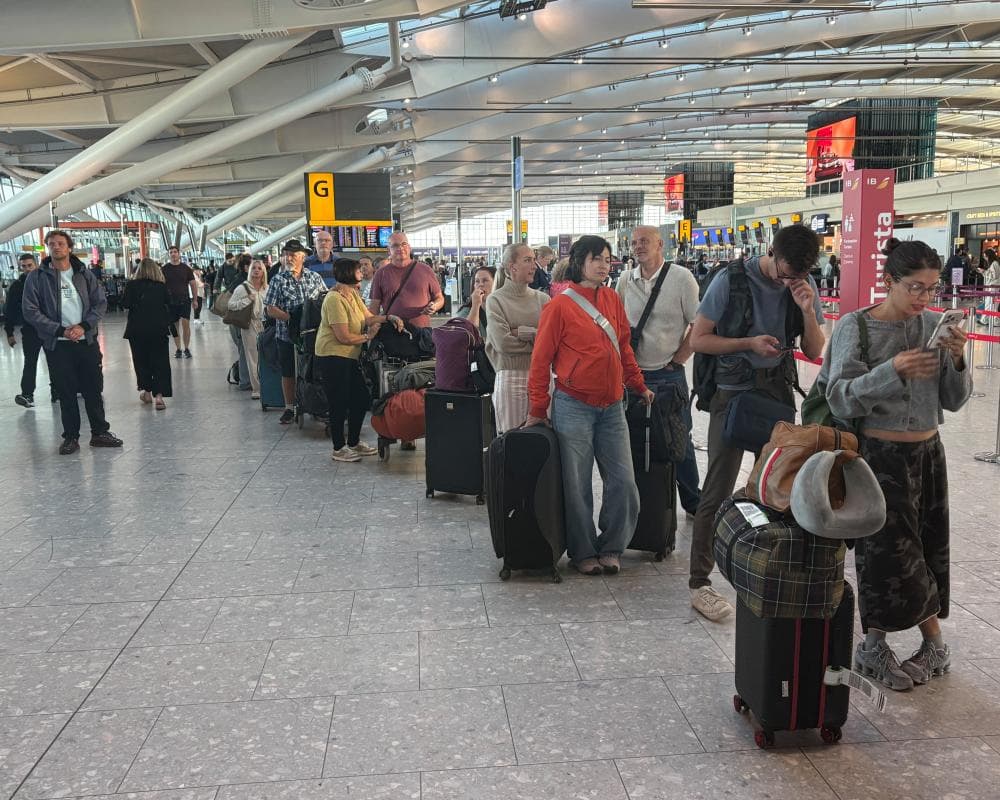
Those delayed included thousands of passengers left stuck on grounded planes for many hours as the incident unravelled, and others stranded overnight at airports abroad.
Airlines including Ryanair and Wizz called for Rolfe to resign or be sacked by Alexander.
Rolfe ruled out a cyber-attack as a cause for the “technical issue” at air traffic control and defended the resiliency of the systems run by Nats, which provides services to 15 UK airports.
“We will be doing a very thorough and full investigation,” he told BBC Radio 4’s Today programme. “We have at this point ruled out a cyber-attack.
“I don’t believe we have ever seen an incident happen more than once. This will be something we haven’t seen in more than 50 years of operation. I would say the UK has one of the best reputations in the world both from a safety perspective and resilience perspective.”
Nats said the problem occurred in its flight processing system but was not the same fault as those that caused outages and mass disruption in 2023 and 2025.
However, Ryanair queried the explanation and said lessons had not been learned. The carrier, which on Tuesday said more than 65,000 of its passengers had been disrupted when 50 flights were cancelled, said it had now cancelled more than 250 flights and its costs would run into millions.
Ryanair’s chief operations officer, Neal McMahon, said the airline had been told the issue had occurred in the flight processing system again.
“Airlines across the UK cancelled over a thousand flights, and hundreds of thousands of people were disrupted because the lessons learned for the previous failures have not been delivered by Martin Rolfe,” he told Times Radio.
McMahon added: “We’re told yesterday this was a spurious flight plan which caused the same outage and our question is like: ‘These things can happen, but where’s the backup systems?’”
The airline, Europe’s biggest carrier, had earlier urged Alexander and Nats’ board to “stop making excuses for repeated Nats failures and appoint a new leader capable of running the UK ATC system”.
Yvonne Moynihan, the managing director of Wizz Air UK, called on Rolfe to consider resigning over the repeated technical failures at Nats.
“In any industry when you’ve had three failures, you need to consider three strikes and you’re out,” she told Today.
“A third time and a third excuse is not enough any more. What we need to see from leadership is accountability. There are serious questions about the resilience of the system. I think Nats and the leadership need to look deep inside themselves.”
On Tuesday, Nats said that the fix had been a “very complex recovery and has created difficulties for the whole aviation network, from which it will take time to recover”.
According to data from the analysts Cirium, more than 1,900 flights in and out of UK airports have now been cancelled because of the failure, including 1,750 yesterday out of 5,800 scheduled flights. Of these, 541 were at Heathrow.
In a statement on social media on Wednesday morning, Heathrow said: “Following yesterday’s Nats technical issue, flights are operating today, but some disruption may continue as airlines reposition aircraft and crew.
“Please check your flight status with your airline before travelling to the airport and only travel if your flight is confirmed to be operating.”
In a statement on X, Gatwick also said flights had resumed but the disruption was likely to continue.
The breakdown started at about 1pm on Tuesday and affected departing flights at many of Britain’s biggest airports, including Heathrow, Gatwick, Manchester and Stansted.
London airports, as well as Manchester, were among the most directly affected, with operations effectively suspended for hours in the afternoon. While Heathrow said the fault initially only stopped takeoffs, the airport was soon too full to accommodate more planes, with arriving flights diverted around European airports.
Flights to and from other airports around the UK, including Birmingham, Edinburgh and Belfast, were also disrupted.
The air traffic control problems follow an “isolated event” a year ago that caused widespread disruption, and appeared less severe than the full grounding of flights in August 2023, which prompted a parliamentary inquiry.