Loading...
Please wait for a bit
Please wait for a bit
Click any word to translate
Original article by Jakub Krupa
… and on that note, it’s a wrap for today!
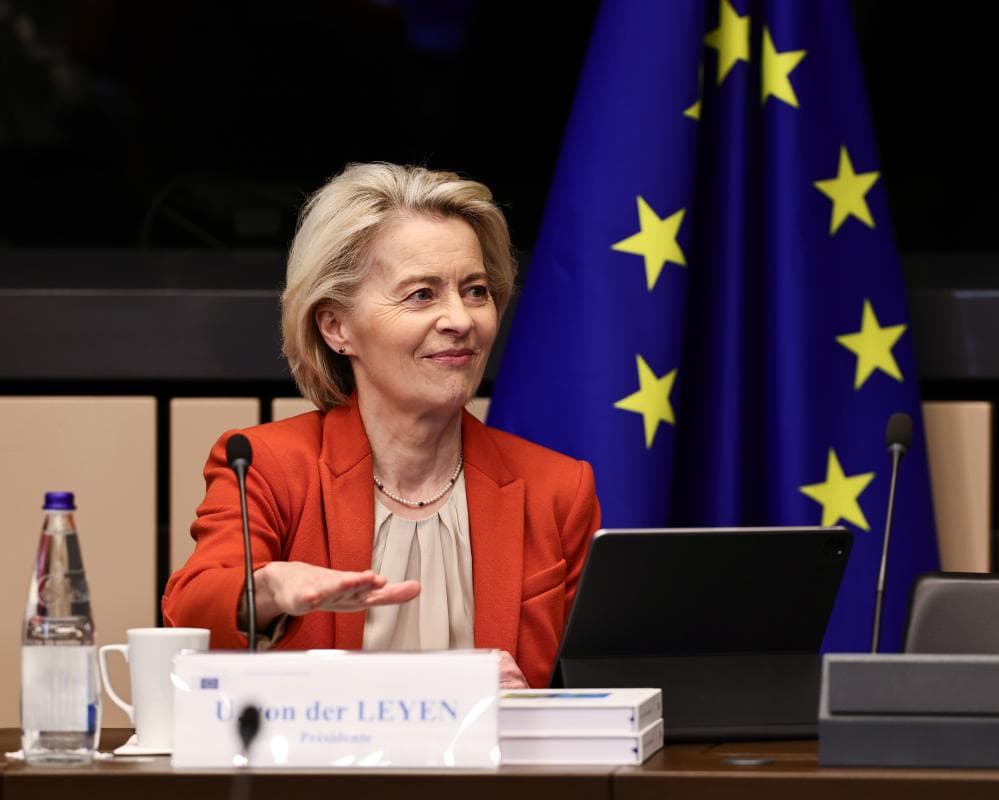
European Commission president Ursula von der Leyen has warned that the consequences of the Iran war “may echo for months or even years to come” (9:22), as the bloc’s executive rushes to shield energy-intensive industries from price hikes offering more help and relaxed state aid rules (12:29, 13:19).
Hungary’s incoming prime minister Péter Magyar is in Brussels for high-level talks with the European Union about planned reforms that could help him regain access to billions of euros in frozen EU funds (10:38, 11:20, 16:11).
His visit comes as a leading MEP has called on the Hungarian European commissioner associated with the outgoing prime minister Viktor Orbán to resign, after the European parliament found “serious and prolonged management” failures in the department he ran (16:27).
And in less grim news,
French president Emmanuel Macron joined some diplomatic jokes with Britain’s King Charles and the US president, Donald Trump, responding to Charles’s speech at a state dinner in Washington last night (14:13).
If you have any tips, comments or suggestions, email me at jakub.krupa@theguardian.com.
I am also on Bluesky at @jakubkrupa.bsky.social and on X at @jakubkrupa.
in Brussels
In other Hungarian news from Brussels, a leading MEP has called on the country’s European commissioner to resign, after a European parliament found “serious and prolonged management” failures in the department he ran.
Olivér Várhelyi has been Hungary’s EU commissioner since 2019, after being appointed by outgoing prime minister Viktor Orbán.
It has been a controversial tenure marked by accusations that he ran EU enlargement policy, his role 2019-24, according to Hungarian government interests, downplaying concerns about democracy and the rule of law in candidate countries.
He has also been caught up in espionage allegations that relate to his time as Hungary’s top EU diplomat in Brussels, which he denies.
Now the European parliament has censored him during a vote on the routine sign-off of the EU budget. In a resolution adopted with 418 votes in favour, 207 against and 14 abstentions, the parliament said:
“Taken together, the past serious and prolonged management failures in DG NEAR [the enlargement department], the provision of inaccurate information to Parliament in the context of the discharge procedure and the additional concerns relating to the conduct and independence … demonstrate a pattern that is incompatible with the standards of accountability, reliability and sound administration required of a member of the commission.”
The MEP leading the parliament’s work on the budget signoff procedure, Green MEP Daniel Freund, went further and called on Várhelyi to resign.
“Such management failures raise serious questions. Add to that espionage allegations, and my conclusion is clear: Várhelyi must resign.”
Várhelyi has been contacted for comment via the European Commission.
It’s an interesting moment for this bruising indictment to land, just as prime minister elect Péter Magyar arrives in Brussels for highly anticipated meetings with EU leaders.
Magyar has already called on other Orbán appointees to resign.
In terms of any media comments, we only heard Magyar wishing photographers “have a nice day.”
I will reluctantly admit that this is not the most exciting update ever.
Hungary’s incoming prime minister Péter Magyar is now at the European Commission’s Berlaymont building.
But it looks like this official welcome – Magyar shaking hands with the commission’s president, Ursula von der Leyen – is all we are going to see today.
Updated
Meanwhile over in Bulgaria, the country’s police have charged three people and are seeking a fourth after an ongoing investigation into drug trafficking and money laundering uncovered a cannabis farm built inside a, erm, former zinc mine, Reuters reported.
So far, about 70 kilograms of drugs, €600,000 in cash and 600 rounds of ammunition have been seized, said Emil Borisov, deputy director of the General Directorate for Combating Organised Crime.
“The former mine was equipped with high-tech infrastructure and was likely used for large-scale production intended for trafficking abroad,” Borisov said. The mine is located near the village of Garlyano, at the bottom of the Osogovo mountain, a few kilometers from the border with North Macedonia.
Authorities said the ongoing investigation could take months, adding that the mine’s ownership and the full scope of the operation were being examined, Reuters said.
Ireland correspondent
What goes up must come down – unless it’s a Palestinian flag at the top of Dublin’s tallest landmark that no one knows how to remove.
The flag appeared on the 120-metre Spire on O’Connell Street last September and for seven months it has defied every proposed measure to take it down. Who installed it and how remains a mystery.
City authorities have considered options such as climbing ropes, “bespoke ladders” and a 300-tonne crane and rejected them as too dangerous, expensive or futile.
“Someone could just come along again and drop another flag on the Spire,” an engineer told Dublin city council, according to internal correspondence reported in the Irish Times this week.
“We have probably taken the options for accessing the Spire from the ground up as far as we can at this stage.”
A brisk wind on Wednesday fluttered the small, green, red and black of Palestine high above traffic and pedestrians. Media interviews suggest many people are oblivious to it, as it often gets tangled and is difficult to see, but approve once notified of its presence.
Ireland is one of the EU’s most outspoken critics of Israeli action in Gaza and the West Bank.
Since we’re talking about France…
The country’s consumer protection authority said that three-quarters of the products it tested from major e-commerce platforms last year failed to meet EU standards, Reuters reported.
The Directorate General for Competition, Consumer Affairs and Fraud Control (DGCCRF) said it had analysed more than 600 products bought from seven foreign online platforms in 2025, triple the number tested in previous years. It found 75% failed to meet EU rules, and 46% were both non-compliant and dangerous.
Reuters noted that France has been leading a Europe-wide crackdown on discount e-commerce platforms like Shein and Temu, which retailers say have enjoyed an unfair advantage due to a customs duty waiver on the low-value parcels of clothes and gadgets they ship directly from factories in China.
The French watchdog said it would share the findings with the European Commission, which has powers under the EU’s Digital Services Act to impose fines of up to 6% of global turnover on platforms, and has opened investigations into Shein, PDD-owned Temu, and Alibaba-owned AliExpress.
Oh, there’s a bit of a diplomatic banter going on involving Britain’s King Charles, US president Donald Trump and … Andorra’s co-prince French president Emmanuel Macron.
During his speech at the White House state dinner in Washington last night, Charles joked that:
“You recently commented, Mr President, that if it were not for the United States, European countries would be speaking German. Dare I say that, if it wasn’t for us, you’d be speaking French …!”
Macron has now picked up on the joke, clipping it for his social media (I mean, not by himself, surely), and responding on X:
“That would be chic!”
Updated
Meanwhile, net profits at French fuel company, TotalEnergies, have jumped 51% in the first three months of the year to $5.8bn (£4.3bn) boosted by the oil price hikes in the wake of the Iran war, drawing criticism from climate groups.
Growth in its oil and gas production in Brazil, Libya and Australia allowed the group to offset losses in the Gulf region, which is normally equivalent to 15% of its total oil and gas business, the company said in a statement, while also highlighting its “ability to capitalise on rising prices”.
The profits statement comes as the EU introduces emergency measures to compensate businesses for up to 70% of the extra cost of fuel and fertiliser caused by the US and Israel’s war on Iran.
“TotalEnergies’ war profits highlight our persistent dependence on fossil fuels, whose soaring prices once again benefit shareholders at the expense of consumers,” reacted Antoine Bouhey, campaign coordinator at Reclaim Finance.
Meanwhile, Greenpeace France denounced a “cynical logic” while “households pay the high price at the pump.”
Soaring gas prices have revived a political debate in Europe on taxing windfall profits made on high oil prices, an idea to which French prime minister Sébastien Lecornu said in early April that he had “no objection in principle”.
Let’s go back to Lisa O’Carroll for more on the EU’s intervention today (12:29)…
Individual member states can design the state aid they offer businesses according to local conditions, but small hauliers, farmers and fishers will be able to claim the fixed amount of up to €50,000 with minimal fuss.
They will not, for example, need to provide receipts for fuel at petrol pumps.
Although this risks fraud, the EU believes the problems facing small and medium-sized businesses after the sharp rise in costs since the US and Israel launched their war on Iran mean a light-touch approach is necessary.
The €50,000 available to small businesses will be based on aggregates of extra fuel costs between March and the end of the year.
Slovakia’s supreme court upheld the ruling of a lower court that sentenced him to 21 years in prison for attempting to assassinate country’s populist prime minister Robert Fico almost two years ago, AP reported.
Juraj Cintula, 73, opened fire on Fico on 15 May 2024, as the prime minister greeted supporters following a government meeting in the town of Handlová, about 140 kilometers (85 miles) northeast of the capital of Bratislava.
Cintula was arrested immediately after the attack and remanded in custody. He was convicted of as terrorist attack and sentenced in October.
He claimed his motive for the shooting was that he disagreed with government policies but rejected the accusation of being a “terrorist.”
Following his appeal, today’s ruling is final, AP said. Cintula will be able ask for an early release after 16 years, Slovak media reported.
The EU is to subsidise up to 70% of the extra cost of fuel caused by the Iran war for farmers, fishers and road hauliers as part of a package of emergency measures unveiled today.
The measures come days after the EU announced rules addressing household fuel consumption and involve temporary relaxation of state aid rules because they apply to companies, not individuals.
Individual companies can claim up to €50,000 each between now and the end of the year with minimum paperwork a measure the EU hopes will remove what they see as an existential threat to hauliers and farmers.
Energy intensive industries will be able to claim up to 70% of the extra electricity cost of the eligible consumption.
European Commission vice-president Teresa Ribera said the temporary measures, which will apply until 31 December, were targeted “at those that are directly and most heavily affected” including hauliers, farmers fishers, railway networks, intra-EU shipping companies.
Meanwhile, Germany will impose a levy on sugary drinks from 2028, as part of a broad healthcare reform package approved by the government today, aiming to tackle rising rates of obesity and ease pressure on the health system, Reuters reported.
An expected annual revenue of about €450m is to flow into the statutory health insurance system to fund prevention programmes, including workplace health promotion and community initiatives that benefit the wider population.
Details of the levy, including the rate or the design, are still under discussion. The sugary drinks levy proposal follows mounting public and cross-party support for stricter measures against excessive sugar consumption and related illnesses.
A Forsa survey published in February showed around 60% of Germans support a levy on sugary soft drinks.
Reuters said that more than 100 countries, including about half of EU member states, tax sugary drinks, according to the World Health Organization. Studies in Britain and Mexico have shown such measures can cut sugar intake and help prevent diseases like diabetes.
AFP is reporting that so far, officials in Brussels are hopeful that Péter Magyar – who once served under Viktor Orbán, before turning on his former boss – will genuinely launch a new chapter in ties.
But wary of celebrating too soon, they insist they need to see concrete moves and not just kind words.
“So far, wait and see,” one EU diplomat said, on condition of anonymity, summing up the attitude toward Magyar. “But that might change, considering all the good things he says and does.”
We reported more on the behind-the-scenes discussions that are aimed at helping Hungary access the frozen funds earlier this month:
Updated
Hungary’s incoming prime minister Péter Magyar has just posted a social media update that he is on his way to Brussels for his talks with the European Commission president, Ursula von der Leyen, and the European Council president, António Costa.
“A huge mandate, a strong mandate, a great responsibility!
We know our task: we will bring home the EU funds that Hungarians are entitled to. More soon.”
Updated
in Brussels
The tech company Meta has been found to be in breach of EU law for failing to prevent children under 13 from using its Facebook and Instagram platforms.
Issuing the preliminary findings of a nearly two-year investigation, the European Commission said on Wednesday that Meta did not have effective measures in place to stop under-13s accessing its services.
The US tech company was unable to meet its own terms and conditions that set 13 as the minimum age to access Facebook and Instagram safely, the commission said.
Following an initial assessment, Meta was found in breach of the EU’s Digital Services Act (DSA), which requires it to “diligently identify and mitigate the risks” of under-13s using its platforms.
The commission said its preliminary findings “do not prejudge the final outcome of the investigation”.
A Meta spokesperson said the company disagreed with the preliminary findings.
“We’re clear that Instagram and Facebook are intended for people aged 13 and older and we have measures in place to detect and remove accounts from anyone under that age. We continue to invest in technologies to find and remove underage users and will have more to share next week about additional measures rolling out soon.”
In somewhat lighter news, we know that many of you have been following the saga of Timmy the whale and the audacious attempt to rescue him from Germany and send him back to the Atlantic Ocean. Our Kate Connolly reported on this in detail.
Timmy is now properly under way towards the Atlantic, travelling at steady 4.5kn (8.5 km/h). The plan is to take him around the northern end of Denmark and then release into the wild again – but it will take a few days to get there.
You can follow his journey aboard a custom-made whale barge – essentially a giant steel aquarium – pulled by Fortuna B ship here.
Updated
In von der Leyen’s speech earlier, there was one other notable passage.
When talking about Russia, she warned that as the Russian economy is increasingly struggling with the impact of sanctions, “the Kremlin responds in an unusual way by restricting the internet and free communication.”
“So much so that Russians feel that they live behind an iron curtain again; this time a digital iron curtain. But, hon members, if history has one lesson, it’s that all walls eventually fall.”
A Kazakh man was arrested in Germany for alleged espionage for Russia, which allegedly included passing on details on Germany’s military infrastructure and its support for Ukraine to Moscow.
The Federal Prosecutor’s Office said the man, identified only as Sergei K, was particularly interested in the German arms and defence industry, including companies developing drones and robots, and offered hints as to “suitable targets for sabotage in Germany,” offering to recruit accomplices to help him carry them out.
He will appear in court later today.
Von der Leyen says that “every member state has a different energy mix,” so no blanket EU solution would work.
But she calls for more coordination not just on common procurement, but also on fuel reserves, “especially jet fuel and diesel, where markets are tightening.”
She adds that the EU needs to “protect consumers and businesses,” but targeting “the most vulnerable households and industries only.”
Von der Leyen says that previously too much money was spent on “untargeted” interventions, and this needs to change.
She says the EU needs to “reduce energy demand by modernising systemic energy use,” with grid reforms,
“ Let us use this to make the switch to electricity – not just in transport, but also in industry and heating. This is not only a matter of affordability and competitiveness; this is also a matter of economic security. Thus, speaking of European independence, this is the moment to electrify Europe.”
On the Middle East, von der Leyen says that the EU “want the ceasefires in Iran and Lebanon to hold,” with urgent need to “re-establish peace and stability through diplomatic means.”
But she warns that “the consequences of this conflict may echo for months or even years to come.”
“This is the second energy crisis within four years, and the lesson should be very clear. Our overdependency on imported fossil fuels makes us vulnerable. … We must reduce our overdependency on imported fossil fuels and boost our home-grown, affordable, clean energy supply. From renewables to nuclear, in full respect of technology neutrality.”
Commission president von der Leyen is speaking now and begins with an update on the €90bn loan for Ukraine.
She says the EU always insisted it would deliver the loan “one way or the other,” and it’s now done as Hungary has dropped its veto.
The first tranche of €45bn will be paid out “this quarter,” she says.
“Our message is clear: we will continue our support to the brave Ukrainian people and their armed forces.”
She also repeats that “while Russia doubles down on its aggression, Europe doubles down on our support to Ukraine.”
European Commission president Ursula von der Leyen is set to brief EU lawmakers on the bloc’s view of the Iran war and the likely impact on the European economies.
Her assessment will probably strike a tricky balance as she wants to reassure them that everything is in hand, while making it also clear that things may get tricky further down the line.
Only last week, the commission talked about a number of measures it had at its disposal to soften the blow, and sought to assure Europeans that their holidays are not (yet) at risk.
I will bring you all the key lines from her speech here.
Later today, von der Leyen will welcome Hungary’s incoming prime minister Péter Magyar as he continues his bid to get a political agreement with the EU on accelerated reforms in key areas in exchange for unfreezing billions of euros in EU funds.
Magyar, who will only formally take the job on 9 May, is a man in hurry as the future of some €10bn of EU funds need to be decided before August. It’s going to be a busy summer in Budapest. If you’re a Tisza MP, I wouldn’t book your holidays.
It’s Wednesday, 29 April 2026, it’s Jakub Krupa here, and this is Europe Live.
Good morning.