Loading...
Please wait for a bit
Please wait for a bit
Click any word to translate
Original article by Yohannes Lowe (now); Vivian Ho and Vicky Graham (earlier)
At least 39 people have been killed and 12 others are in intensive care after two trains collided in southern Spain yesterday evening.
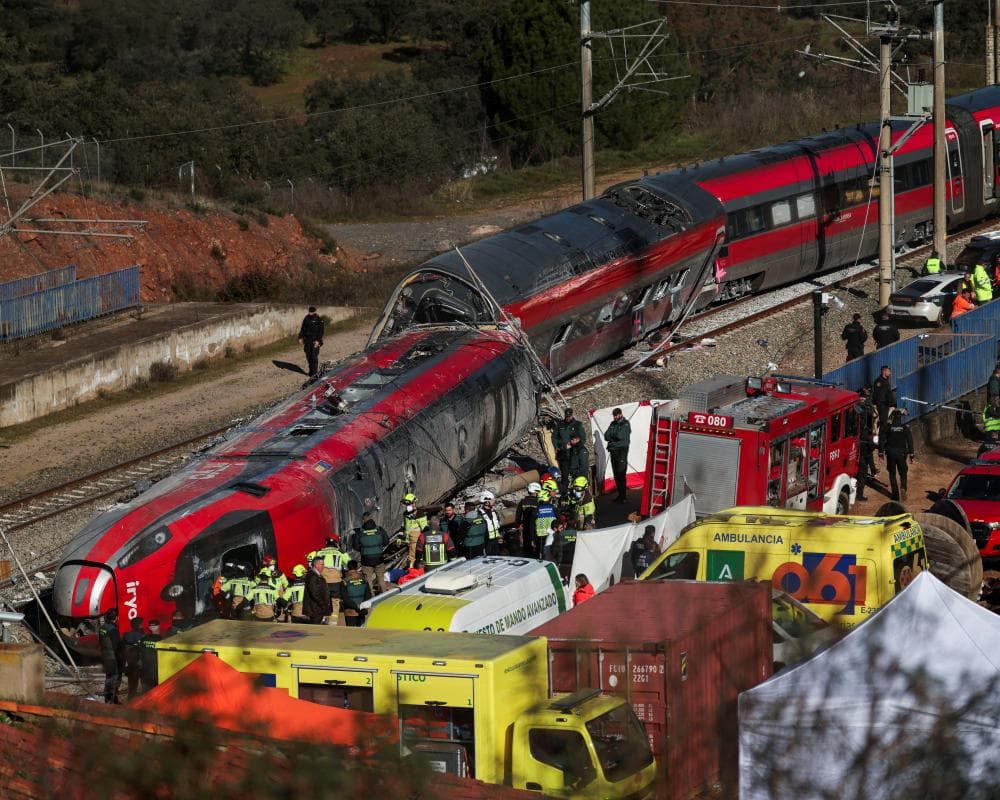
A high-speed Iryo train travelling from Málaga to Madrid derailed near the municipality of Adamuz in Córdoba province at about 7.40pm yesterday, crossing on to the other track where it hit an oncoming train, which was travelling south from Madrid to Huelva.
The impact of the crash pushed the carriages of the second train into an embankment, the Spanish transport minister, Óscar Puente, said, adding that most of those killed and injured had been in the first two carriages of the second train.
The first train to derail was “practically new”, making the accident “extremely strange”, Puente said.
Officials said 122 people were treated for injuries, with 48 still in hospital.
Experts probing the cause of the crash found a broken joint on the rails, a source told the Reuters news agency, which also reported that Spain’s train drivers union had written a letter to state-owned rail infrastructure administrator ADIF last August warning about the railway track where the two trains collided.
An investigation has been launched into the crash but it is not expected to determine the causes for at least a month.
Spanish prime minister, Pedro Sánchez, declared three days of mourning starting from midnight tonight and called for Spaniards to unite in grief.
Sunday’s crash was the deadliest train accident since 2013, when a train travelling at 111mph (179km/h) derailed on a stretch of track with a 50mph speed limit in the north-western region of Galicia, killing 80 people.
We are closing this blog now. Thanks for following along. You can read more of the latest developments in regards to the deadly train collision in this story.
The Madrid-Andalucía high-speed line, which was involved in Sunday’s deadly collision, will be closed until at least Friday, according to reports.
Experts inspecting the site of the high-speed train crash that killed at least 39 people in Adamuz have identified a broken joint on the track, the Reuters news agency is reporting, citing a source with knowledge of the matter.
Technicians on site analysing the rails identified some wear on the joint between sections of the rail, which they said showed the fault had been there for some time, the source told Reuters.
They found that the faulty joint created a gap between the rail sections that widened as trains continued to travel on the track.
The source said the technicians believe the faulty joint is key to identifying the cause of the accident, which has not officially been determined yet, although Alvaro Fernandez Heredia, the president of Spain’s state-owned rail operator, Renfe, said earlier that “human error is practically ruled out” as the cause.
Spain’s Commission of Investigation of Rail Accidents is investigating into the causes of the crash but did not respond to Reuters’ requests for comment. We have not been able to independently verify the information in the report yet.
Updated
The Vatican has issued a statement saying that Pope Leo XIV expressed his condolences for those killed in the crash, added that he hopes for the quick recovery of the injured.
Sánchez has vowed that a “thorough and absolutely transparent” investigation into the crash will take place.
“I can guarantee the victims that we will be protecting them and assisting them for as long as necessary,” he told journalists.
Updated
The Spanish prime minister, Pedro Sánchez, on Monday declared three days of mourning over the high-speed train collision that killed at least 39 and hospitalised dozens more, AFP reports.
Sánchez also vowed to launch a full investigation into the cause of the collision.
“We will uncover the answer, and once the cause of this tragedy is determined, we will present it with absolute transparency,” he told reporters in the town of Adamuz, near where the disaster occurred.
Updated
The condition of the railway tracks where the two trains collided had caused a crew member to suffer an injury in July, El Mundo reports.
According to a report obtained by the newspaper, the condition of the tracks had caused enough rattling and shaking that a piece of equipment fell on the head of a crew member.
Rafael Escudero, the general secretary of the Spanish railway union, told El Mundo that the rattling and shaking happens because the tracks cannot absorb the weight and force of the trains. Escudero said they have often received complaints about the jolting.
The state-owned rail infrastructure administrator ADIF told El Mundo that it had recorded almost a dozen incidents on this particular section of railway in Adamuz.
Spain’s prime minister, Pedro Sánchez, is speaking near the site of the crash in the municipality of Adamuz in Córdoba province.
Stay tuned for an update on his remarks.
🔴 EN DIRECTO
— La Moncloa (@desdelamoncloa) January 19, 2026
Declaraciones del presidente del Gobierno, @sanchezcastejon, desde Adamuz, Córdoba. https://t.co/QCTDPMN1sX
Spain’s train drivers union had written a letter to state-owned rail infrastructure administrator ADIF last August warning about the railway track where the two trains collided, Reuters reports.
According to a copy of the letter seen by Reuters, the train drivers union SEMAF said that along that stretch of track, potholes and imbalances in overhead power lines were causing frequent breakdowns and damaging the trains.
ADIF did not immediately respond to a request for comment from Reuters.
Alvaro Fernandez Heredia, the president of Spain’s state-owned rail operator, Renfe, told Spanish public radio RNE that human error has “been practically ruled out”.
“It must be related to Iryo’s rolling stock or an infrastructure issue,” he added. Renfe is the operator of the second train travelling to the southern city of Huelva from Madrid.
An investigation has been launched into the crash but it is not expected to determine the causes for at least a month.
In a social media post about an hour ago, the Spanish transport minister, Óscar Puente, said the causes of the crash remain unknown. He said:
After more than 3 hours on the ground, we have been able to confirm the severity of what happened and the terrible consequences. But we do not know, nor does anyone know at this moment, the causes.
It will be the CIAF (Spain’s Railway Accident Investigation Committee) that determines them, so caution with hasty analyses based on mere speculation. Thanks to all the administrations for their collaboration and sensitivity.
Updated
Greece’s foreign ministry, meanwhile, has expressed its condolences in a message of support for Spain.
In a statement on X, it said:
We express our deepest condolences to the families of the victims. Our thoughts are with the injured and all those affected by this tragedy. At this moment of grief, Greece stands in solidarity with the people and the government of Spain.
Sunday’s crash is not without echoes in Greece where questions are still being asked, almost three years later, as to how a northbound passenger train could collide head-on with a freight train, leaving 57 dead. The 28 February crash was the worst rail disaster ever recorded in Greece.
More on Spanish monarch King Felipe who is in Athens, with his Greek-born mother, Sophia, to attend the funeral of her sister Irene (see post at 10.21).
The train crash has lent a particularly sombre tone to the funeral of Irene, whose body was brought back from Madrid where she had lived with her older and much beloved sister, Sophia, for years.
The entire Spanish royal family has flown in for the funeral of a woman who kept out of the spotlight but has been described as a quiet force who was also one of the most unconventional and interesting royal figures of modern times – she once flew a plane of cows to India as an act of charity.
Irene’s body had laid in state in Madrid before being flown to Athens where well-wishers paid their respects before a casket draped with the Greek flag in a chapel next to the cathedral where the funeral service is underway.
The Greek royal family was dethroned by popular vote in 1974 when democracy was restored and Greece became a republic. King Felipe had addressed the train crash as he arrived with his with family at the cathedral.
Updated
We have another update from Spain’s Guardia Civil, a military-style law enforcement agency, which said in a post on X that over 220 civil guard officers were involved in rescue operations at the crash site, including those in the air service.
The central forensic team is working on identifying victims, the Spanish law enforcement agency added.
In comments to Spanish news broadcaster, La Sexta, Juanma Moreno said:
These kinds of accidents are surprising. The crash was very, very serious. A train carries society – grandparents, children, pregnant women … It’s a catastrophe.
Andalucía regional president Juanma Moreno spoke to journalists this morning. Here is some of what he has said:
It is likely (that there will be more dead people found) when you look at the mass of metal that is there. The firefighters have done a great job, but unfortunately when they get the heavy machinery to lift the carriages it is probable we will find more victims …
Here at ground zero, when you look at this mass of twisted iron, you see the violence of the impact …
The impact was so incredibly violent that we have found bodies hundreds of meters away, which means that people were thrown through the windows.
Updated
Messages of condolences over the tragic train collision in southern Spain have poured in from numerous European leaders.
French President Emmanuel Macron said:
A railway tragedy strikes Andalusia. My thoughts are with the victims, their families and the entire Spanish people. France stands by your side.
Italy’s prime minister, Giorgia Meloni, said: “Italy stands close to Spain in its grief for this tragedy.”
The Dutch prime minister, Dick Schoof, said:
Horrific news from Spain, where a train accident has claimed dozens of lives. I have expressed my support and condolences to prime minister Sanchez. My thoughts are with all the victims and their families affected by this enormous disaster.
German Chancellor Friedrich Merz said:
The news of the tragic train accident in Adamuz has deeply shaken me. My thoughts are with the families and loved ones of the victims. I offer them my sincere condolences. To the injured, I wish strength and a speedy recovery. Germany stands with Spain at this time.
Updated
Spain’s Civil Guard has said in a post on X that it has set up several offices so that the families of those affected by the crash in Adamuz “can file reports and provide DNA samples for identification purposes”.
There were about 400 passengers on the two trains, operated by Iryo and Alvia, according to an earlier statement from state-owned rail operator Renfe.
Emergency workers said the twisted wreckage of the trains has made it hard to recover those trapped inside the carriages.
As we have mentioned in the blog already, officials have said at least 39 people were killed in the crash but this figure is expected to rise as rescue work continues throughout the day.
On Monday morning, emergency services in Andalucía said 122 people had been treated for their injuries and 48 people were still in hospital, of whom 12 were in intensive care units.
Updated
King Felipe of Spain has expressed his “concern about the terrible accident” in which at least 39 people have been killed.
Speaking from Greece, the monarch was quoted as having told the media:
We have been in contact with Sánchez and Juanma Moreno to learn the details. As soon as we finish, we will return as soon as possible. I understand the anguish of the families of the victims and the injured.
We know that many residents of Adamuz assisted the victims immediately, and we express our gratitude to them for that.
Here are some of the latest images being sent to us over the newswires as rescue efforts continue in the aftermath of the deadly train collision in southern Spain:
Updated
The municipal sports centre of Adamuz, in Córdoba, has been turned into an improvised field hospital, where the most minor injuries are reported to have been treated.
Here is a recap of what we know so far about the deadly train collision:
At least 39 people have been killed and 12 others are in intensive care after two trains collided in southern Spain on Sunday evening.
A high-speed Iryo train travelling from Málaga to Madrid derailed near the municipality of Adamuz in Córdoba province at about 7.40pm yesterday, crossing on to the other track where it hit an oncoming train, which was travelling south from Madrid to Huelva.
The impact of the crash pushed the carriages of the second train into an embankment, the Spanish transport minister, Óscar Puente, said, adding that most of those killed and injured had been in the first two carriages of the second train.
The first train to derail was “practically new”, making the accident “extremely strange”, Puente said.
The cause of the derailment has not yet been determined. Spain’s Railway Accident Investigation Commission is investigating the crash.
Rescue efforts to recover all the victims from the derailed carriages are continuing this morning with the death toll expected to increase.
On Monday morning, emergency services in Andalucía said 122 people had been treated for their injuries and 48 people were still in hospital, of whom 12 were in intensive care units.
Train services between Madrid and cities in Andalucía were cancelled on Monday.
Sunday’s crash was the deadliest train accident since 2013, when a train travelling at 111mph (179km/h) derailed on a stretch of track with a 50mph speed limit in the north-western region of Galicia, killing 80 people.
Updated
The European commissioner for equality, preparedness and crisis management, Hadja Lahbib, has said the commission’s emergency centre is in contact with Spanish authorities regarding the fatal train crash and is “ready to help with support” if requested.
Iryo, a private rail company that operated the journey from Málaga, has issued a statement on social media saying it “deeply regrets” what it describes as a “serious railway accident” yesterday.
At the start of the journey to Madrid last night, the company said there were these many people onboard:
289 passengers
4 crew members
1 driver
The statement added:
As indicated by the ministry of transport, this was an accident that occurred on a section of the line, and the train involved was newly built, manufactured in 2022, with the last inspection carried out on 15 January.
Iryo said its CEO, Fabrizio Favara, travelled to the site of the crash yesterday and is closely monitoring the situation. The company’s chair, Carlos Bertomeu, is travelling to the site too, it said.
Iryo said the “entire company” sends its condolences to the families of those who died and expresses its solidarity to those who were injured, wishing them a “speedy recovery”.
Updated
Sam Jones is Madrid correspondent for the Guardian
Spain’s transport minister, Óscar Puente, said the cause of the accident had yet to be established. Speaking at a press conference at Atocha station in Madrid, he added it was “really strange” that a derailment should have happened on a straight stretch of track. This section of track was renewed in May, he said.
Puente said most of those killed and injured had been in the first two carriages of the second train …
A journalist from the public broadcaster RNE, who was travelling on one of the trains, said the impact had felt like an earthquake. Passengers had used emergency hammers to break carriages windows and get out, he said.
A woman named Carmen posted on X that she had been onboard the Málaga to Madrid train. “Ten minutes after departing [from Córdoba], the train started to shake a lot, and it derailed from coach six behind us. The lights went out.”
You can read the full story here:
The Spanish prime minister, Pedro Sánchez, will visit the crash site later today.
Earlier, he wrote on X:
Tonight is a night of deep pain for our country due to the tragic railway accident in Adamuz. I want to express my most sincere condolences to the families and loved ones of the victims.
No words can alleviate such immense suffering, but I want them to know that the entire country stands with them in this extremely difficult moment. All emergency services are working in a coordinated manner without rest.
Updated
The death toll from the high-speed train crash in southern Spain is not final, the transport minister Oscar Puente said Monday, indicating it could rise from the current figure of 39.
“The death toll has already reached 39 and is not definitive. I want to express my deepest gratitude for the tremendous work of the rescue teams throughout the night, under very difficult circumstances,” he wrote on X.
Spanish police said Monday that at least 39 people died in the high-speed train collision Sunday in southern Spain and rescue efforts were continuing.
The collision occurred when the tail end of a high-speed Iryo train travelling between Málaga and Madrid with about 300 passengers went off the rails near the municipality of Adamuz in Córdoba province at 7:45pm local time (6.45pm GMT).
It slammed into a train coming from Madrid to Huelva operated by the state rail company, Renfe. This also derailed and went down an embankment, authorities said. It is not clear how many were on board.
Rescue efforts were still underway Monday morning. Andalusia regional President Juanma Moreno said 75 passengers had been taken to hospital.
Updated