Zelenskyy meets European leaders in London for talks on ending Ukraine war
Click any word to translate
Original article by Peter Beaumont
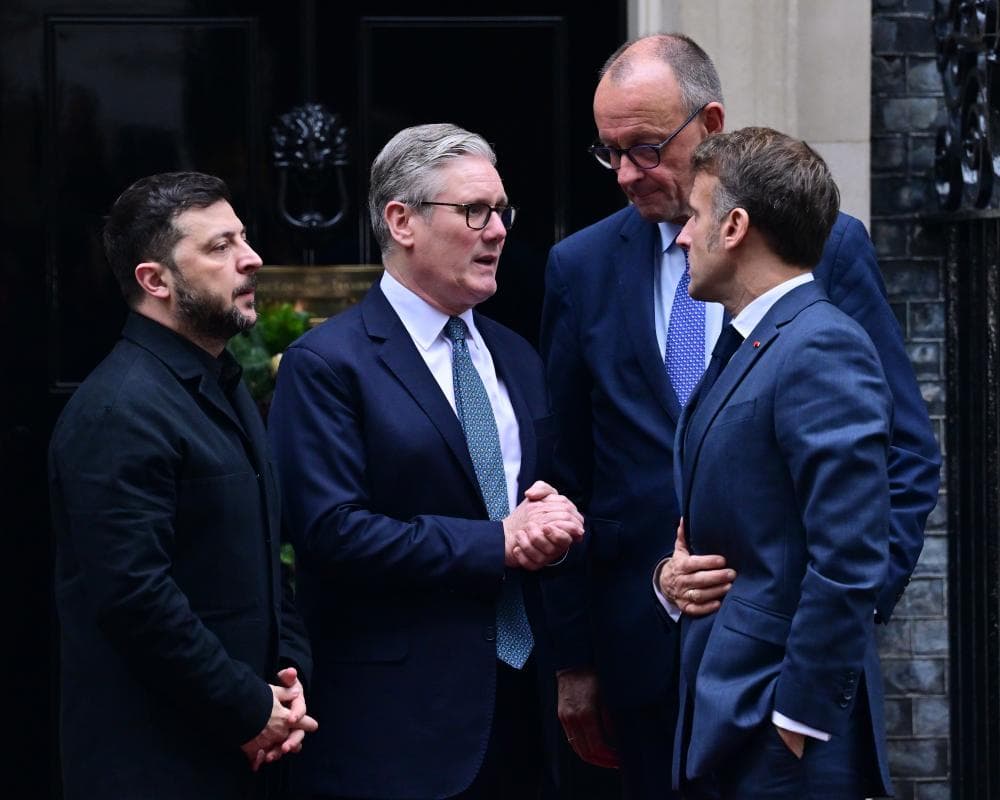
Volodymyr Zelenskyy has met the leaders of the UK, France and Germany in London amid heavy pressure from the Trump administration for Ukraine to cede territory it holds to bring the war to an end quickly.
The talks on Monday followed several days of negotiations between US and Ukrainian officials, which ended on Saturday without an apparent breakthrough and were characterised by the Ukrainian president as “constructive, although not easy”.
The UK prime minister, Keir Starmer, held a bilateral meeting with Zelenskyy in Downing Street, after the two men earlier met with the French president, Emmanuel Macron, and the German chancellor, Friedrich Merz.
For its part, the Élysée Palace, echoing Starmer, said France planned more work to provide Ukraine with robust security guarantees, a key concern for Kyiv.
The meeting took place as European leaders scrambled to show solidarity with Ukraine as the White House’s efforts to push through a peace deal enter a key phase. Starmer insisted that he “won’t be putting pressure” on Zelenskyy to accept a peace settlement, while Merz expressed “scepticism” over the US proposal.
After the Downing Street meeting, Zelenskyy was due to meet senior Nato officials and the European Commission president, Ursula von der Leyen, in Brussels.
Earlier, an official in Kyiv familiar with the talks told AFP that territory remained the most problematic issue. “[Vladimir] Putin does not want to enter into an agreement without territory. So they are looking for any options to ensure that Ukraine cedes territory,” the official, speaking on condition of anonymity, said.
“The Americans are pressuring, like ‘faster, faster, faster,’” the source added, saying that Ukraine “cannot agree to everything without working out the details”.
The latest contacts follow widespread concern over the Trump administration’s framework for a peace proposal, seen by many critics as favouring positions held by Russia.
Trump doubled down on that position on Sunday night, suggesting Zelenskyy “hasn’t yet read the [US] proposal” and claiming without evidence that “his people love it”.
“And I have to say I’m a little bit disappointed that President Zelenskyy hasn’t yet read the proposal. That was as of a few hours ago.”
“Russia, I guess, would rather have the whole country, when you think of it, but Russia is, I believe, fine with it,” Trump said before taking part in the Kennedy Center Honors in Washington.
Starmer, Macron and Merz took a more supportive stance toward Kyiv in comments before their Monday meeting, which lasted about two hours. Starmer said the push for peace was at a “critical stage” and stressed the need for “a just and lasting ceasefire”.
Merz, meanwhile, said he was “sceptical” about some details in documents released by the US. “We have to talk about it. That’s why we are here,” he said. “The coming days … could be a decisive time for all of us.”
Trump’s claim that his plan enjoys Ukrainian public support is contradicted by recent polling by the Kyiv International Institute of Sociology, which suggests a majority of Ukrainians remain opposed to territorial concessions.
Kyiv’s senior negotiator, Rustem Umerov, said Zelenskyy would be briefed about his team’s dialogue with US officials and receive all documents related to the peace plan on Monday.
Off the back of the Trump-backed Gaza ceasefire, the US has been working to push through a peace deal between Kyiv and Moscow.
US officials claim they are in the final stage of reaching an agreement but there is little sign that either Ukraine or Russia is willing to sign the framework deal drawn up by Trump’s negotiating team.
The British foreign secretary, Yvette Cooper, is, meanwhile, expected in Washington on Monday, where she will meet her US counterpart, Marco Rubio. “The UK and US will reaffirm their commitment to reaching a peace deal in Ukraine,” the Foreign Office in London said, announcing Cooper’s visit.
The European talks on Ukraine follow the publication of a new US national security strategy that alarmed European leaders and was welcomed by Russia.
The Kremlin spokesperson Dmitry Peskov said the document, which spells out the administration’s core foreign policy interests, was largely in line with Moscow’s vision.
The document released on Friday by the White House said the US wanted to improve its relationship with Russia after years of Moscow being treated as a global pariah and that ending the war was a core US interest to “re-establish strategic stability with Russia”.
The document also said Nato must not be “a perpetually expanding alliance”, echoing another of Russia’s complaints. It was scathing about the migration and free speech policies of longstanding US allies in Europe, suggesting they face the “prospect of civilisational erasure” because of migration.
Washington’s initial plan to bring an end to the almost four-year war involved Ukraine surrendering land that Russia had not been able to win on the battlefield in return for security promises that fell short of Kyiv’s aspirations to join Nato.
Despite efforts from Trump and his team to push through a deal, progress in the talks has been slow, with disputes over security guarantees for Kyiv and the status of Russian-occupied territory still unresolved.
Starmer has stressed repeatedly that Ukraine must determine its own future, and said a European peacekeeping force would play a “vital role” in guaranteeing the country’s security.
The Russian president has not publicly expressed approval for the White House plan, and last week said aspects of Trump’s proposal were unworkable. The US envoys Steve Witkoff and Jared Kushner met Putin at the Kremlin last week but failed to achieve an obvious breakthrough.
“The American representatives know the basic Ukrainian positions,” Zelenskyy said in his nightly video address on Sunday.
Trump has had a turbulent relationship with Zelenskyy since re-entering the White House, and has urged the Ukrainians repeatedly to cede land to Russia to bring an end to a conflict he says has cost far too many lives.
AFP and Associated Press contributed reporting to this article