Loading...
Please wait for a bit
Please wait for a bit
Click any word to translate
Original article by Jamie Grierson and Peter Walker
Lebanon must be included in any US-Iran ceasefire agreement and the strait of Hormuz must remain free of any tolls, two senior ministers have said, as divisions deepen between the UK and Donald Trump over how to implement a truce.
John Healey, the UK defence secretary, told a press conference in London that Israel should end its attacks on Lebanon, and warned that imposing tolls in the strait, as suggested by Trump, would set a dangerous precedent for international shipping.
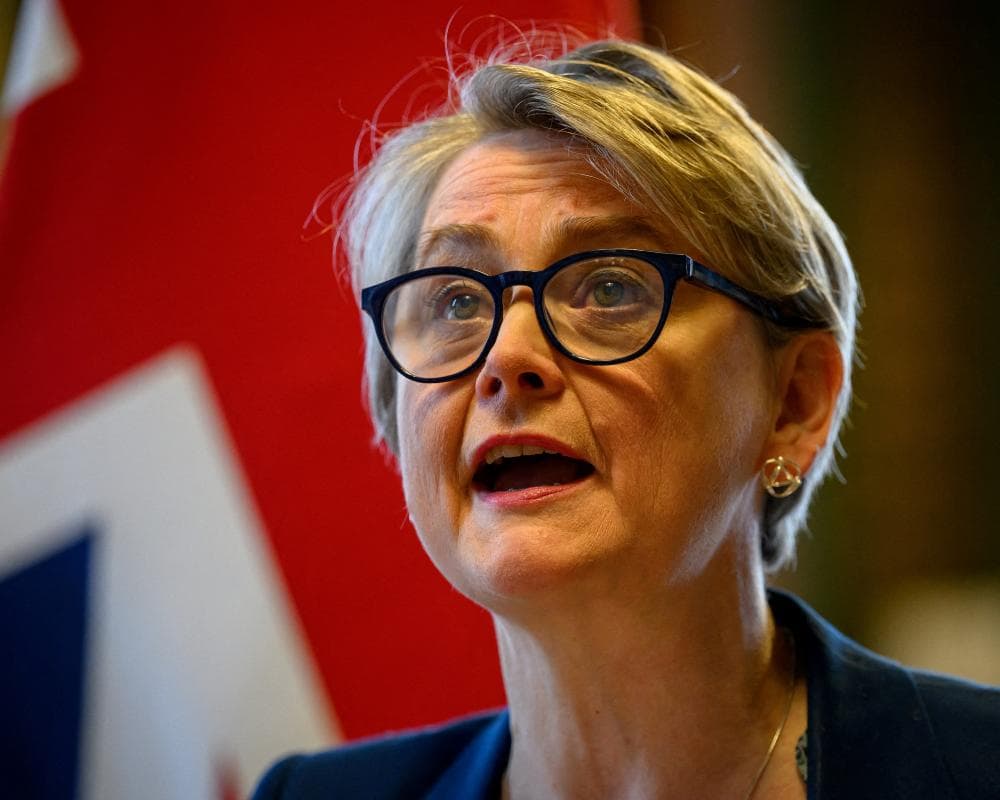
Speaking later on Thursday at an event in Mansion House in London, Yvette Cooper, the foreign secretary, is expected to say there “must be no return to conflict” after the ceasefire announced by the Trump, late on Tuesday.
Despite the announcement, Israel intensified its bombing campaign in Lebanon, with at least 254 people killed, prompting Iran to once again halt the passage of oil tankers through the crucial strait of Hormuz.
Before her speech, Cooper told BBC Radio 4’s Today programme that the continued Israeli strikes on Lebanon were “completely wrong”.
“We want to see an end to hostilities in Lebanon,” she said. “What Israel was doing yesterday with this escalation of strikes was completely wrong … this escalation is damaging, it’s wrong, it’s going the wrong direction. We want the ceasefire extended to cover Lebanon.”
Cooper said the UK’s position on Lebanon has been raised with the US and directly with Israel.
Answering questions at an event in Westminster, Healey said: “We condemn the escalation in Lebanon. We want the Israel-Lebanon conflict to be brought within the terms of the ceasefire, because we want to see greater stability.”
He warned against the idea of Iran charging ships for safe passage in the strait of Hormuz, something Trump mused in a social media post could be done in conjunction with the US.
Healey said: “We want to see the strait of Hormuz remain open and free, consistent with the long-established laws of international navigation, without any sort of tolls for passage.
“The introduction of any sort of pay-for-passage tolls would create a potential principle that could be used and abused by others elsewhere.”
Asked if the UK might deploy military assets to stop tolls being charged, Healey said that while he could not discuss “what-ifs”, such a plan “simply isn’t sensible – it isn’t actually doable”.
While neither Healey or Cooper directly criticised the US, their answers reinforce the increasing gap between Trump’s tactics and rhetoric and the approach of Keir Starmer’s government to the aftermath of a war it declined to support.
Any hope that Israel would immediately stop hitting targets in Lebanon appeared to be dashed on Wednesday when the US vice-president, JD Vance, said the country was not part of the ceasefire deal with Iran.
Speaking in the Hungarian capital, Budapest, Vance said: “I think this comes from a legitimate misunderstanding. I think the Iranians thought that the ceasefire included Lebanon, and it just didn’t. We never made that promise, we never indicated that was going to be the case.”
But in her speech at the Lady Mayor’s Easter Banquet on Thursday, Cooper will say Lebanon must be included in the ceasefire.
She will say: “There is considerable work to do, and we support the negotiations: they must make progress; there must be no return to conflict; Lebanon must be included in the ceasefire; there must be no further threat from Iran to its neighbours; and crucially, the strait of Hormuz must be fully reopened.
“More than 3,000 miles away from here – yet the deliberate blocking of this critical artery of the global economy is affecting mortgage rates, petrol and food prices, here at home. Every country on every continent has felt the effects.
“That is why we have been working for a swift resolution of this conflict and to support the reopening of the strait of Hormuz.”
Iran closed the crucial waterway as a thoroughfare in response to the US and Israel’s attacks that started in late February. Since then, global prices of fuel and fertiliser have risen sharply, which has put pressure on household budgets.
In her address to City leaders, Cooper will stress the importance of ensuring the critical shipping route remains open. She will say: “Fertiliser for Africa, liquid natural gas for Asia, jet fuel for the world; the trading route for Qatar, UAE, Bahrain, Kuwait, Iraq, Saudi Arabia and Oman, all hijacked by Iran so they can hold the global economy hostage.
“No country can close these routes – it goes against the fundamental principles of the law of the sea.”
She will add: “We know more than ever that freedom of navigation is the underpinning of global trade. It matters for every sea, ocean and strait. Every country has a stake in this. Every industry is affected by it.”