Loading...
Please wait for a bit
Please wait for a bit
Click any word to translate
Original article by Ashifa Kassam and Flora Garamvolgyi in Budapest
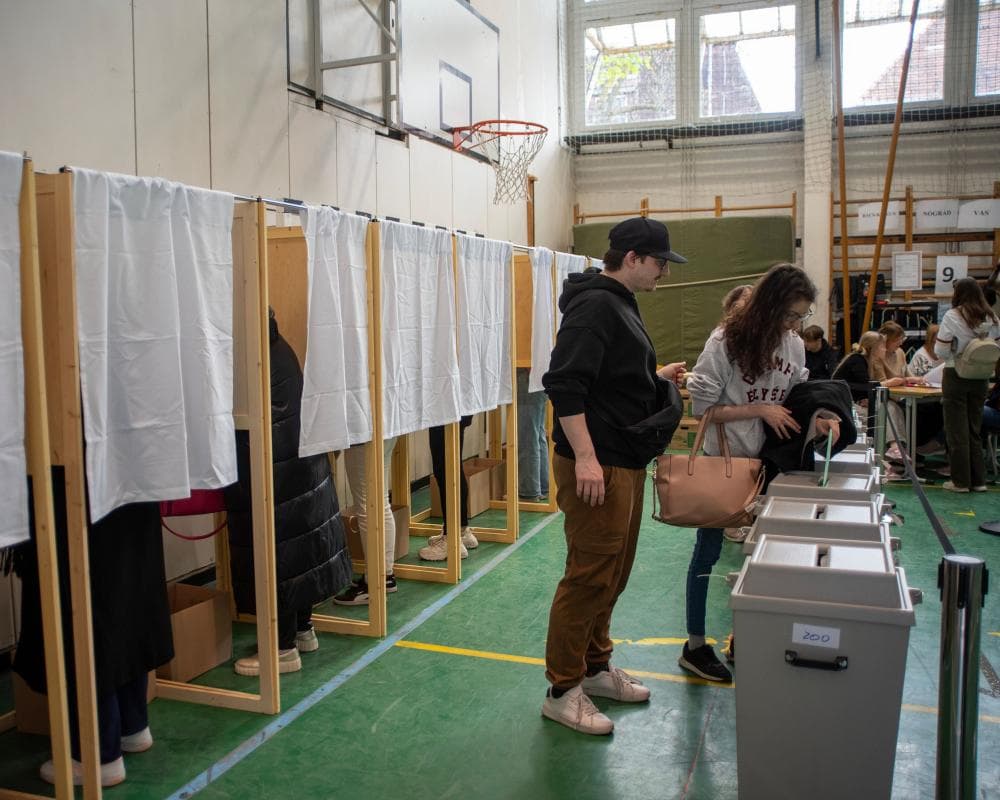
As Fruzsi, 22, waited to cast her vote at a polling station in central Budapest, a note of optimism laced through her voice. “I think everyone is hopeful,” she said. “It feels like we might be writing history tonight.”
It was a hint of the heady mix of hope, anxiety, and fear being felt across the country as a record number of Hungarians turned up on Sunday to cast their ballots in the parliamentary election.
For the bulk of Fruzsi’s life, Viktor Orbán had been Hungary’s prime minister, using his past 16 years in power to transform the country into what he described as “a petri dish for illiberalism”.
Now, after a hard fought campaign in which his party had consistently trailed in the polls, she was hopeful that Hungarians were ready to turn the page on his government. “There are a lot of angry people,” she said. “The government, they lie, lie and lie – and still people believe them.”
The race was transformed in early 2024, after Péter Magyar, a former insider in Orbán’s Fidesz party, began speaking out, alleging that corruption and cronyism were rife within the party.
Soon Magyar’s hastily formed centre-right Tisza party had rocketed to the top of the polls with pledges to repair the country’s drift away from the EU, crackdown on corruption, and restore democratic checks and balances, turning the election into a broader plebiscite on Hungary’s future.
But on Sunday, many said they were backing Magyar while others said they were content with the status quo. “The outcome is unpredictable, no?” said Mária, 81. “Hopefully Fidesz will win. They help the young and elderly in so many ways, and I trust that they will continue to protect the country.”
Her comments were a nod to a campaign that had sought to appeal to very different concerns among voters. Orbán asserted that the war in Ukraine was the country’s top threat and he was the only leader capable of keeping the peace, while Tisza urged voters to focus on tackling economic stagnation, fraying social services and corruption.
The discrepancies were reflected in how Hungarians saw Sunday’s vote. “I can’t think of any negative things to say about Fidesz,” said Mária, 58. “I’m hopeful they will have a super majority”
The campaign, she said, had made her fearful of the alternative. “I think Magyar is a disaster and Tisza is unpredictable.”
A few blocks away, Gergő, 36, said the time had come for change. For 16 years he had watched as Orbán’s government took aim at George Soros, the EU, migrants and, this time around, Volodymyr Zelenskyy. “The government attacks everyone, from teachers to judges, all kinds of minority groups. It’s terrible,” he said. “There’s always another enemy – it’s endless.”
He was steeling himself for the results with an “anything is possible” attitude, he said, as he had hoped for change in previous elections, only to see Fidesz win time and again. “But I’m hoping for change.”
The election is being closely watched around the world, as a loss for Orbán could rattle far-right movements across the globe and reshape the country’s relationship with Russia and the EU.
Despite Tisza’s poll lead, analysts said before the vote that the outcome was far from certain, as undecided voters, a redrawing of the electoral map in favour of Fidesz, allegations of vote-buying and the votes cast by Hungarians abroad could all sway the results.
Orbán’s most fervent supporters include many in the White House, where backers of the Hungarian strongman have long cited him as an inspiration. The final days of the campaign saw JD Vance travel to Budapest to rally behind Orbán, while Donald Trump repeatedly endorsed the right-wing populist on social media.
But for voters such as Mira, 26, the election was fundamentally about issues closer to home, namely whether she would have a future in Hungary. “I want to stay here, but obviously corruption has reached such proportions that healthcare and education are practically unacceptable,” she said.
If change didn’t come tonight, she wasn’t sure what she would be able to do abroad as a lawyer trained in Hungary. “I don’t know where I would go, or what I would do.”
While the desire for change threaded through many of the conversations with Tisza voters, many were swift to note that they were not expecting it to come quickly.
During Fidesz’s 16 years in power, the party stacked the Hungarian state, media and judiciary with loyalists; how they would respond to a potential change in government remain up in the air.
And then there is the two-thirds majority needed to amend the constitution and key laws, meaning Tisza’s ability to change Hungary could be limited if the party wins the election but falls short of a supermajority.
“They’re leaving so much behind – from the budget deficit to all their loyalists – as long as those things remain, nothing will change,” said Zoltán, 29. “But there will be a vision for the future. And that means that in the long run we can start to build something.”