Wildfires kill two in Greece and torch Belgian nature reserve
Click any word to translate
Original article by Angela Giuffrida and agencies
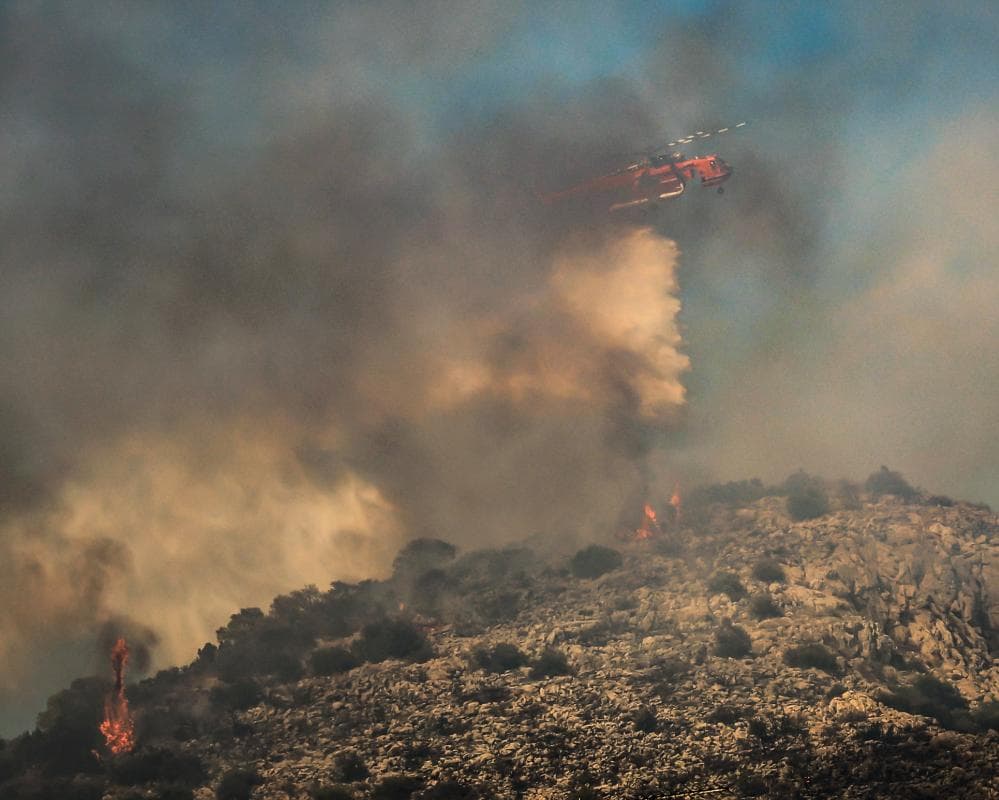
An elderly couple died in fires on the Greek island of Salamis on Sunday and Belgium is battling its largest modern-day wildfire at an inaccessible area near Germany, in the latest wave of European wildfires.
The couple died outside their home in the Peristeria beach area of Salamis, Greece’s coastguard said. More than 500 people were ordered to evacuate.
In Spain, a soldier died on Sunday while helping efforts to extinguish a large wildfire in Aragon, authorities said. French reinforcements were due to help contain the wildfire in the north-eastern region, which has raged for a week and threatened a 1,000-year-old monastery.
In Belgium, a wildfire that broke out on Friday in the High Fens, a large nature reserve popular with hikers, had ravaged about 3,000 hectares (7,400 acres) of land and was encroaching on the border with Germany by early Sunday morning.
About 600 people in the municipalities of Waimes and Bütgenbach, in Liège province, were told on Saturday to evacuate from their homes, and tourists were also advised to leave, as winds shifted and smoke spread.
Of those who followed the order, about 20 spent the night in a sports hall, while others sought refuge with family and friends.
Hervé Jamar, the governor of Liège, said more than 250 firefighters and emergency staff were involved in the operation, including firefighters from Germany.
Farmers have also been helping to battle the blaze, using their tractors to pull in water from Lake Robertville.
Air support, provided by two water-bombing aircraft from Sweden and four helicopters – two from Belgium and two from the Netherlands – is crucial owing to the nature reserve’s complex and fragile terrain, which is made up of dense forest, peat bogs and raised wooden boardwalks where heavy firefighting vehicles risk sinking.
Access to Lake Bütgenbach was prohibited on Sunday to allow the aircraft to refill.
Authorities described the conditions as still challenging, although two fire fronts towards Jalhay and Monschau were now under control, said Belgium’s interior minister, Bernard Quintin, after visiting the crisis centre in Vottem on Sunday afternoon.
“On this third day of fighting the fires, all resources remain mobilised on the ground,” he wrote on X, and he thanked all those involved.
“We can also count on the solidarity of our European partners … thank you to everyone who mobilised to fight the fires. United, we are stronger.”
The fire, described by officials as the largest in Belgium’s modern history, began in an area that in 1911 was badly affected by massive wildfires during a drought.
In Portugal, hundreds of firefighters were battling a series of blazes. At a wildfire near Dine, a village close to the border with Spain, five firefighters were injured when their vehicle caught fire, local media reported. Other fires were burning near the Spanish border, including at Boticas and Chavez.
Human-caused climate breakdown is supercharging extreme weather around the world, driving more frequent and deadlier disasters from heatwaves to floods to wildfires.
Much of Europe is experiencing a new period of intense heat, creating conditions conducive to wildfire outbreaks.
On Friday a fire engulfed homes in a Croatian holiday resort, killing one person, injuring 40 and forcing 1,200 to evacuate, officials said, as the EU warned that pockets of “very extreme” wildfire conditions stretched across the continent.
Hundreds more people were evacuated from villages in western Germany and south-west France, while stranded holidaymakers were picked up from beaches threatened by flames in Greece and the army rescued historical relics in Spain.