Loading...
Please wait for a bit
Please wait for a bit
Click any word to translate
Original article by Oscar Lopez in Mexico City
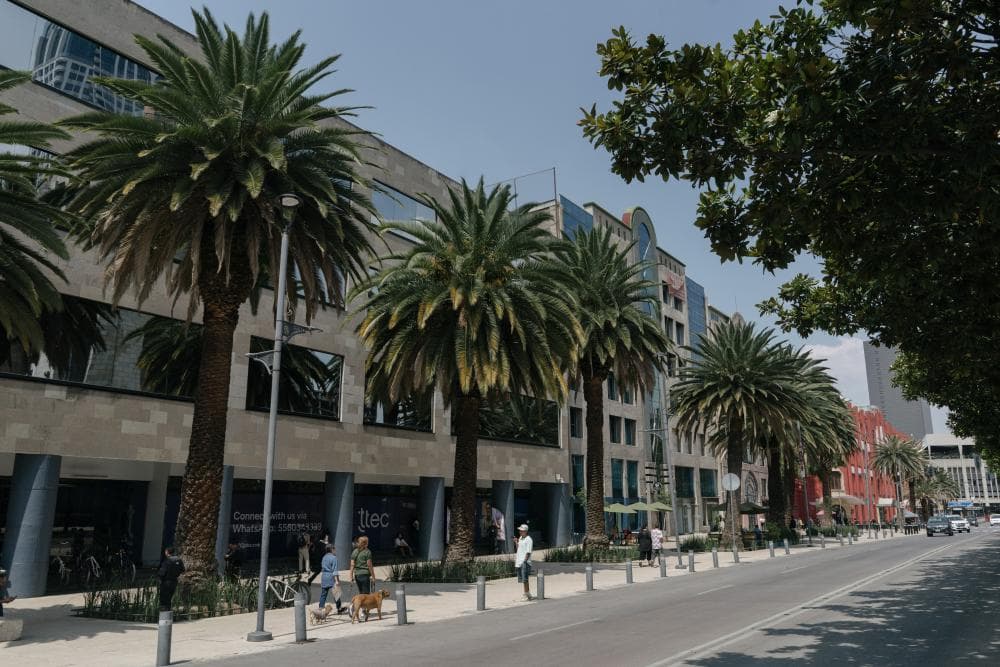
With its wide avenues lined with tall palm trees, its quaint cafes and old-school cantinas, as well as the mix of English and Spanish spoken on the street, the Tabacalera neighborhood in downtown Mexico City has a certain US feel – so much so that it is has become known as Little LA.
The nickname is about more than appearances, however. In recent years, this corner of the metropolis has become a haven for many Mexicans deported from the US, particularly those who spent years or decades living across the border and for whom Mexico feels like a foreign country. In Little LA, they have found a more familiar place to belong.
With the Trump administration embarking on a massive anti-immigrant crackdown, deportations to Mexico are expected to surge. Since taking office for the second time in January 2025, Trump has deported roughly 145,500 Mexican nationals.
Christopher Gil Ortíz was one of them. He was on his way to work in Los Angeles in June this year when Immigrations and Customs Enforcement (ICE) agents stopped him, handcuffed him and threw him in detention.
After months of living in constant fear as an undocumented immigrant in Trump’s US, Ortíz said that when the detention finally happened he felt relieved. “At this point I was like, OK, that’s it, I’m going back,” he recalled. “It’s like they took a weight off my shoulders.”
More than 30 years since he had left as a child, Ortíz was sent back to Mexico, leaving behind his wife and two young children. Dumped in the resort town of Tulum, he made his way to Cancún, only to have all his belongings stolen from his hotel room. Eventually, he ended up in Mexico City, where he had family.
“I was nervous,” he said. “Even though I was born here, I have very vague memories of the city itself.”
He was also facing the many challenges of being a deportee: getting his birth certificate, ID and finding a job. His sister sent him a TikTok post from an organization called New Comienzos (New Beginnings). Based in Little LA, it was set up to help returnees reintegrate. When he saw the post, Ortiz decided to check out Little LA for himself.
“Seeing the palm trees, it kind of does make you feel like you’re in LA,” he said, adding that he was grateful to New Comienzos. “There’s a lot of people that are going through what I’m going through and I’m pretty sure there’s going to be more.”
The New Comienzos founder and executive director, Israel Concha, said he was preparing for exactly that. “The atmosphere [in the US] right now is one of humanitarian crisis and panic. People no longer even want to take their children to school,” Concha said. “You’ll probably start seeing mass deportations in a few months.”
Concha founded New Comienzos when he witnessed first-hand how little support the Mexican government was offering recent arrivals. In 2012, he was living in Texas with his pregnant wife and had started a successful private transport business. He had lived in the US for 30 years. “I wanted to try to achieve that American dream, and I think I succeeded,” he said.
Then one day he was caught speeding on his way to pick up a client. While in detention, he fought his case for two years but was deported in 2014. On his first day in Mexico, he was kidnapped by a criminal gang working with local police.
“That was my welcome to my native country,” he said.
After being severely beaten, Concha escaped to Mexico City, where he found a job at a bilingual call centre – one of several starting to pop up in the Tabacalera neighborhood, attracting young returnees who spoke fluent English. Less than a year later, he started New Comienzos to address the challenges faced by people like himself.
“People didn’t just need a job; many of them needed emotional support because they had just lost everything following a deportation,” he said. The organisation offers legal support and free English certification and classes, as well as mentorship for recent arrivals. Little LA remains the organization’s center of operations.
“A community reintegration lab,” said Concha, “that’s what we’ve created there in Little Los Angeles.”
Sergio Aaron Pérez, 36, said the area felt like home. Wearing a Los Angeles Lakers jersey and baseball cap, his face and arms covered in tattoos, Pérez looked as though he had just stepped off the plane from the US. In fact, having lived in the US for more than 30 years, the former California resident was deported in 2011 for doing what he calls “bad things”.
In Little LA, he found work at call centers. “If you speak English there’s a lot of money,” said Pérez. “I love my city. There’s a lot of community.”
Ortíz, for his part, had little interest in a call center job. He has applied for a job at a glass-making factory – work he used to do in the US. Next on his agenda: bringing his wife and children to Mexico.
“My kids are OK with it,” he said. Referencing a local Mexican custom, he added: “My daughter told me that she was already practising drinking soda out of a plastic bag.”