Goodbye to the Soviet Union – archive, 1991
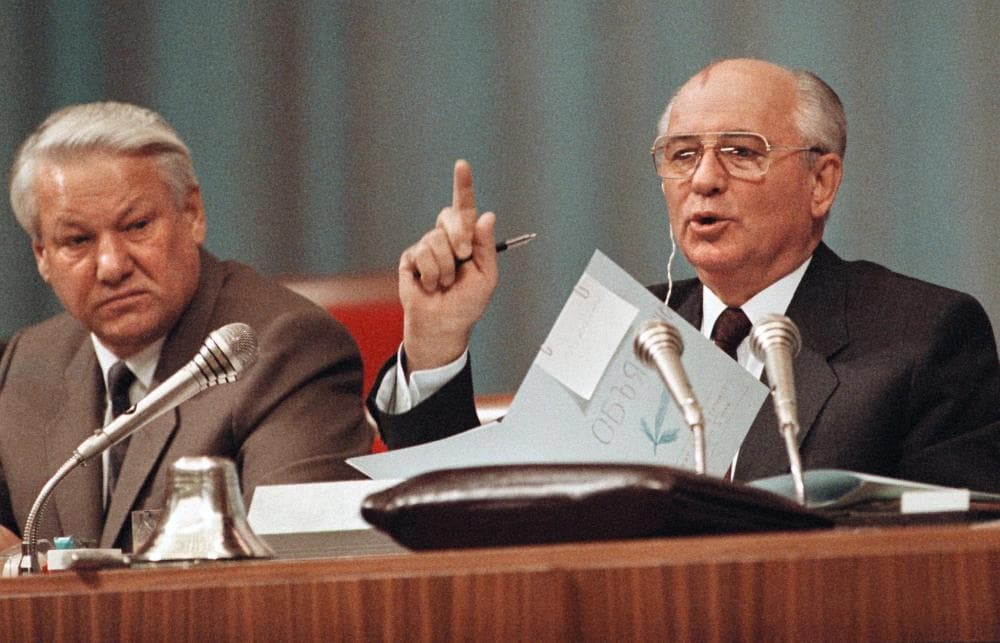
Click any word to translate
Original article by Compiled by Richard Nelsson
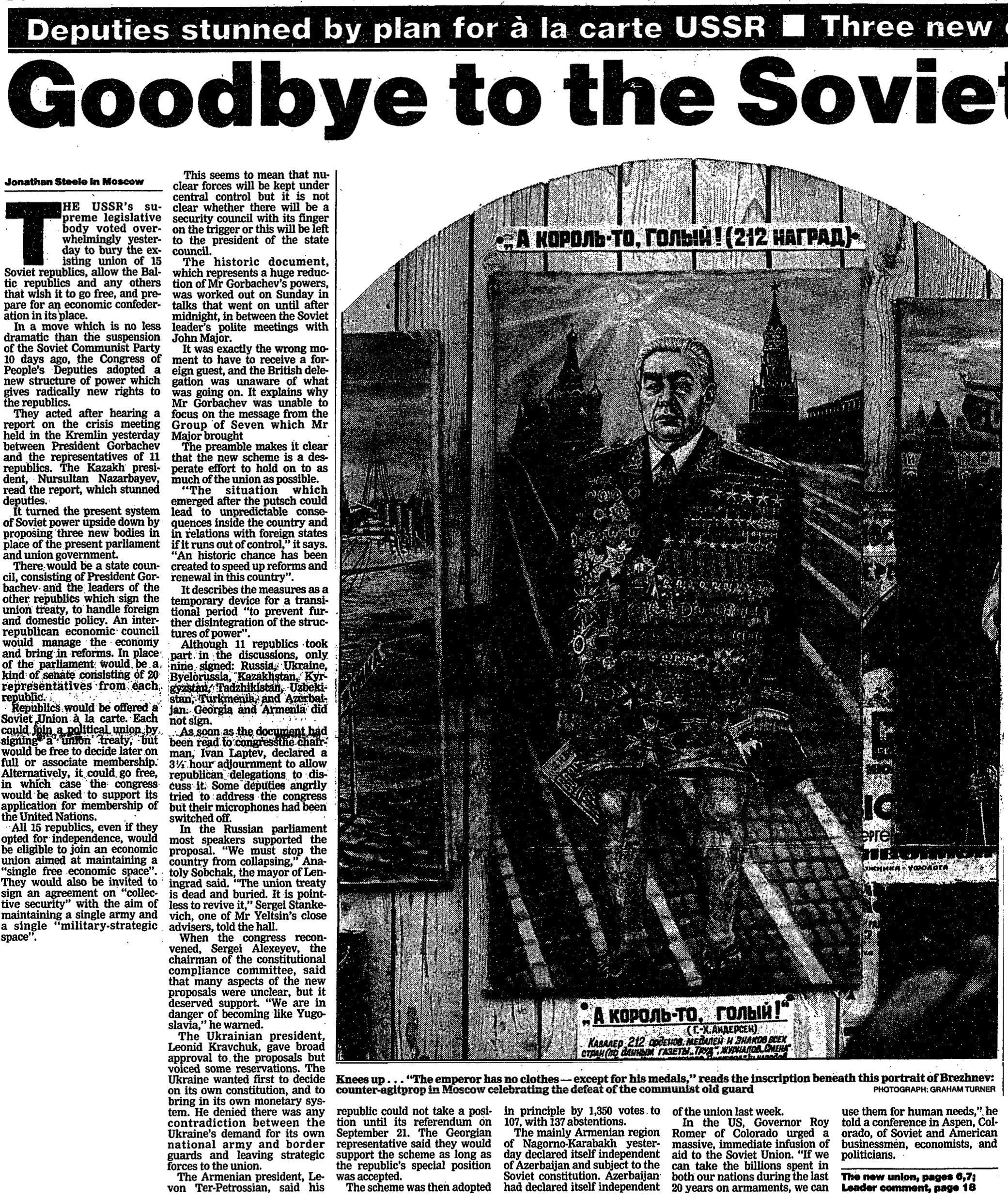
Deputies stunned by plan for a la carte USSR
By Jonathan Steele in Moscow
3 September 1991
The USSR’s supreme legislative body voted overwhelmingly yesterday to bury the existing union of 15 Soviet republics, allow the Baltic republics and any others that wish it to go free, and prepare for an economic confederation in its place.
In a move which is no less dramatic than the suspension of the Soviet Communist party 10 days ago, the Congress of People’s Deputies adopted a new structure of power which gives radically new rights to the republics.
They acted after hearing a report on the crisis meeting held in the Kremlin yesterday between President Gorbachev and the representatives of 11 republics. The Kazakh president, Nursultan Nazarbayev, read the report, which stunned deputies.
It turned the present system of Soviet power upside down by proposing three new bodies in place of the present parliament and union government.
There would be a state council, consisting of President Gorbachev and the leaders of the other republics which sign the union treaty, to handle foreign and domestic policy. An inter-republican economic council would manage the economy and bring in reforms. In place of the parliament would be a kind of senate consisting of 20 representatives from each republic.
Republics would be offered a Soviet Union a la carte. Each could join a political union by signing a union treaty, but would be free to decide later on full or associate membership. Alternatively, it could go free, in which case the congress would be asked to support its application for membership of the United Nations.
All 15 republics, even if they opted for independence, would be eligible to join an economic union aimed at maintaining a ‘single free economic space’. They would also be invited to sign an agreement on ‘collective security’ with the aim of maintaining a single army and a single ‘military-strategic space’.
Continue reading.
Editorial: Mikhail signs, but Boris calls the shots
3 September 1991
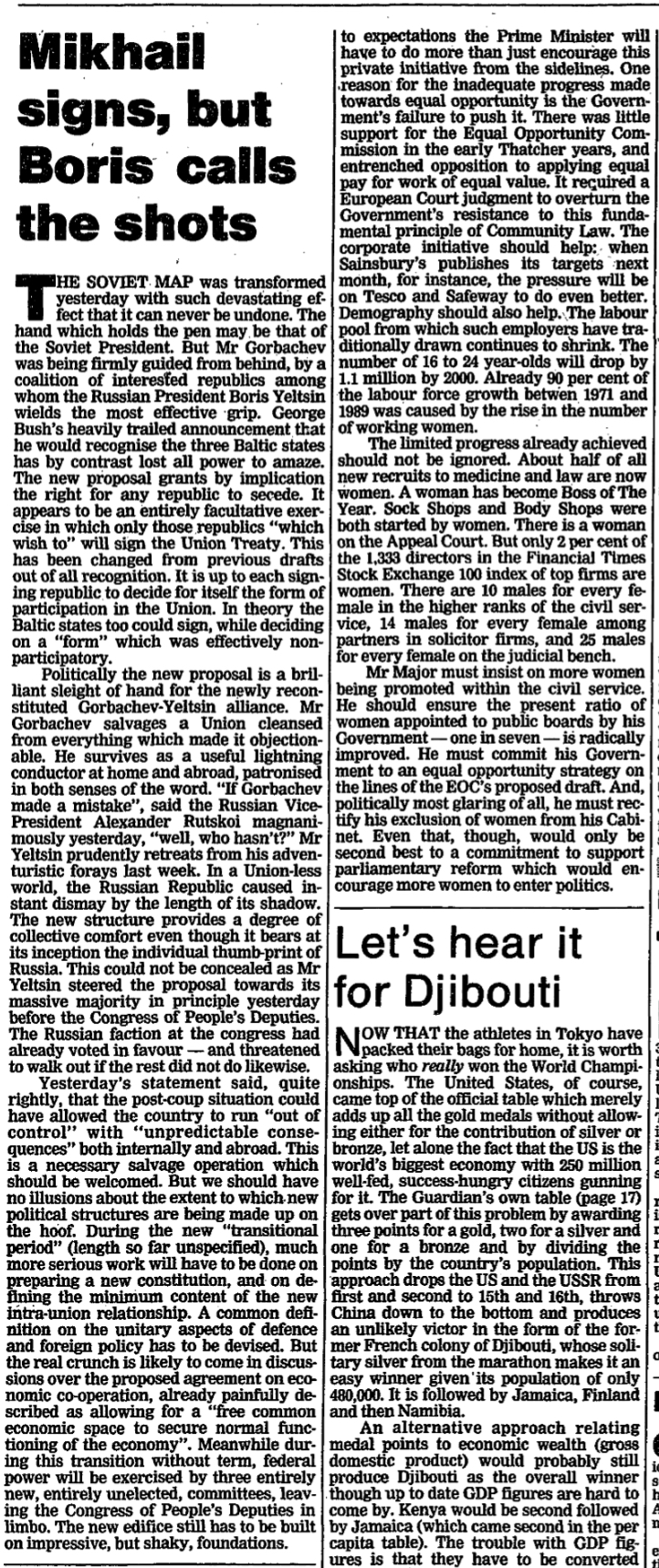
The Soviet map was transformed yesterday with such devastating effect that it can never be undone. The hand which holds the pen may be that of the Soviet President. But Mr Gorbachev was being firmly guided from behind, by a coalition of interested republics among whom the Russian President Boris Yeltsin wields the most effective grip. George Bush’s heavily trailed announcement that he would recognise the three Baltic states has by contrast lost all power to amaze. The new proposal grants by implication the right for any republic to secede. It appears to be an entirely facultative exercise in which only those republics ‘which wish to’ will sign the Union Treaty. This has been changed from previous drafts out of all recognition. It is up to each signing republic to decide for itself the form of participation in the Union. In theory the Baltic states too could sign, while deciding on a ‘form’ which was effectively non-participatory.
Politically the new proposal is a brilliant sleight of hand for the newly reconstituted Gorbachev-Yeltsin alliance. Mr Gorbachev salvages a Union cleansed from everything which made it objectionable. He survives as a useful lightning conductor at home and abroad, patronised in both senses of the word.
Continue reading.
Soviets tuck in a la carte
6 September 1991
After three days of intense argument, the Soviet Union’s Congress of People’s Deputies approved President Mikhail Gorbachev’s plan to replace the centralised Soviet Union with a loose confederation of sovereign states.
The a la carte plan envisages a multi-tier structure which will allow republics to decide the extent of their relations with central government while retaining the armed forces under a single military command.
The confederation plan was drafted in overnight negotiations on Monday between President Gorbachev and the representatives of Russia, Ukraine, Armenia, Byelorussia and six other republics.
The Baltic states and Moldova refused to take part in the discussions, while Georgia attended with observer status. The confederation plan caused great suspicion and disagreement in the Congress, with representatives of several republics and nationalities objecting to aspects of the proposals and many deputies opposing their own reduced role.
After warnings from President Gorbachev that a decision had to be made quickly, the Congress passed a law suspending parts of the Soviet constitution and substituting a three-part interim government structure: a parliament, a State Council made up of President Gorbachev and the leaders of participating republics, and an Inter-Republican Economic Committee.
Prospects of independence for the Baltic states increased rapidly during the week when the United States announced its recognition. The three states – Estonia, Latvia and Lithuania – applied for membership of the United Nations. Meanwhile Azerbaijan declared its independence from the Soviet Union. Russians in Moldova – which declared its independence last month – set up a separate republic of the Dniester.
Serbian rebels and Yugoslav government troops captured most of the eastern Croatian region of Slavonia, in which many Serbs live. The Slavonian capital, Osijek, was the centre of heavy fighting in which at least 16 people were killed. Seven more deaths were reported from Pretinje, south of Zagreb. Road and rail links between Croatia and Serbia were completely severed.