Loading...
Please wait for a bit
Please wait for a bit
Click any word to translate
Original article by Patrick Wintour in Munich
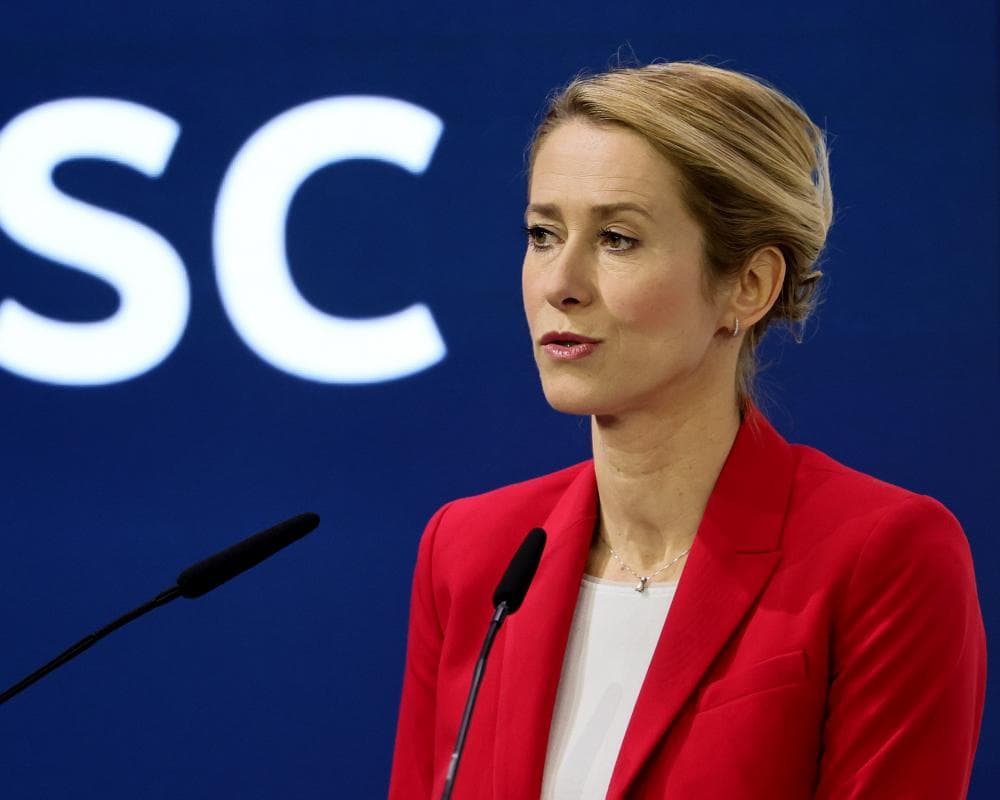
The EU’s foreign policy chief has denied claims levelled by the US that Europe is facing civilisational erasure, rejecting what she condemned as “fashionable euro-bashing” by Washington.
Kaja Kallas also said the US was discovering that it could not settle the war in Ukraine without Europe’s involvement and consent.
Her remarks capped a difficult three-day Munich Security Conference attended by world leaders and security officials in which the health of the transatlantic alliance, a stronger European pillar inside Nato, and the Ukraine peace talks dominated discussions.
In his speech on Saturday, the US secretary of state, Marco Rubio, laced a more diplomatic tone with a firm message that Washington would only work alongside Europe if it changed to accommodate US leadership on mass migration, free trade and greater European defence spending.
Kallas, speaking on the last day of the conference, suggested some of Rubio’s remarks were directed at a domestic audience.
“Euro-bashing” was now “very fashionable” despite all “the good things that Europe actually has to offer,” Kallas said. “When I travel around the world, I see countries that look up to us because we represent values that are still highly regarded.
“Contrary to what some may say, woke, decadent Europe is not facing civilisational erasure. In fact, people still want to join our club, and not just fellow Europeans. In Canada, I was told over 40% of Canadians have an interest in joining the EU.”
She challenged the US criticism of media freedom in Europe, pointing out that her own country, Estonia, ranked second in the world press freedom index and the US 58th. Given the EU’s record on human rights, she said, she found some of the criticisms very hard to take.
“We are, you know, pushing humanity forward, trying to defend human rights and all this, which is actually bringing also prosperity for people. So that’s why it’s very hard for me to believe these accusations.”
Kallas, a fierce opponent of Russia, has repeatedly clashed with the Trump administration. She said she did not think the EU was ready to give Ukraine a date for membership, suggesting accession as early as 2027 is unrealistic.
The previous day, Rubio made an emotional but highly conditional offer of a new partnership, insisting the two continents belonged together and describing America as “a child of Europe”.
In a much-anticipated speech, he said the US was intent on building a new world order, adding: “While we are prepared, if necessary, to do this alone, it is our preference and it is our hope to do this together with you, our friends here in Europe.”
Admitting the Americans may come across as a little direct and urgent, he said this was only because the US was profoundly concerned by the fate of Europe and knew their destinies were intertwined.
Rubio travelled to Bratislava in Slovakia after the conference where he skirted around why the US intelligence agencies had not been involved in the report prepared by five European intelligence agencies, including the UK’s, that found the Russian opposition leader Alexei Navalny had been poisoned. The agencies concluded he was poisoned with a toxin derived from dart frogs found in South America, and accused the Russian state of being responsible.
When asked why the US had not joined the statement, Rubio said this had been an endeavour by the agencies. “Those countries came to that conclusion. They coordinated that. We chose – doesn’t mean we disagree with the outcome. We just, it wasn’t our endeavour. Sometimes, countries go out and do their thing based on the intelligence they’ve gathered,” Rubio said.
Keir Starmer said on Saturday that cooperation between the UK and the US on intelligence was closer than ever.