Loading...
Please wait for a bit
Please wait for a bit
Click any word to translate
Original article by Caitlin Cassidy
Standing in line at Ikea’s click and collect service to pick up a large plush orangutan, a wave of fatigue washes over me.
Not only because I have been in transit for almost 24 hours after a series of flight delays, and this is my last stop before collapsing in a heap on my living room floor, but also for the reason I, and so many others, have made this journey.
It’s to secure the toy that people on the internet believe has brought comfort to an abandoned monkey named Punch at a Japanese zoo, who has gone viral for reasons largely unclear to me.
It feels a little like Moo Deng 2.0, but sadder, because this baby monkey has not been embraced by his peers.
If not for the plush Ikea toy he had been given by zookeepers, which he grips on to like a life raft, he would be alone and unloved, his days spent avoiding being dragged and chased by older Japanese macaques inside his enclosure.
There are different stuffed Ikea toys all named “Djungelskog”. I am here to see if the plush orangutan Punch is so attached to will bring me the safety and security that it seems to have brought him.
The soft toy has gone viral in a similar way to its owner. According to eBay Australia, listings of Djungelskog increased by 650% between January and February of this year, and it has been selling at prices between $33 and a whopping $175.
A spokesperson for Ikea Australia said there had been a more than 200% increase in sales of Djungelskog in the past week, with more than 990 bought across Australian stores and online.
“As global attention continues to build around Punch’s remarkable story, our iconic orangutan soft toy is now experiencing unprecedented demand,” they said. “Fans should get in fast as it is selling quickly.”
So unprecedented is the demand that when I arrive at the front desk after rushing from Sydney airport to collect my order, I find Djungelskog has already sold out.
I am told it will be back in stock tomorrow. I leave Ikea disappointed, empty-handed and extremely tired.
The next morning, I come back early, and a kind Ikea employee brings a Djungelskog to my car.
“Everyone has bought one,” she tells me excitedly. “We sold out yesterday and had to call all these stores … I was like, ‘what is up with all these monkeys?’ and then I saw the videos [of Punch] and I’m like, ‘I need one’.”
Laughing as if I am not extremely aware of these facts, I clutch my Djungelskog and buckle them into my car. Already, I feel a sense of profound peace wash over me. Perhaps it is something to do with their hauntingly large, vacant eyes.
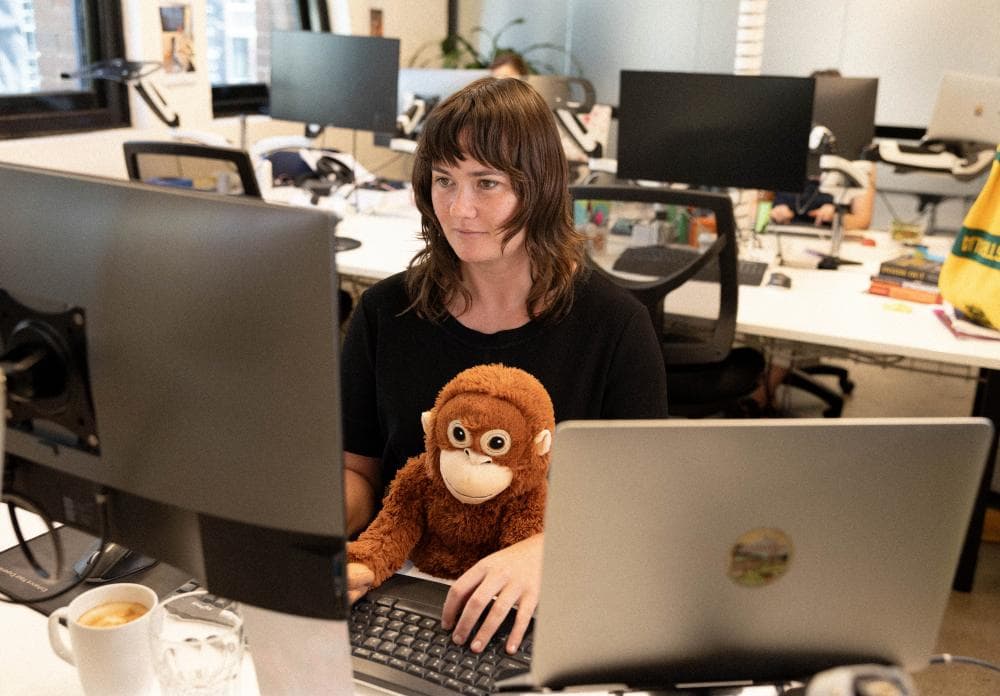
After dropping my car off at home, I wrap Djungelskog around my arms and together we commute to work. I am quietly muttering to the orangutan to help them get a sense of their surroundings.
“This is where I work!” I tell them. “We’re hopping into the lift!”
The orangutan is extremely soft and is about the size of a real baby. I find myself not wanting to let go. My colleagues gush and ask me what I’m going to call them. “It’s like meeting a celebrity!” one says.
For the rest of the morning, Djungelskog sits beside my computer, staring at nothing.
It is all extremely cute, and yet I am struck by intense sadness when I watch footage of real-life Punch and his own Djungelskog.
It makes me think of a podcast about Keiko, the orca that starred in Free Willy, whose life was akin to a Shakespearean tragedy.
Keiko was raised at a sea park in Mexico in a pen way too small for him. After shooting to fame, a massive campaign was undertaken to “free” him back into the wild to be with his own kind.
But for his whole life, people had been his companions. Efforts to integrate him into whale pods largely failed, and he died of acute pneumonia in the ocean at just 27, remaining dependent on human care until his death.
I don’t know why this monkey was abandoned by his mother, or what conditions are like where he is displayed at Ichikawa City Zoo (though reviews point to small enclosures, and Japanese animal welfare laws are often critiqued as being inefficient).
But there is a definite tinge of anthropomorphism to our obsession with Punch on social media that reminds me of the tragedy of Keiko.
Seeing the monkey playing with a cute toy, we see something human and childlike that makes us think of ourselves. But this is a wild animal, and its Djungelskog is not real.
When I get home this evening, I will embrace my dog, whose excitement to see me when I got home from Ikea was genuine – something Djungelskog, as soft and cute as it is, could never grant me.