Loading...
Please wait for a bit
Please wait for a bit
Click any word to translate
Original article by Eva Corlett
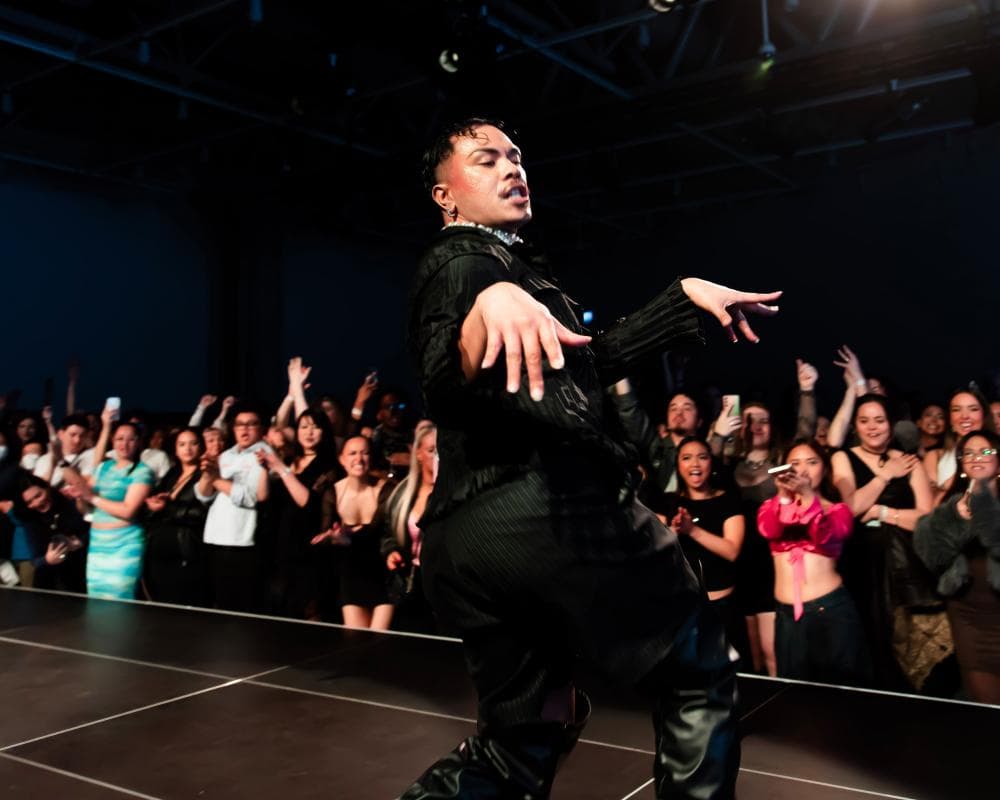
In a large gallery at New Zealand’s national museum in Wellington, a 600-strong crowd cheers ecstatically as a group of fabulously dressed performers take to the stage.
In impossibly high heels, the predominantly Māori and Pasifika (Indigenous people of the Pacific Islands) performers twist their arms into geometric forms and spiral to the ground, contorting their bodies into outstretched shapes. Other performers parade their highly stylised costumes, while some embody the struts, poses and attitudes of supermodels.
A panel of judges preside over the show like royalty – if they like what they see, they’ll hand out “10s across the board”, if not, you’re “chopped”.
This is a vogue ball, a form of performance and self-expression developed by a queer Black and Latinx subculture in 1960s Harlem that has found life in New Zealand’s Māori and Pasifika queer communities and is now winning over the mainstream.
“There is something really visceral about seeing black, brown, queer, indigenous bodies so authentically and unapologetically be themselves,” says Cypris Afakasi, who is known as Fatheir Fang of the Auckland-based Kiki House of Coven-Aucoin.
In ballroom culture, a “house” is a collective of performers – headed by mother or father figures – who compete together at ballroom events and become a chosen family in and out of the ballroom scene. Performances have elements of drag, dance and fashion, and often centre around a ball where performers “walk” in front of judges.
Vogue balls arose in New York as an act of resistance against racism in the local drag scene. The culture found wider fame as the subject of Jennie Livingston’s 1991 documentary Paris is Burning, and has influenced countless entertainers, including Madonna, with her 1990 hit Vogue, reality competition show RuPaul’s Drag Race and TV show Pose.
Those unfamiliar with ballroom culture may be familiar with some of its vernacular: “realness”, “yas queen” and “throwing shade”.
In more recent years, the culture has flourished around the world. New Zealand’s scene began more than 10 years ago in Auckland, led by trans Pasifika and Māori people, seeking a safe place to express their identities and find community.
“Every day for us is a survival … ballroom is an outlet for resistance,” says Karamera, a Māori artist and a house mother of Wellington-based Kiki House of Marama.
Karamera launched Wellington’s first house with their friend Romé, in 2023 after attending a ball at Wellington’s city art gallery in 2020.
“To see other people holding themselves in a ballroom space who come from similar backgrounds is what really assured us,” Karamera says. “We never looked back and have been immersed in ballroom culture since then.”
Early on, they performed in living rooms to a handful of people. Two years later, their house has 16 members and their venues and audiences have transformed – from lounges and clubs to Wellington’s largest ever ball held at the national museum, Te Papa Tongarewa, in October.
The museum held the community with care and love, Karamera said. “They were such an example of allyship – I encourage other institutions to follow their example and allow the girls to feel like the celebrities they are.”
Te Papa’s public programming manager, Rachel Fox, said ballroom has become more visible in New Zealand in the past five years, partly due to public institutions platforming the culture.
“By being part of what ballroom looks like, through collaborations like this, Te Papa is actively creating a more inclusive and affirming cultural landscape,” she said.
While New Zealand’s community draws heavily from New York’s scene, it has taken on a distinctly Māori and Pasifika tone, which shows up in music, styling and cultural references.
“Because we are so connected to our identities in Aotearoa [New Zealand] – whether it’s a counter-culture or ethnic-culture – it’s really important for us to honour the integrity of it,” said Afakasi, who is Samoan and Māori.
Like its origins, New Zealand’s scene is a platform for political resistance.
During a ball at the Dowse Art Museum in late 2024, House of Marama member, Kiwi, ripped up a piece of paper depicting the government’s highly controversial treaty principles bill, echoing the viral moment Te Pati Māori MP Hana-Rāwhiti Maipi-Clarke tore it up in parliament and led a haka.
“To [Kiwi], it was not just the ripping of the bill, it was the action of just tearing everything down, especially in a world that just isn’t made for her,” Karamera said.
“People who perform in ballroom offer a different perspective on life and how they choose to either honour it or completely dismantle it.”
More than anything, however, it is a place where people leave feeling more excited about life, Karamera said, and for those who have never attended one, “get ready to be wowed by queer excellence”.
“When I dip on a stage, it is very much … all eyes on me, you’re all on my time, I’m going to give you a show, and, you’re welcome.”