Loading...
Please wait for a bit
Please wait for a bit
Click any word to translate
Original article by Hannah Al-Othman North of England correspondent
When the 1967 Abortion Act cleared parliament, marking one of the most significant steps forward for women’s rights in history, Diane Munday was among the campaigners raising a glass of champagne on the terrace of the House of Commons.
“I’m only drinking a half a glass,” she told her colleagues at the time, “because the job is only half done.”
And, she was right. “Fifty years later, women were still going to prison,” says Munday, who co-founded the British Pregnancy Advice Service. She was also a leading member of the Abortion Law Reform Association during the 1960s and 1970s and is a patron of Humanists UK.
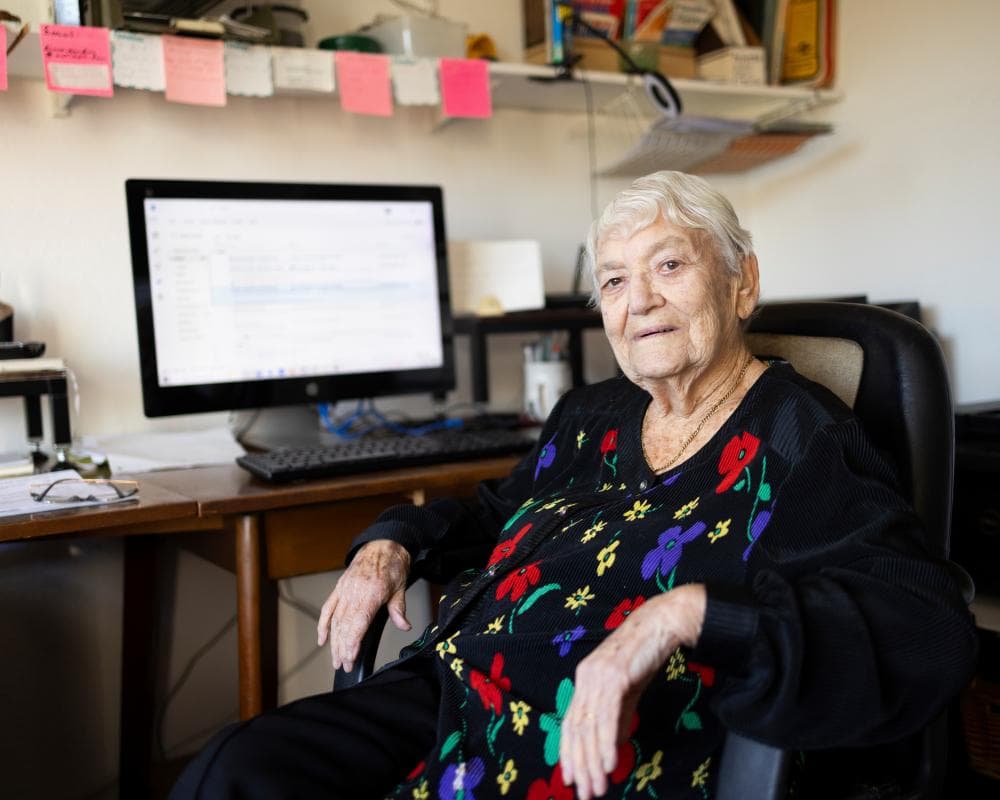
The 94-year-old campaigner still spends most of her days at work in her home office, where evidence of her passion is clear: from the bookshelf stacked with titles about abortion, to the notes tacked above her desk, to the filing cabinet stuffed with decades of history.
Various green swing files contain press cuttings, or copies of private members’ bills printed on acetate. One, labelled “crank letters”, is full of handwritten notes calling her a “murderer” and “moral leper” living a “life of whoremongery.”
Despite the opposition she has encountered, Munday is undeterred. Ahead of a landmark vote in parliament early this summer, she was among the voices calling for change.
In what has been hailed as the most significant advance for reproductive rights since 1967, parliament passed an amendment put forward by Labour MP Tonia Antoniazzi to the crime and policing bill, which sought to end the criminal investigation and prosecution of women who terminate their pregnancies.
This followed a series of high-profile prosecutions in which women were hauled before the courts for ending pregnancies outside the strict legal framework.
Munday’s passion is personal as well as political. In 1961, when she was already a mother to three young boys, she had an abortion.
“I’d known a young woman who died, she lived near us in London, she was a dressmaker,” she said. “Like me, she was married with three young children. She had a pregnancy she found intolerable, she went to the back streets and she died.
“We raised £90, I went to Harley Street and I was alive. And the unfairness, the injustice of that, is I think what drove me all those years. I’ve never forgotten her.”
In the 1960s, Munday threw herself into building public support for the abortion bill, in the knowledge that this was needed for it to clear parliament.
She had started by lobbying politicians directly but said the prime minister of the day, Harold Wilson, had described abortion as “a petty middle-class reform”.
“Go away and prove to me the country wants it, and then come back again,” Wilson told her.
And so she addressed meetings of the Women’s Institute, Rotary and the Townswomen’s Guild, asking them to pass motions in favour of law reform.
“I went and they all wore gloves and hats and were very respectable,” she said. “And I stood up and I said ‘I have had an abortion’ and one after another at the tea interval they came up to me and said things like ‘I had an abortion. You’re the only person except my husband that knows, it was during the depression’ or ‘my husband was out of work’. This became the pattern wherever I went.
“Even my mother admitted that a very close relative had had an abortion and my mother had looked after her afterwards. Wherever I went ‘I had an abortion, I had an abortion, I’ve never told anybody’.
“And it became obvious that this was common, that it was a thing that women did, but didn’t talk about. The word wasn’t written or spoken in those days, and that drove me on, because I kept remembering the woman I’d known.”
Despite the vote in June, Munday is not ready to drink a full glass of champagne because she wants abortion to be fully decriminalised.
She said: “Parliamentarians need to get rid of the restrictions – the two doctors [who must sign off an abortion] – make it readily available.”
Munday follows the news on abortion through internet alerts set up for the term and she is worried “a great deal” by the situation in the US. In 2022, the country’s supreme court overturned the historic Roe v Wade ruling, which in 1973 had guaranteed women the constitutional right to an abortion.
“I always saw America as being a sort of ‘modern society’ and it’s going backwards, and that worries me hugely,” she added. “American women have got to get up and fight for what they want.”
Nigel Farage has called for a reduction in the abortion time limit and Munday said the Reform UK leader “could be the next prime minister the way things are going”.
However, she hopes that the younger makeup of parliament may counter any attempts to curtail reproductive rights: “I don’t think they’d see abortion rights restricted, because they would have grown up with it legal.”
She also welcomed the news in October that emergency contraception would become more readily available. “That is a big step forward,” she said. “The morning-after pill, free of charge from any pharmacist, that’s a huge advance.”
When she raised that half glass of champagne on the terrace of parliament, Munday said “no way” would she have expected, that 60 years later, abortion would still not be fully decriminalised.
There are members of parliament who want to bring in a new, modern abortion act, relevant to the 21st century. Munday said this would be “amazing” but she was “not very optimistic” that it would happen in her lifetime.
“That was what I always aimed at from the early 1960s,” she added. “That has been the thing I thought should be available.”