Loading...
Please wait for a bit
Please wait for a bit
Click any word to translate
Original article by Patrick Wintour Diplomatic editor
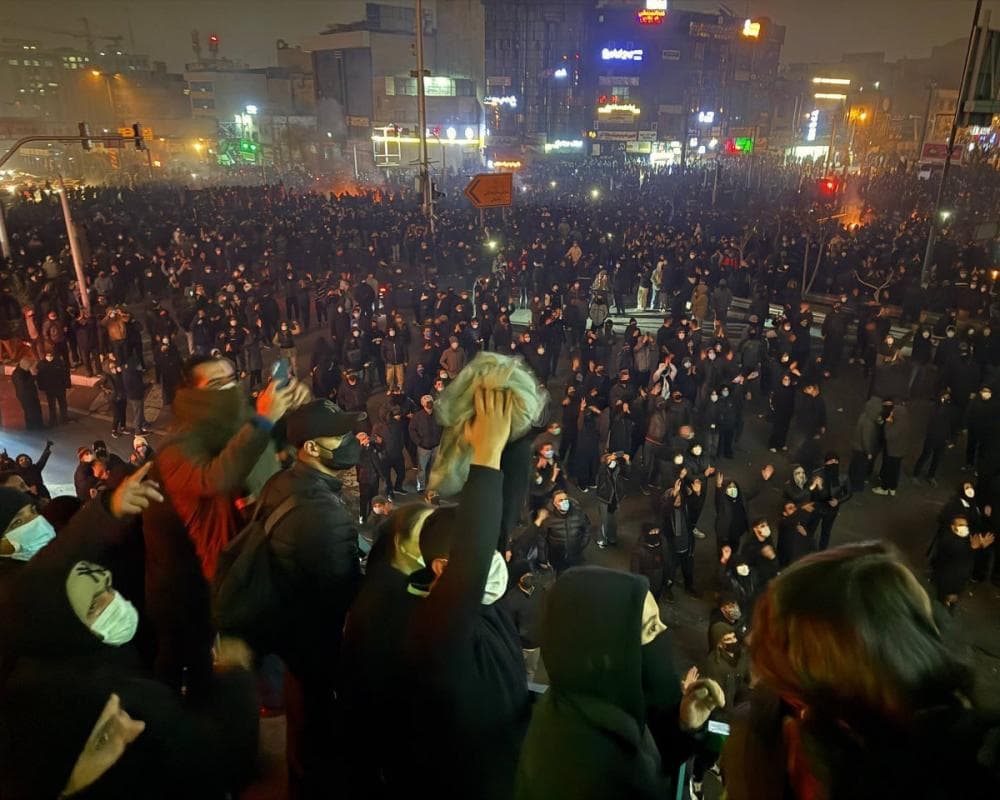
Donald Trump is being warned by Iranians that it will be too late unless he acts quickly to fulfil his promise to help protesters under fire from security services in Iran but the president is receiving conflicting advice about the potential effectiveness of a US intervention.
A major intervention by Washington, some are warning, will only fuel the fire of an Iranian government narrative that the protests are being manipulated as part of an anti-Islamic plot being led by the US and Israel.
Trump has promised that he will “shoot at Iran” if Iranian security services attack protesters; however, analysts suggested the speed of the crisis meant his team has no developed response ready. There has been no major movement of US military assets, and many of his closest Middle East partners such as Qatar are urging restraint. Military options and other possibilities were being placed in front of the unpredictable president, the New York Times and Wall Street Journal reported. The US secretary of state, Marco Rubio, spoke to the Israeli prime minister, Benjamin Netanyahu, on Saturday.
The population density of Tehran – where roughly 12 million Iranians live – means it is hard to mount a targeted campaign from the air without risking many civilian casualties, as the US-Israeli assault in June showed. More than 1,000 Iranians died, creating a new, now apparently dissipated, nationalism.
Obvious potential US targets – leading Revolutionary Guards figures, as well as the supreme leader, Ayatollah Ali Khamenei – have strengthened their personal security precautions, making a decapitation strategy harder. However, Revolutionary Guards bases in south Tehran and police barracks are seen as potentially more feasible targets.
Over the weekend Iranian opposition leaders lobbied Washington, arguing that the scale of the regime violence amounted to a crime against humanity. One group warned that the protesters could probably withstand two more days of the current level of police and army violence.
In a letter, seven Iranian political, civil and cultural figures urged Trump to recognise the scale of the repression under way. The letter was signed by Javad Akbarin, a religious scholar and journalist, Nazanin Ansari, the managing director of the Kayhan newspaper in London, Foad Pashaei, the secretary general of the Constitutionalist party of Iran, Yazdan Shohadai, spokesperson for the Transition Council, Shirin Ebadi, a lawyer and Nobel peace prize winner, Mohsen Makhmalbaf, a writer and director, and Abdullah Mohtadi, secretary general of the Kurdistan Komala party of Iran. They pointed out Trump has repeatedly promised to intervene and warned “every minute of delay will expand the dimensions of the crime against the defenceless people of Iran”.
The son of the former shah Raza Pahlavi who claims to have some control over the protests has also appealed for Trump to act. But he has tempered his advice to protesters, highlighting self-protection. He said: “Go to the main streets of the cities in groups with your friends and family members; along the way, do not separate from one another or from the crowds of people; and do not take side streets that could endanger your lives.”
Many external observers are advising caution, arguing US bombing could be counter-productive.
Danny Citrinowicz, a former senior Israeli defence intelligence specialist on Iran, said the key question was that if Trump took a deliberately limited action designed to prevent escalation, whether that “would actually affect the regime’s ability to confront the protesters, or whether it could instead produce the opposite outcome, given expectations within the Iranian opposition for deeper and more decisive US involvement”.
Sanam Vakil from Chatham House’s Middle East programme said the likely primary impact of a US intervention would be to “shore up elite unity and suppress fractures within the regime at a moment of heightened vulnerability”.
Esfandyar Batmanghelidj, the chief executive of Bourse and Bazaar, said “The strongest argument against US intervention is the Trump administration’s failure to steward peace in Ukraine, Gaza and Lebanon or political transitions in Syria and Venezuela. In each place they made bold promises. But they have no bandwidth and no strategy to actually see things through.”
The former UK ambassador to Tehran Rob Macaire said US strikes “may not necessarily play out as people expect”, pointing out that the attacks in June were not seen as helping to diminish the power of the state. At the same time he admitted Trump’s statements meant “we are going to get to a point where there is a gap between rhetoric and reality”.
He urged policymakers to think more about how a transition could be achieved. He said: “This is a government that came in with an economic reform platform saying it will make the lives of ordinary people better and that was hung in part on the idea there was an agreement with the west and sanctions would be lifted. But that has not happened.”
The Iranian government “do not have answers to the inequality, the structural challenges, the IRGC [Islamic Revolutionary Guard Corps] dominating the economy, the smuggling that goes on with sanctions, and how that narrows the resources of the government. They do not have any way of solving the problems the protesters are so angry about. Yet there is no one out there that does – there is no one you can go to enthrone, whether it is Pahlavi or anyone else.”
The Iranian government is already seeking to persuade Iranians that they are responsible for saving the country from chaos being engineered from abroad. In a TV interview on Sunday Iran’s president, Masoud Pezeshkian, repeatedly appealed for national unity, urging the country to go forward “hand in hand” against an external enemy that was encouraging the rioters. He said 80% of the protesters had legitimate complaints but that those burning mosques and shops were rioters and terrorists.
He accused the US of “using the economy as weapon to make us bend down. I am asking the nation: please, stay and back us.”