Loading...
Please wait for a bit
Please wait for a bit
Click any word to translate
Original article by William Christou in Beirut
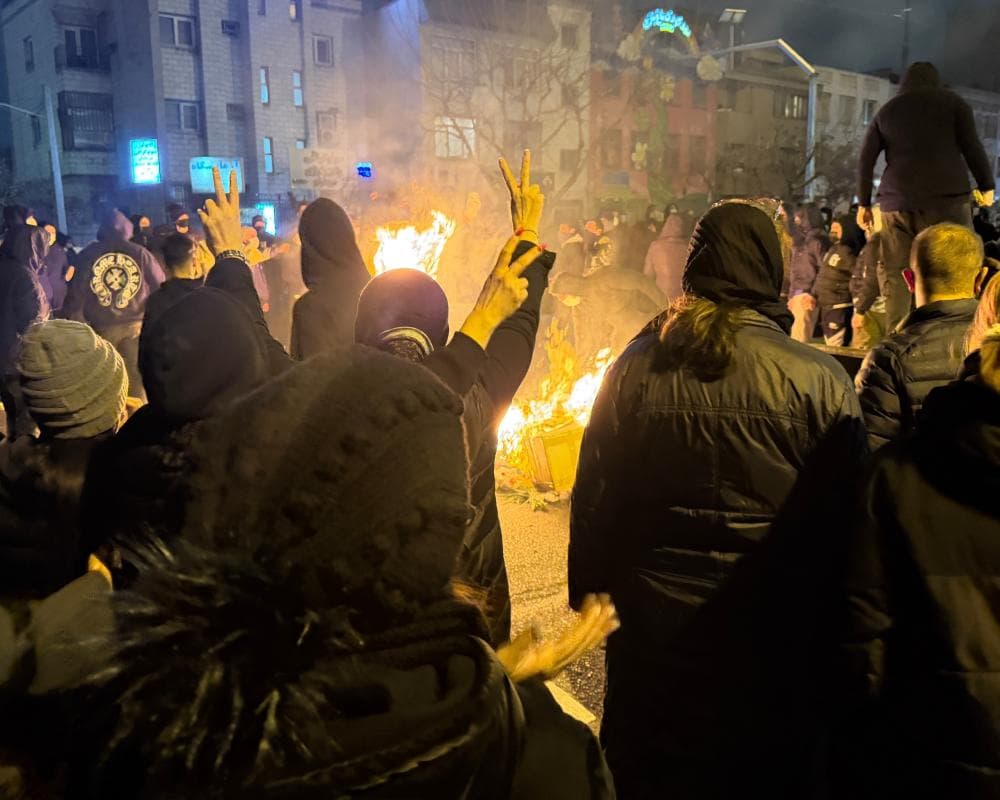
The Iranian government has signalled that detained protesters are to face speedy trials and executions, defying a threat by US president Donald Trump’s to intervene if authorities continued their crackdown.
The comments from Iran’s chief justice on Wednesday came as human rights groups warned that executions of protesters could take place soon. A 26-year-old protester, Erfan Soltani, was slated to face execution on Wednesday, the first anti-government demonstrator to be given a death sentence. It was unclear whether the execution had proceeded or not, as authorities typically carry out death penalties at dawn.
“I am in complete shock, I keep feeling as if I am in a dream,” Somayeh, a relative of Soltani, told CNN. “People trusted Trump’s words and came to the streets. I beg you, please do not let Erfan be executed.”
Iran’s signal that it will carry on with executions came despite Trump threatening to “take very strong action” if Iranian authorities begin executing anti-government protesters this week.
Israeli assessments, according to Reuters, indicate that Trump has decided to intervene in Iran, but it is still unclear what form or scale military action could take.
“If they do such a thing, we will take very strong action,” Trump told CBS News in an interview broadcast on Tuesday night, hours before the US president was due to be briefed on the scale of casualties inside Iran.
Neighbouring countries to Iran, including Turkey, Egypt and Saudi Arabia, have reportedly discouraged the US from intervening in Iran – warning that doing so could ignite a “full-scale war”.
That war would “certainly” have severe consequences “not only on the Middle East but on the global economy,” a Cairo-based diplomat told the Associated Press, pointing to a potential response by Iranian-backed militias across the region.
The death toll in Iran has soared as authorities have carried out a brutal crackdown, with 2,571 people killed and more than 18,100 people arrested, according to the US-based Human Rights Activists News Agency (HRNA). Already, the death toll from the two-week protest movement dwarfs any other in Iran since its 1979 revolution.
Protesters said there was a heavy security force on Wednesday as authorities prepared for a mass funeral of 300 security forces and civilians killed in demonstrations.
“We are very frightened because of these sounds [of gunfire] and protests,” a mother of two told the Associated Press on Wednesday. “We have heard many are killed and many are injured. Now peace has been restored but schools are closed and I’m scared to send my children to school again.”
Amnesty International highlighted Soltani’s case, warning of concerns that Iranian authorities might “once again resort to swift trials and arbitrary executions to crush and deter dissent”.
Iran’s judicial chief, Gholamhossein Mohseni-Ejei, told state media: “If we want to do a job, we should do it now. If we want to do something, we have to do it quickly. If it becomes late, two months, three months later, it doesn’t have the same effect. If we want to do something, we have to do that fast.”
Last year, Iran hanged at least 1,500 people, the Norway-based Iran Human Rights group said.
The 26-year-old was arrested in Karaj on Thursday, a city just on the north-west outskirts of Tehran, at the peak of the protests before the internet blackout.
Trump told CBS he was aware a “pretty substantial number” of people had been killed over the more than two weeks of demonstrations.
Iranian state television has offered the first official acknowledgment of the deaths, quoting an official saying the country had “a lot of martyrs”.
On Tuesday evening, the state department warned US citizens to leave Iran immediately, and various western countries issued similar travel warnings.
In his CBS interview, Trump was asked about the hangings reportedly set to begin in Iran on Wednesday and what he meant by “we will take very strong action”. The president referenced the recent US strikes on Venezuela and the 2019 killing of then Islamic State leader Abu Bakr al-Baghdadi, before issuing a warning to the regime.
“We don’t want to see what’s happening in Iran happen … When they start killing thousands of people. And now you’re telling me about hanging. We’ll see how that works out for them. It’s not going to work out good,” he said.
Earlier, Trump had posted a message of support to protesters on Truth Social.
“Iranian Patriots, KEEP PROTESTING - TAKE OVER YOUR INSTITUTIONS!!!” he wrote. “Save the names of the killers and abusers. They will pay a big price. I have cancelled all meetings with Iranian Officials until the senseless killing of protesters STOPS. HELP IS ON ITS WAY.”
In response, Iran’s UN mission vowed Washington’s “playbook” would “fail again”.
“US fantasies and policy toward Iran are rooted in regime change, with sanctions, threats, engineered unrest, and chaos serving as the modus operandi to manufacture a pretext for military intervention,” the statement posted on X said.
A Russian foreign ministry spokesperson characterised US pressure on Iran by saying that “external forces hostile to Iran are trying to use the growing public tension to destabilise and destroy the Iranian state”.
Iranian authorities have insisted they had regained control of the country after successive nights of mass protests nationwide since Thursday.
For the first time in days, Iranians were on Tuesday able to make phone calls abroad after authorities severed communications during the crackdown.
Security service personnel have apparently been searching for Starlink satellite internet terminals, as people in northern Tehran reported authorities raiding apartment buildings with satellite dishes.
While satellite television dishes are illegal, many in the capital have them in homes, and officials broadly had given up on enforcing the law in recent years. Activists said on Wednesday that Starlink was offering free service in Iran.
Meanwhile, Iranian state media has aired at least 97 confessions from protesters since 28 December, according to HRANA. The group said testimony it has collected from those released shows these confessions are coerced, often after torture. The group says such coerced confessions can lead to severe consequences, including state executions.
Witnesses, who have spoken to the Associated Press on condition of anonymity for fear of reprisal, said police were present at major intersections, and security officials in plain clothes were visible in public spaces.
Anti-riot police officers wore helmets and body armour while carrying batons, shields, shotguns and teargas launchers, they said.
With Associated Press and Reuters