Loading...
Please wait for a bit
Please wait for a bit
Click any word to translate
Original article by Miranda Bryant in Copenhagen
For the past three weeks, 24 hours a day, Denmark has been consumed by discussions about whether or not Greenland, a largely self-governing part of the Danish kingdom, will be invaded by the US, the Danes’ closest ally.
“We got a wake-up call,” said Linea Obbekjær, 64, as she left a supermarket with her bike in Copenhagen’s sprawling Østerbro neighbourhood. “So we are thinking about what is important to us.” Many had been spurred by recent events to take action. “People want to do something,” said Obbekjær. “Not sit and look at the television, but go out and do something.”
The country is working through a shared sense of anger and bewilderment that has bruised its pride and shaken its collective sense of self.
But as well as galvanising the Danish population against him, Donald Trump’s martial rhetoric – often arriving in the early hours of the morning thanks to the transatlantic time difference and his habit of posting on social media late into the US night – has also gone some way to easing tensions between Denmark and Greenland.
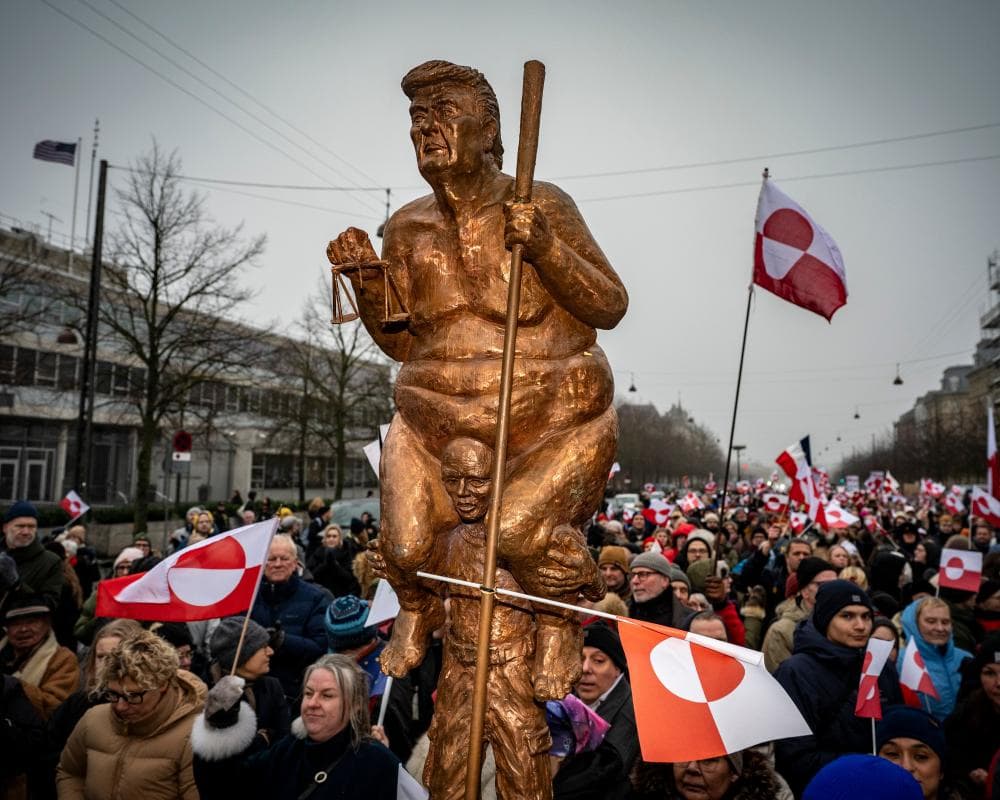
Last weekend, thousands took to the streets of Copenhagen in protest, waving red and white Greenlandic and Danish flags. Many wore Maga-style red hats bearing slogans including “Nu det NUUK!”, a play on the Danish phrase nu det nok, meaning “now it’s enough”, to incorporate the name of the Greenlandic capital.
Julie Rademacher, a member of Uagut, the national organisation for Greenlandic people in Denmark and one of the protest organisers, was overwhelmed by the support the protesters had received – from Greenlanders, Danes, Americans and people around the world. “The first half-hour in front of City Hall when this ocean of people just showed up, every time they cheered because of the speeches I couldn’t stop crying,” she said, her eyes welling up at the memory.
Like many in Denmark and Greenland, Rademacher has a family member who fought alongside US soldiers in Afghanistan and Iraq. “It’s been unbelievable to experience one of our closest allies threatening to annex our country,” she said. “But it is happening and we need to fight.”
Rademacher believes Trump has achieved the opposite of what he was seeking to do, in that Greenlanders have been pushed away from him, while relations between Greenlanders and Danes, while having a long way to go, are “under reparation”.
She cited a recent encounter on the streets between another member of Uagut and a Danish stranger who wanted to apologise for Denmark’s colonial abuses of Greenlanders. “One Greenlander, one Dane,” she said. “Our Greenlandic member was so touched by it, because it shows so much respect and trust.”
Jesper Rabe Tonnesen, 58, a vintage shop owner and creator of the Nu det NUUK! hats, said Denmark had gone on a journey from disagreement to unity.
“We feel threatened like the people from Greenland,” he said. “Of course, we are a little country – one of the best countries in the world, but a small economy. We can’t do anything about this without France and the greater nations.”
There was, he said, a feeling like wartime solidarity between Denmark and Greenland and with the EU.
Tonnesen said the cap had been “my little protest” eight months ago when people kept telling him that they had stopped paying attention to the news because it made them depressed. He had 80 made and nobody bought them, but after going viral a couple of weeks ago, supplies sold out in two hours. Hundreds more were made to distribute at the protest, with thousands more on the way. In another small act of defiance, the cafe at his creative workshop now calls Americanos “Canados”, in reference to another country in the crosshairs of Trump’s aggressive and erratic foreign policy whims.
The US, he said, had meant everything to Denmark in terms of defence but had also influenced culture. “In the fashion, the way of thinking, the American dream to become something, and especially maybe to take care of democracy to keep a free world,” he said. “And what we see now is not a free world any more in America. All the values in Denmark and almost all of Europe are changing now.”
Outside the US embassy, Tina Henriksen, 58, a nurse, who is half Greenlandic and half Danish, said Greenland and Denmark now “have to stand together”, adding that Danish people were “opening their minds to Greenland” in a new way.
Despite the signs of a newfound unity between Danes and Greenlanders, the colonial wounds run deep. As recently as December, victims of a historical IUD scandal, in which thousands of Greenlandic women and girls were forcibly fitted with contraceptive coils without their knowledge or consent, claimed victory in their legal fight with the Danish government after it was confirmed they would be eligible for compensation.
It was not until last year that “parenting competence” tests were banned on people with Greenlandic backgrounds after years of criticism by campaigners and human rights bodies, who argued successfully that the tests were racist because they were culturally unsuitable for people from Inuit backgrounds.
At the beginning of January, Björk drew attention to the scandals on social media and urged Greenlanders to declare independence. “I burst for sympathy for Greenlanders,” wrote the singer, who comes from Iceland, itself a former Danish dependency.
The post divided people in Denmark. One record store, RecordPusher in the city of Odense, responded by boycotting the star’s music entirely. Its chief executive, Bo Ellegaard Pedersen, said at the time that the statement had “in no way done anything good for the current situation of the Danish commonwealth” and accused her of “creating her own reality like Trump”. He added: “This post divides friends and only helps the idiot on the other side of the Atlantic.”
Speaking this week, Ellegaard said he had felt compelled to act because Björk’s comments felt like a “stab in the back”. He said he had been inundated with messages in the aftermath, including some calling him a racist and a colonialist, but he says many were positive.
When Jakob Hejnfelt Thoren, 37, the owner of Rekords, a hip-hop record store in Copenhagen’s Nørrebro district, saw the boycott post, he decided to do the opposite and started stocking Björk records.
While he does not necessarily agree entirely with what Björk wrote, he wanted to support the right to freedom of speech. “Being a part of hip-hop culture it comes very natural to be on the oppressed side,” he said in his store, its racks filled with hip-hop classics by artists including The Notorious BIG and 2Pac.
Greenland is “trapped between these two colonisers, so of course we are on their side”, he added.
A father of two small children, he wakes up every morning checking the news and is worried about what might happen with Trump’s politics suddenly feeling so close to home. “You never know what Trump is going to say, what he is going to do.”
Danish students Emily Jensen, 26, and Rikke Nielsen, 26, said the current crisis had been dominating conversations at home. “It’s impossible to understand what he is going to do actually so it’s really frustrating and scary,” said Jensen.
They have been trying to learn more about Greenlandic people. Nielsen said she had become more aware of Denmark’s colonial history with Greenland when the prime minister, Mette Frederiksen, last year apologised to victims of the IUD scandal.
Others have been showing their outrage with the US by boycotting US products. Usage of Made O’Meter, an app that helps people to identify US products in Danish supermarkets, rose by 1,400% in the days after Trump started threatening tariffs against Denmark and other allies that opposed his plans to invade or buy Greenland.
Ian Rosenfeldt, who created the app last March when the US president first hit Europe with tariffs, said this time the reaction was different. “The shock has turned into clarity,” he said. “An ally became someone we cannot trust and one we’re far too dependent on.” People in Denmark and across Europe were realising they needed to reduce their reliance on US technology, products and platforms, he added.
Not everybody thinks the US president has permanently damaged US-Danish relations.
In a coffee shop on Wednesday afternoon, as Trump finished his Davos speech, 76-year-old Mette Jensen said of the relationship: “Of course they can be repaired. But not with Trump.”