Loading...
Please wait for a bit
Please wait for a bit
Click any word to translate
Original article by Rachel Savage in Johannesburg
In Thembelihle, an informal settlement south of Johannesburg where thousands of breeze-block houses and metal shacks line dirt streets flooded with filthy water, Malawians had lived for years alongside South Africans without any problems.
But in the last few weeks, a series of armed robberies has shaken the community. On 29 June, several men broke into the compound of Eibraheem Hussein, a 60-year-old Malawian who has lived in South Africa since 2000. They beat him and stole valuable items.
On the night of 16 July, a gang robbed at least four Malawian households in Thembelihle. The five men told the terrified Malawians to go home in Zulu.
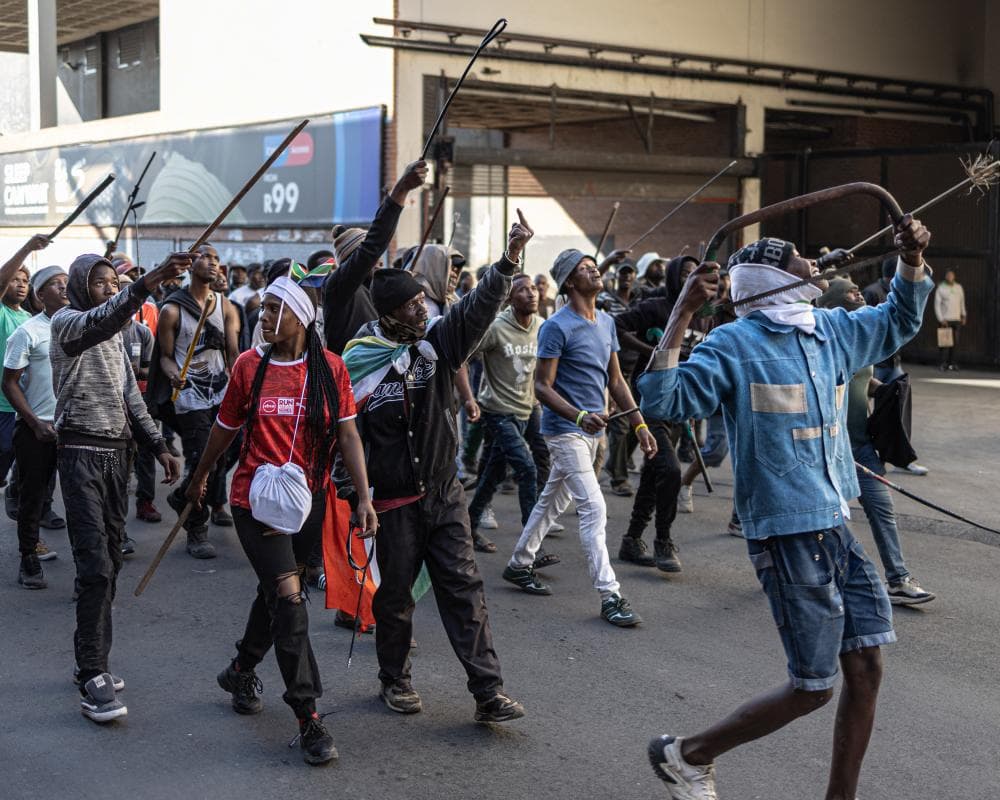
Since March, South Africa has been roiled by often violent demonstrations against illegal immigration. More than 160,000 people from countries including Mozambique, Nigeria and Zimbabwe have left South Africa, according to an AFP tally of official figures, at least 54,000 of whom were deported. At least four people have been killed.
While South Africa has imported labour for generations, immigration rose after Nelson Mandela welcomed people from across Africa when he became the first black and democratically elected president in 1994. Poverty and political repression in some neighbouring countries also pushed many people south.
South Africa’s foreign-born population almost trebled to 2.4 million between 1996 and 2022, according to the census, which aimed to include undocumented people. That represented 3.9% of the 62 million population, up from 2% in 1996. South Africa’s government has said it is working to improve immigration data.
As frustration has grown at South Africa’s high levels of unemployment and inequality, so too has the scapegoating of other Africans. This tension has periodically erupted into often fatal violence.
The current wave of protests about immigration peaked on 30 June, which was an unofficial deadline given by campaign groups for illegal immigrants to leave the country. But the attacks and displacement have continued, leading to thousands more fleeing South Africa this month.
At marches, which are still taking place regularly, people have been thrown out of their homes as police look on. Meanwhile, criminals are taking advantage of the chaos, further terrorising immigrants.
At about 9pm on 16 July, five men kicked down Moosa Addi Kunje’s door, beating him when he said he had no money. His eyes filled with tears as he recounted how the gang took his fridge, TV and mobile phone.
“You can see the blood was flying all over here,” he said, gesturing around him. There was blood all over the floor, splattered on the white curtain dividing the room and smeared on the wall.
When Kunje returned from a nearby clinic, he had stitches where he had been hit on the head with a pistol. His grey tracksuit was covered with dried blood.
Aisha Muhammed, one of Kunje’s neighbours, said they took 4,000 rand (£180) she had been saving for returning to Malawi. “They said: ’You are foreigners. You want to go, you must go,’” she said.
Two other households reported being robbed later that night by five men. All said that they wanted to go back to Malawi, but now couldn’t afford to.
Last week, thousands of Malawians slept without shelter outside their consulate, in an affluent area of north Johannesburg, as temperatures dropped below 10C (50F).
Among those waiting to board buses back to Malawi were dozens of women with young children. One, who did not want to give her name, had been fired by the family she was cleaning for, which had pushed her to leave South Africa with her eight-year-old son.
She left behind her husband, who said he was also fired from his job after 17 years. He was staying to save money to transport their possessions back to Malawi, but already missed his family. “My son, I want to talk to him every time,” he said.
There have been numerous cases of migrants unable to access healthcare, said Claire Waterhouse, who was managing a Médecins Sans Frontières pop-up clinic outside the consulate.
These included two cases of drug-resistant tuberculosis at a temporary displacement camp in Musina, near the Zimbabwe border, and a woman who had severe hallucinations after she was blocked from entering a government clinic to get her psychiatric medication, Waterhouse said.
“There is no humanitarian crisis,” the justice minister, Mmamoloko Kubayi, told a media briefing, when asked about conditions at the Malawian consulate and Musina. The government is only obliged to provide emergency care for illegal immigrants, she said.
The law guarantees everyone in South Africa access to primary healthcare, regardless of their immigration status, said Sasha Stevenson, the executive director of Section27, a human rights NGO.
Jacinta Ngobese-Zuma, the leader of March and March, one of the groups that imposed the deadline for illegal immigrants to leave South Africa, said on 30 June that they would continue demonstrating every Thursday for six months until all had left.
Critics of the marches have accused the organisers of deflecting blame for South Africa’s issues from the government on to migrants.
“With South Africa, we have made a call to say can we have illegal immigrants vacate the country first, so that we can deal with the problems of the country,” Sandile Dube, March and March’s spokesperson, said.
Some government ministers have questioned why the marches were continuing, noting the timing before highly contested local elections in November.
The opposition party uMkhonto we Sizwe, led by the former president Jacob Zuma (who Ngobese-Zuma has said is not a direct relation of her husband), has expressed support for the marches. Smaller parties, including ActionSA and the Inkatha Freedom party, which is in the national coalition government, have also backed the demonstrations.
On 16 July, about 50 people, carrying sticks, clubs and a hacksaw, marched through the Johannesburg township of Alexandra, chanting and singing in Zulu. March leaders initially encouraged protesters to remain peaceful.
But by the afternoon, dozens began breaking down doors as police stood by. They appeared to be indiscriminate in their targeting, with South Africans affected as well as migrants. Karel Shirilda, a South African, said it was the second week that his door had been broken. Ketibone Lamola, another South African, said her children were terrified. “When you come in here and start fighting, you traumatise my kids,” she said.
Two men, who marchers claimed were illegal immigrants from Malawi, were dragged out of a garage and taken away by police. Two women, one hyperventilating, the other holding a baby, were also driven away in a police vehicle, an officer claiming it was for their “safety”.
In at least one instance, marchers demanded to see someone’s immigration documents.
The Alexandra march was not a March and March event, the spokesperson said, adding the group disavowed responsibility for any violence or other illegal activities at marches. “We don’t stand for that,” he said. “We absolutely reject it with the contempt it deserves, any touching of any person, because we are law-abiding.”
“No one is allowed to go door to door demanding identification as that is tantamount to impersonating a law enforcement officer, which is a criminal offence,” said Brenda Muridili, a police spokesperson.
Asked about the Thembelihle incidents, police not intervening in Alexandra and whether those taken away at that march were arrested for breaching immigration law, she said: “I can only report on what has been recorded by the SAPS [South African police service].”