Loading...
Please wait for a bit
Please wait for a bit
Click any word to translate
Original article by Angela Giuffrida
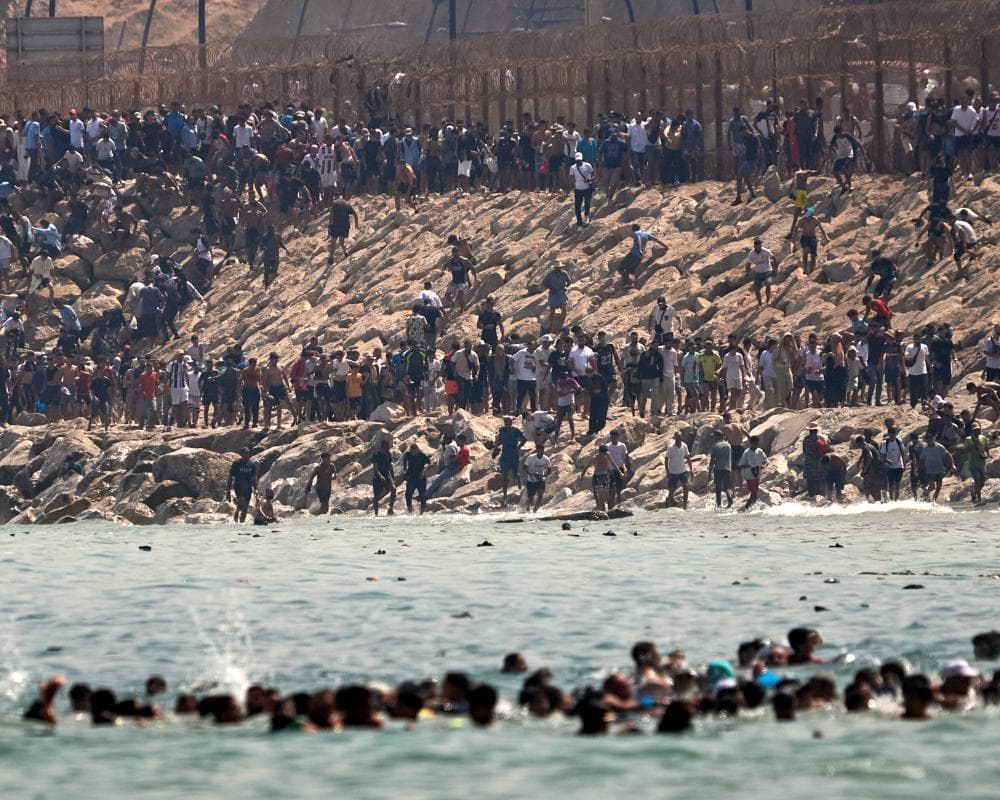
Border controls between Morocco and the tiny Spanish territory of Ceuta appeared to break down in recent days, allowing an estimated 50,000 people to cross on to the Spanish side in chaotic and dangerous scenes that resulted in dozens of deaths.
The number of arrivals was more than two-thirds the size of the ordinary population in Ceuta, where a humanitarian crisis was playing out on Friday.
As of Friday evening, more than 37,500 people had been returned to the Moroccan side of the border, with hundreds more going back by the hour.
Ceuta and Melilla, another Spanish territory 250 miles to the east along north Africa’s Mediterranean coast, constitute the EU’s only land borders with Africa.
In Spanish possession since 1580, Ceuta is home to a mixed population of Christians and Muslims, while its Spanish and Moroccan residents and day workers live in relative harmony. Morocco does not officially recognise Ceuta and Melilla as Spanish territories and often refers to them as occupied lands.
Spain is a main point of arrival into Europe for people seeking better economic opportunities or an escape from violence in their home countries. Ceuta and Melilla are heavily fortified as they are seen as destinations for those trying to reach Spain from Morocco and other parts of Africa.
Many migrants who reach Ceuta or Melilla are immediately turned back, but others are held in migrant shelters while they apply for asylum in Spain.
To reach Ceuta, people often swim from the Moroccan town of Fnideq, covering about 3 miles (5km). Others attempt the crossing from the nearer town of Belyounech.
In 2022, 23 people were killed as about 2,000 people, mostly from sub-Saharan Africa, attempted to cross into Melilla from Morocco, while in 2014 at least 14 people died off Ceuta when 200 people tried to enter by climbing the border fence or swimming around the breakwater that separates the city from Moroccan territory.
Migrant arrivals to Ceuta and Melilla are generally much lower than those reaching Spain through the Canary and Balearic islands.
Spain’s overall immigrant population has grown considerably in recent decades, with about 10 million people in the country of 50 million having been born elsewhere. Many are from Colombia, Venezuela and Morocco and work in key sectors of the Spanish economy including agriculture, tourism and the services sector.
Since at least the mid-1990s, thousands of people cross the Mediterranean each year from north African countries and Turkey in search of asylum in Europe. According to figures from the International Organization for Migration, 35,153 migrant deaths and disappearances have been recored in the Mediterranean since 2014, with 1,493 dead or missing during the first seven months of 2026.
It was not immediately clear. Moroccan authorities have not yet issued a statement, and it is unclear how hard they tried to prevent the crossings.
However, the crossing could be linked to the rivalry between Morocco and Algeria, and a recent trip by the Spanish prime minister, Pedro Sánchez, to Algiers.
The last mass border crossing, in May 2021, took place after Morocco loosened border controls during a diplomatic row with Spain over Spain’s decision to allow the leader of the Western Sahara independence movement, the Polisario Front, to be treated for Covid-19 in Spain.
Morocco and the Polisario Front both lay claim to Western Sahara, which was under Spanish rule until 1975, when colonial authorities handed over the territory to Morocco and Mauritania.
That diplomatic crisis ended in 2022 when Madrid reversed its longstanding policy of neutrality and backed Morocco’s plan for Western Sahara – a move that had caused a diplomatic rift between Madrid and Algiers, which supports the Polisario group.
Sánchez visited Algiers on 20 July – the first such visit by a Spanish head of government in four years – marking a thaw in relations with Algeria.
Speaking from Ceuta on Friday, Sánchez blamed the sudden inflow on human traffickers spreading rumours about a recent Spanish supreme court ruling that irregular migrants arriving by sea cannot be immediately returned.
Matteo Villa, a migration researcher at the Italian Institute for International Political Studies, said politics was most likely involved. “What happened in 2021 was the small-scale version of what happened yesterday,” he said. “I mean, 50,000 people do not come overnight when usually it’s hundreds per month. Sánchez going to Algeria is something Morocco didn’t really like.”
Villa suggested Morocco may have loosened the border as a way of showing it has “the upper hand”, especially because authorities there know it would cause an overreaction in Europe. “They love seeing all the fighting between European countries,” he added.
Spain deployed its armed forces and additional police to restore order after the breach, which Sánchez described as “a violation of Spain’s territorial integrity”.
Images and footage of the border chaos sparked a crisis for the Spanish government and divisions within the EU, where rightwing politicians blamed the incident on Spain’s policy of legalising hundreds of thousands of irregular migrants this year.
Italy’s far-right government went so far as to call for Spain to be suspended from the Schengen free-movement zone – even though Ceuta and Melilla do not fall under Schengen arrangements in the usual way – while France tightened its borders with the country.