Loading...
Please wait for a bit
Please wait for a bit
Click any word to translate
Original article by Facundo Iglesia in Avellanada
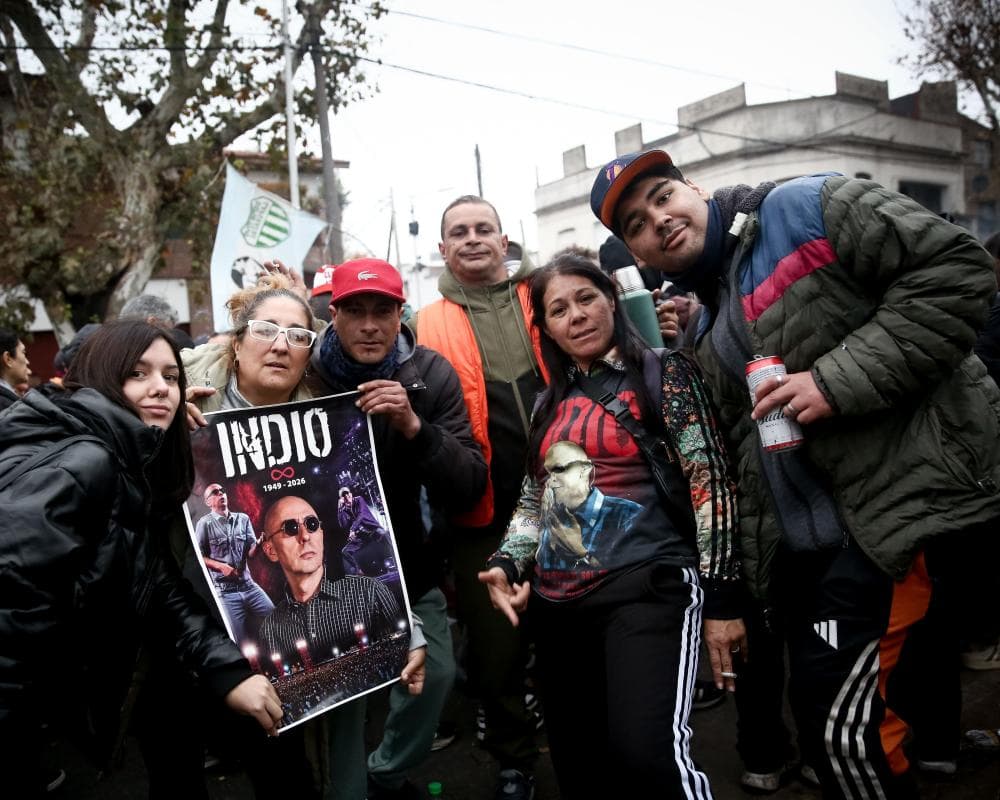
The line stretched for more than 7km (four miles). Mourners sang rock songs, waved banners, and carried speakers blasting music while smoke rose from makeshift barbecues and vendors sold T-shirts bearing the image of a bald man with sunglasses.
As evening fell, a drizzle set in, but the queue remained. At the end of the line in Avellaneda, outer Buenos Aires, stood a chapel containing the body of a rock star.
Hundreds of thousands of people attended the wake on Sunday for the singer Carlos “Indio” Solari.
Solari, who died on Friday from a stroke at the age of 77, was widely regarded as Argentina’s most popular musician: his last concert in 2017 was attended by as many as 400,000 people.
But his popularity challenges assumptions about a shared Latin American cultural sphere: Solari was virtually unknown outside Argentina and neighbouring Uruguay, which shares much of its cultural and linguistic heritage.
His lyrics – usually dense, cryptic, and laden with literary, political and historical references – inspired a devoted following that cut across generations, though it is particularly strong among working-class young people. Ji ji ji, a frenetic anthem, or La gran bestia pop, a critique of the music industry, are ubiquitous at weddings, football matches and parties across Argentina. Phrases such as “every prisoner is a political prisoner” or “violence is to lie” became mottoes for political resistance.
Solari co-founded the influential rock band Patricio Rey y sus Redonditos de Ricota in 1976. After the group split in 2002, he continued performing with a new band until Parkinson’s disease forced him to stop appearing live.
He openly identified as a Peronist, and the far-right government of Javier Milei rejected permission for a wake in the congress building. The ceremony was instead held in Avellaneda, a district governed by Peronists.
“The best things in Argentina were El Indio and Maradona,” said Lorena Núñez, one of the mourners waiting in line. Núñez, an Uruguayan pharmaceutical worker, crossed the Río de la Plata to attend the wake. “He taught us the value of the word – by forcing us to think to interpret his lyrics,” she said. Quoting verses from Solari’s songs, her friend Matías Rodríguez, who travelled with her, said: “El Indio isn’t just a singer: to us, he’s like family; to me, he’s my old man.”
Pablo Alabarces, a sociologist who studies popular culture, said the reason Solari’s music did not travel was “the poetic and musical language”.
“It is a very distinctive style of rock that you don’t hear elsewhere in Latin America. That cryptic yet working-class poetic style is very Argentine. There is no such thing as ‘neutral’ Spanish in El Indio’s poetry, which makes it comprehensible only to a local audience,” he said.
Alabarces said Solari’s career exposed the limits of cultural globalisation. While contemporary genres such as trap and reggaeton circulated easily across Latin America, rock music remained shaped by distinct national histories and political experiences. “Making rock music under the PRI’s ‘perfect dictatorship’ in Mexico is not the same as doing so under Videla’s terror regime in Buenos Aires,” he said.
According to Pablo Perantuono, a journalist who co-authored a book about Solari’s band, his music was rooted in a cultural synthesis that was cosmopolitan yet “distinctly Argentine”, drawing on disparate influences including tango, the beatniks, and Anglo-American rock music. “It is an exceptional movement because it is very hard to track its bloodline,” he said.
Solari self-produced his music, refused major labels, rarely gave interviews, and cultivated an austere, working-class image even in his concerts – things that, Perantuono said, his fans at home appreciated as “a very strong statement of principles” but hampered his music’s chances to be marketed overseas.
“Argentine audiences have a kind of visceral passion in their tastes that you probably won’t find anywhere else,” said Perantuono, arguing that foreign bands such as the Ramones or the German punk band Die Toten Hosen have had a bigger following in Argentina than in their home countries.
At Sunday’s wake, mourners threw flowers, shirts and banners on to Solari’s coffin. Daniel “Roli” González, a 37-year-old maintenance worker, struggled to hold back tears. “It’s beautiful; it’s a privilege to experience this,” he said, gesturing towards the crowd, which kept singing. “You can’t experience this anywhere else. This is unique.”