Loading...
Please wait for a bit
Please wait for a bit
Click any word to translate
Original article by Jillian Ambrose and Joanna Partridge. Graphics by Tural Ahmedzade
Donald Trump has claimed that the US has been conducting a “secret mission” in the strait of Hormuz to help Gulf petrostates bypass Iran’s chokehold on oil flows – which has roiled global energy markets for months.
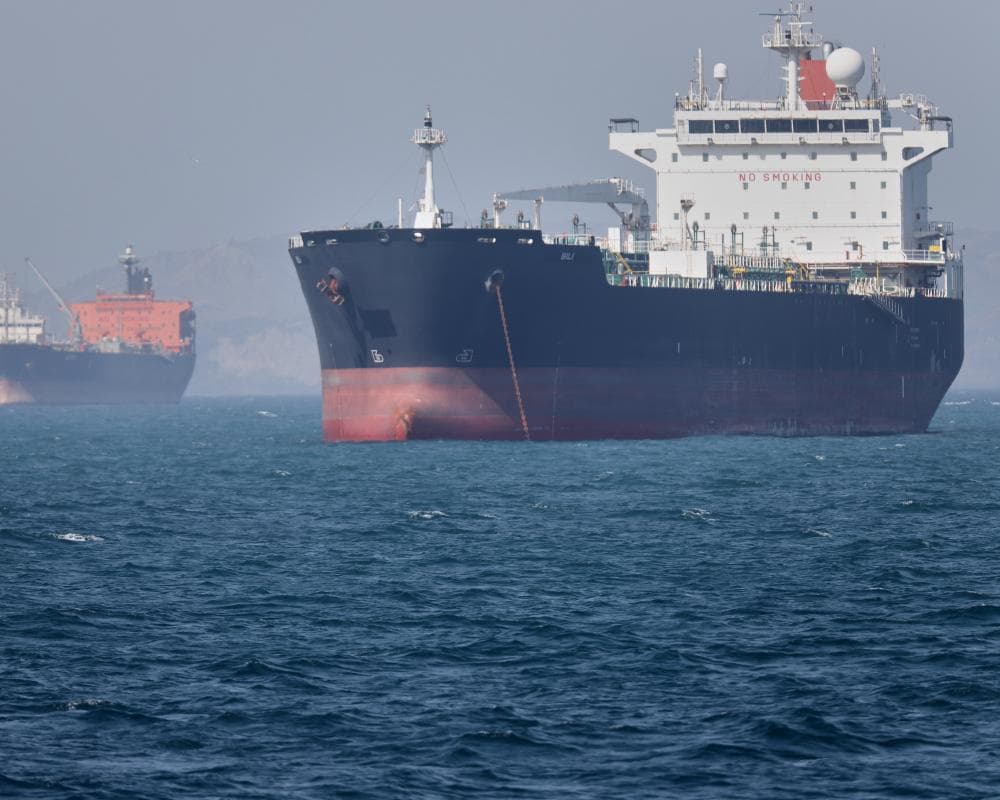
In televised comments from the Oval Office on Wednesday, the president claimed Iran was unaware that dozens of tankers had been escorted out of the blockaded channel at night with their transmitters off.
He later wrote in a post on his Truth Social platform that 200 vessels had got out this way, transporting more than 100m barrels of oil to global buyers.
So what is actually going on?
Trump’s energy secretary, Chris Wright, told a congressional hearing after the comments that he was unaware of the US having helped get millions of barrels out, but earlier in the hearing he did say the US military had helped get some oil out of the strait.
It seems hard to believe this development was a secret to Iran, given recent reporting in multiple news outlets about a rising number of tankers being shepherded out of the waterway at night with their Automatic Identification System (AIS) transmitters switched off to avoid detection.
According to Lloyd’s List, a leading provider of maritime intelligence, the US has been helping some of these “shadow transits” by running “overwatch operations”, using autonomous vehicles, aircraft and drones to escort them through the southern part of the strait, close to the coast of Oman and out of the line of fire from Iranian territory.
Once vessels are out they transfer their cargoes to other waiting tankers undetected before returning to the Gulf to reload more oil and gas.
Richard Meade, the editor-in-chief of Lloyd’s List, said: “Tankers are exiting the Gulf, they’re then conducting ship-to-ship transfers to other tankers in the Gulf of Oman.
“Those empty tankers which ran the strait with their AIS off, run back through the strait and pick up new loads of oil from the UAE, Saudi, Bahrain, Qatar and Iraq. And this operation is happening in the dark.”
The number of oil and gas tankers transiting is nowhere near pre-crisis levels, but there is evidence that more are making their way back to the global market.
Before the crisis 138 ships a day were transiting the waterway on average, according to the Joint Maritime Information Center.
But once the war began about this same number of vessels were estimated to have made the journey in the whole month of March, according to Lloyd’s List intelligence.
Today, about 25% of the tankers present in the Gulf at the start of the crisis have managed to leave the region since the conflict began, according to Lloyd’s List. These have included ships carrying oil and gas to buyers in the global market.
However, the amount of oil and gas getting out could be much higher than this figure suggests. This is because turning AIS off makes the exact movement of tankers hard to track, and some are believed to be going back and forth through the strait to ferry fossil fuels to vessels waiting in the Gulf of Oman.
Satellite images show these “dark tankers” loading at Gulf ports before undertaking shadow transits and ship-to-ship transfers. Analysts at Lloyd’s List were able to record 36 transits through the strait between 1 and 7 June, or which 17 were “dark” and 19 were traceable.
However, they caution that they sometimes only see with a week’s delay that a ship has previously transited the strait, when it switches its transmitter back on in a different location, often far from the strait, making the exact number of dark transits difficult to gauge.
Given the difficulty of counting dark transits, Trump’s 100m barrel figure cannot be fully factchecked, but according to market analysts at data firm Kpler it could be broadly consistent with the crude flows it has observed from Gulf producers, excluding Iran. Even if accurate, it only equates to the volume that would have passed through in five days in normal times.
Nevertheless, market observers believe much more oil could be leaving the Gulf than previously thought as clandestine flows via dark transits and shuttle tankers may have picked up in recent weeks.
Ship-to-ship transfers may have helped an average of about 1.9m barrels of oil a day to move through the strait of Hormuz to the Gulf of Oman since the start of April, according to Kpler.
The figure may have reached highs of 2.1m barrels a day in late May, according to estimates from JP Morgan, or even as high as 2.9m barrels per day, according to investment bank Piper Sandler. However, that represents just a fraction of the 15.6m barrels that flowed through the strait per day before the war.
In recent weeks the price of Brent crude has tumbled from over $110 a barrel at the start of last month to about $93 a barrel this week, even as global oil inventories continue to fall, and some of this may be down to tankers beating the blockade.
JP Morgan noted this week that “surprising volumes of crude and petroleum products still appear to be transiting the strait” despite the ongoing naval blockade, thanks to the clandestine shipments.
In addition, Saudi Arabia and the United Arab Emirates are continuing to reroute a total of 4.5m barrels a day out of the Gulf via pipelines. At the same time, China has slowed its imports in favour of drawing on its record high stockpiles.
However, without a return to normal oil flows, rising prices are expected to return.
“Things are going to get worse,” according to Jan Stuart, global energy economist and strategist at Piper Sandler. He expects the price of Brent crude to average $130 a barrel in July and August as global oil inventories continue to sink and demand for fuels during the summer driving season rises.