Loading...
Please wait for a bit
Please wait for a bit
Click any word to translate
Original article by Shaun Walker in Budapest
Hungarian rights groups have raised concerns over the appointment of Vladimir Putin’s former interpreter to a key role in an international election monitoring mission, amid fears of Russian interference ahead of Hungary’s crucial vote next month.
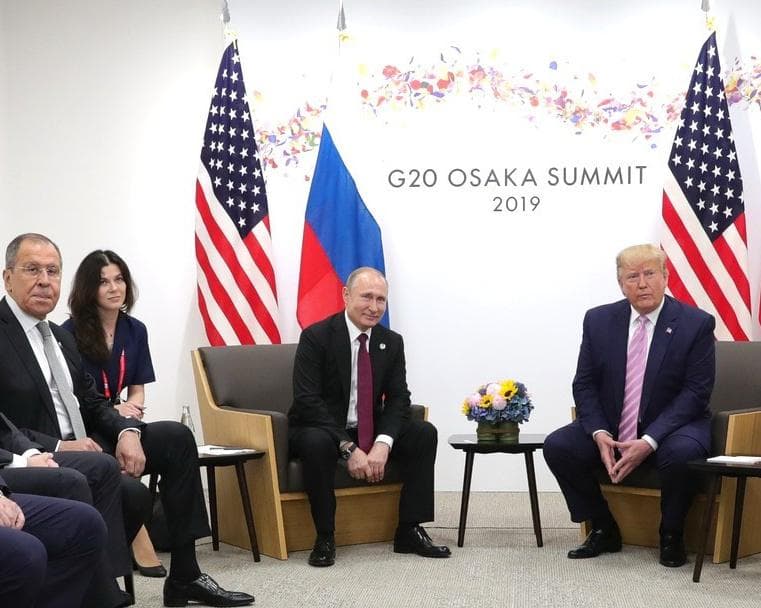
Daria Boyarskaya, who worked for many years for Russia’s foreign ministry and interpreted in numerous high-level meetings including one between Putin and Donald Trump, is now a senior adviser at the parliamentary assembly of the Organization for Security and Co-operation in Europe (OSCE-PA), based in Vienna. She is coordinating the body’s mission to monitor next month’s parliamentary election in Hungary.
The vote could end the nationalist leader Viktor Orbán’s grip on power after 16 years in charge. Orbán is the EU’s most pro-Russian EU leader and he has made criticism of Ukraine and its president, Volodymyr Zelenskyy, a key pillar of his election campaign, as well as blocking EU loans to Ukraine. There have been numerous allegations that Russia has been deploying assets to boost Orbán’s chances in the vote.
Over his long years in charge, Orbán has frequently targeted civil society groups and independent media, and in a number of recent speeches he has referred to them as “bugs” who need to be cleansed or quashed. Given this chilling climate, and the close relations between Orbán and Moscow, some worry about sharing their concerns with a figure with clear links to the Kremlin.
Boyarskaya invited representatives of civil society organisations to a closed-door meeting next week in Budapest to share their concerns about the Hungarian political landscape. The delegation will be led by the British Labour MP Rupa Huq and Sargis Khandanyan, an Armenian MP, and is meant to lay the groundwork for a much larger monitoring mission made up of MPs from OSCE member nations that will travel to Hungary around the time of the vote.
“Such meetings often involve the exchange of highly sensitive information concerning political pressure, electoral manipulation risks and threats faced by human rights defenders and journalists,” wrote Márta Pardavi, a co-chair of the Hungarian Helsinki Committee, in a letter sent earlier this month to various OSCE officials and seen by the Guardian. The Austrian weekly Falter and Bloomberg previously covered aspects of the story.
Whether or not Boyarskaya retained links with Russian official bodies, she said, “even the perception that confidential exchanges could be accessed by malign external actors” would prevent rights activists from speaking freely.
Pardavi therefore requested that the OSCE-PA should consider “immediately removing Ms Boyarskaya from all her tasks related to the election observation mission in Hungary, and ensuring that Ms Boyarskaya does not have access to sensitive election-related information or civil society interlocutors going forward”.
In a strongly worded response to Pardavi also seen by the Guardian, Roberto Montella, the Italian secretary general of the OSCE-PA, claimed her letter had a “slandering nature”. He said he had personally selected Boyarskaya to take part in the mission to Hungary and said she enjoyed his “full trust and confidence”.
He suggested an external auditor had looked into Boyarskaya in 2023 and made the “unequivocal” conclusion that allegations against her were unfounded.
Boyarskaya has worked with the OSCE on and off for more than a decade and was hired full-time in 2021. There is no evidence she has any relationship with Russian intelligence or shares information with the Russian government.
In an emailed response to questions, she said she abided by OSCE rules by which “all staff members are explicitly prohibited from accepting instructions from their national authorities”.
Unlike many OSCE employees who are seconded by their governments, Boyarskaya is directly hired by the body. Nat Perry, a spokesperson for the OSCE-PA, said: “The Russian government does not pay Ms Boyarskaya’s salary, nor has it done it so in the past.”
Security sources say international bodies such as the OSCE-PA are a target for Russian and other intelligence services.
Andrei Soldatov, an author who has written extensively on Russian intelligence networks and is currently a visiting fellow at King’s Centre for the Study of Intelligence in London, said: “Organisations like this are a prime target for Russian intelligence penetrations: it’s international, has access to sensitive information and is in the centre of Europe, which is now elevated to Moscow’s primary target.”
As an interpreter for Putin, Boyarskaya would almost certainly have come under the view of the Russian security services. “With that level of access to the ‘first person’, she would need to have the highest-level clearance, which usually includes understanding of the needs of the security services, if they would ask something,” Soldatov said.
Fiona Hill, Trump’s national security adviser on Russia during his first term, has claimed that in a 2019 meeting in Osaka, Putin swapped in Boyarskaya at the last minute as a means of distracting Trump with an attractive female translator.
“There had been somebody else on the list, a man, intended to translate for that particular session, and at the very last minute the Russians swapped out for that translator,” Hill said in a 2021 interview with Good Morning America.
“It was clearly intended to draw attention because President Putin made a big point of introducing President Trump to the interpreter, which is something he didn’t normally do,” Hill said, although she added that Boyarskaya proved to be an “excellent translator”.
In late 2022, Poland declared Boyarskaya persona non grata ahead of an OSCE-PA meeting in the country, saying her presence would “pose a threat to state security”, according to media reports at the time.
Travel records available in leaked Russian databases show she has continued to visit Russia regularly since the full-scale invasion of Ukraine in 2022.
Additional reporting by Pjotr Sauer