Loading...
Please wait for a bit
Please wait for a bit
Click any word to translate
Original article by Ajit Niranjan
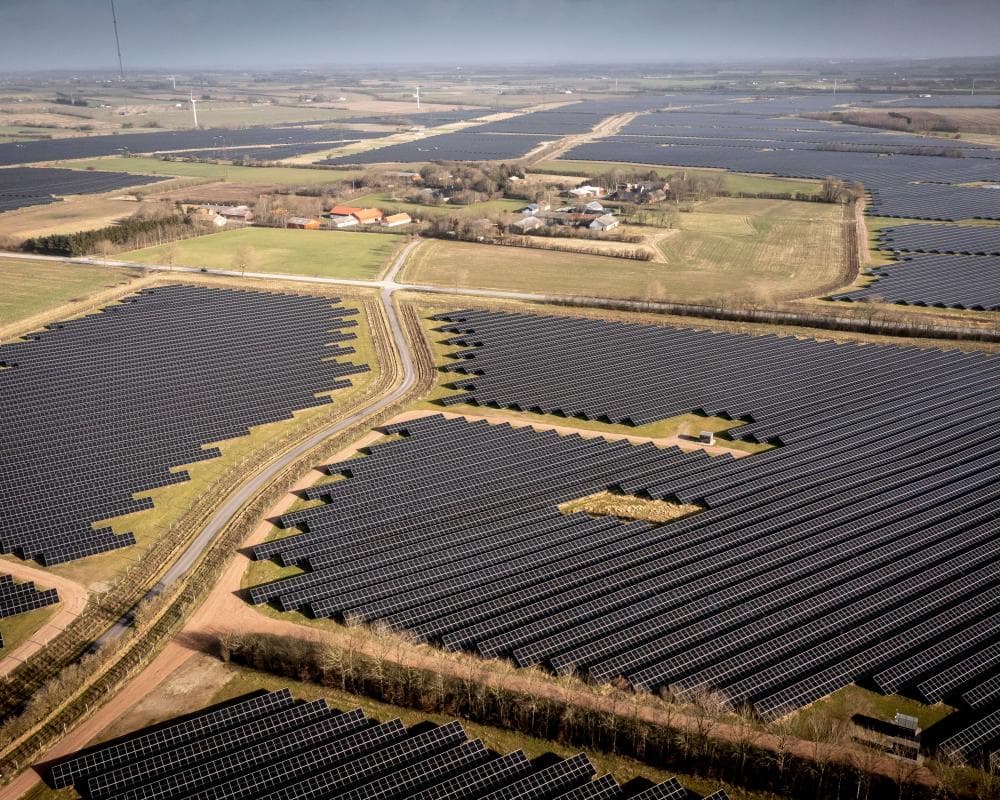
In one telling of the story, the golden fields of a proud farming nation are under attack. Besieged by an industrial sprawl of solar panels, they are being smothered at the behest of an urban elite.
That narrative has failed to thrive in conservative heartlands such as Texas and Hungary, which have embraced solar power while lambasting green rules. But it is taking root in Denmark, the most climate-ambitious nation on Earth. “We say yes to fields of wheat,” said Inger Støjberg, the leader of the rightwing populist Denmark Democrats in a speech in 2024. “And we say no to fields of iron!”
Jernmarker, or iron fields, was chosen as the Danish word of the year in December after the solar backlash swayed municipal elections and prompted some councils to pull projects. The spectre of barren metal landscapes has since returned to the campaign trail as Danes prepare to vote in national elections on Tuesday. “We need more common sense in the green transition,” Støjberg said in the first televised debate between party leaders last month.
Pockets of resistance to clean energy have hardened across Europe as far-right parties focus on climate action as their second target after migrants. Until now, solar panels had escaped the wrath of powerful campaigns that have stymied the rollout of wind turbines, heat pumps, electric cars and plant-based meat.
But in Denmark, which generates 90% of its electricity from renewables and aims to cut planet-heating pollution faster than any other wealthy country, the spread of solar power has alarmed some regions in which construction is concentrated. Solar tripled from 4% of Danish power production in 2021 to 13% in 2025. And a handful of villages have found themselves surrounded by silicon.
Opponents of solar farms say the photovoltaic panels are ugly, destroy nature and deflate property prices in neglected hinterlands. As drone shots of encircled farmhouses have become a symbol of urban overreach, the campaign has led even some established parties to soften their support of solar.
The backlash had been brewing locally, but Lukas Slothuus, a climate politics researcher at the University of Sussex who grew up in a rural town near the Danish-German border, said the Denmark Democrats had provided a “clear vector to articulate that discontent politically” across the nation. “The far right have realised – and decided – that climate is a potent electoral battleground,” he said. “It’s just about finding one issue to centre it around.”
The resistance has led to cancelled projects. The municipality of Køge voted in January to cancel a renewable energy park in Vallø, and in Viborg, the council voted last month to stop a planned solar farm in Iglsø while approving only the wind and biogas components of another project in Vinge. In Samsø, the first island in the world powered entirely by renewables, councillors from across the political spectrum voted last year to reject a solar park.
In Ringkøbing-Skjern, the country’s solar heartland, the appetite for new projects has dried up. Mads Fuglede, a Denmark Democrats politician who was elected to its council in November, said: “Solar panels have become a symbol of the political elite that wants a green transition and doesn’t care about what happens to the countryside. Because that’s not where they live or where their voters live.”
Unlike some of their political counterparts across Europe, who deny climate science and oppose cutting pollution, the Denmark Democrats say they support the shift to a clean economy. Fuglede said the party was not against solar as a technology. “You can get your solar panels, but put them up where you live in the cities. There’s no need to cover farmland.”
Denmark has long enjoyed public support for its shift to a clean economy and ambitious green rules such as the world’s first tax on farm pollution. A poll in November found 77% of people whose vote was influenced by green energy projects were in favour of them. But among the two biggest rightwing-populist parties, whose voter base is concentrated in rural regions, more than 80% were opposed.
Some argue that the political noise surrounding solar power does not match the scale of the issue. Solar panels cover the equivalent of only 0.2% of Danish farmland, according to the Danish Solar Association, and about one-third of solar capacity is installed on rooftops.
Some municipalities have responded to the backlash by advancing projects with less fanfare. Camilla Holbech, the vice-president of renewable energy at Green Power Denmark, said: “Municipal politicians that are in favour have been green hushing: not being too vocal about it, they’ve just gone out and done it.”
The resistance has raised wider questions about how clean energy developers can win the support of local communities as renewables boom.
Henrik Stiesdal, an inventor who built one of Denmark’s first wind turbines in the 1970s and went on to build its first offshore windfarm in 1991, said: “The thing that has changed since the first decades is Facebook. Even though the greater population feels things are good, you can get enough local people and enough not-local-but-angry people to provide opinions.”
Ultimately, the bigger threat to solar may be its own success. Projects in Denmark have few sunny days a year in which they can make money, and as more solar panels have been laid, the number of days with negative electricity prices has soared, leading to a cannibalisation of profits. The slow electrification rate and congestion in the electricity grid has further frustrated developers.
Torsten Hasforth, the chief economist at Concito, a Danish climate thinktank, said: “Over the next 10 years, the official expectation is a very large rise in the amount of solar produced. But that kind of clashes with the reality on the ground – they can’t make money.”
He said some developers had done a poor job of engaging local communities but that the backlash was “something that can be handled”. “Opponents of solar cells are always happy to show drone images,” he said. “But no one watches the world through a drone. We’re a flat country. It’s fairly easy to hide them.”