Loading...
Please wait for a bit
Please wait for a bit
Click any word to translate
Original article by Jakub Krupa (now); Emily Mackay (earlier)
… and on that note, it’s a wrap for today!
US president Donald Trump has doubled down on his criticism of Nato saying it was “very disappointing” in another critical social media post on the alliance, just a day after meeting with Nato’s secretary general Mark Rutte (15:13).
Rutte is about to deliver a speech in Washington this afternoon, with further live coverage over on the Middle East blog.
But Trump’s criticisms prompted mixed reactions across Europe, with German chancellor Friedrich Merz warning against “a split in Nato” and offering help with securing the strait of Hormuz (16:28).
But Czech president Petr Pavel warned that Donald Trump’s recent comments questioning the role of Nato have damaged the alliance’s credibility more than anything the Russian president, Vladimir Putin, has done in several years (13:33).
Separately,
The European Commission has demanded an urgent explanation from Hungary after another leaked phone call between foreign minister Péter Szijjártó and his Russian counterpart, Sergei Lavrov, reignited concerns over Budapest’s relationship with the Kremlin (11:08, 12:55).
The French foreign minister, Jean-Noël Barrot, accused Hungary of “betrayal of the solidarity required between countries of the European Union” (11:08).
The controversy comes just three days before the key parliamentary election in Hungary, with polls suggesting the opposition Tisza party could have a chance of ousting Viktor Orbán after 16 years in power (14:25, 15:54).
On that note, hopefully I will see you from Budapest tomorrow as we enter the final days of the Hungarian campaign ahead of the big vote on Sunday and will be on the ground to bring you the latest.
If you have any tips, comments or suggestions, email me at jakub.krupa@theguardian.com.
I am also on Bluesky at @jakubkrupa.bsky.social and on X at @jakubkrupa.
Back to Hungary, Donald Trump’s ambassador to the EU denied in an AFP interview that the US leader or his vice-president were “meddling” in Hungary’s election by endorsing nationalist incumbent Viktor Orbán.
Speaking two days after JD Vance travelled to Budapest to stump with Orban, US envoy Andrew Puzder noted that both Trump and his vice-president had “been very vocal on their support” for the Hungarian prime minister.
But the ambassador pushed back at the charge that the visit by Vance – who railed against Brussels “bureaucrats” he accused of pushing for Orban’s ouster – amounted to interference.
“I do not believe that what the vice-president or the president did was meddling in the Hungarian election,” Puzder said, adding of Vance: “I think he was careful not to be coercive, or make economic threats, or do the kinds of things that could be coercive.”
German chancellor Friedrich Merz said he did not want the US-Israeli campaign in Iran to “split” Nato or put further pressure on the relations between the US and its European allies, as he suggested Germany could play a role in securing the strait of Hormuz.
Responding to Trump’s recent criticism of the alliance, Merz said that “we do not want – I do not want – a split in Nato,” and cautioned against the war putting “further strain” on relations between the US and European Nato partners.
“Nato is a guarantor of our security, including and above all in Europe,” he stressed.
He also played down the risk of withdrawal or restriction of US troops stationing in Germany, after media suggestions that Trump was mulling such a move.
He said that he suggested the pair discuss the future of Nato at the alliance’s summit in Ankara in June, adding that it was his “firm intention” to preserve Nato’s security guarantees for Europe.
Merz separately confirmed plans to help with securing the strait of Hormuz, but stressed that any such mission would “ideally” have the backing of the UN security council and of the German parliament, so “no decisions are to be expected within a few days.”
He also offered his take on the state of US negotiations with Iran, warning the ceasefire was “fragile,” and urging for more diplomatic talks to resolve the crisis in a more permanent way.
More on that:
Hungary’s centre-right opposition Tisza party appears to lead prime minister Viktor Orbán’s ruling Fidesz ahead of a parliamentary election scheduled for Sunday, another poll showed.
Tisza, led by former government insider Péter Magyar, had the support of 50% of decided voters, while 37% backed Fidesz, the poll by Idea Institute showed, Reuters reported.
The survey, which had a sample size of 1,500, showed 39% support for Tisza among all voters, with Fidesz backed by 30%.
But – and that’s a big, big caveat – some 21% of respondents said they had not decided how they would vote.
Donald Trump has taken to his Truth Social platform again on Thursday to renew his criticism of the alliance.
The US president posted that “none of these people” (which people is unclear), including “our own, very disappointing Nato, understood anything unless they have pressure placed upon them!!!”.
Whether that relates to earlier reports (13.28) that Trump told the Nato secretary general, Mark Rutte, he wanted to see concrete commitments within days from Nato members for helping to secure the strait of Hormuz remains to be seen.
Rutte is expected to speak at an event in Washington later today.
Updated
Nato secretary general Mark Rutte has briefed some capitals that US president Donald Trump wants concrete commitments within the next few days for help securing the strait of Hormuz, two European diplomats told Reuters.
The report appears to confirm yesterday’s report in the German economic daily Handelsblatt, claiming Nato was considering a naval mission to secure the strait in a move to “appease” Trump (Europe Live Wednesday).
The move comes after Rutte’s long meeting with Trump in Washington DC yesterday, after which he said the president was “clearly disappointed” with allies over their refusal to get involved in Iran (10:19).
Updated
Europe correspondent
After years of relentless EU-bashing by their nationalist, illiberal prime minister, an overwhelming majority of Hungary’s voters back its membership of the bloc, and most – including many of Viktor Orbán’s voters – now want a new approach to Brussels.
Days before elections at which Orbán, who has consistently painted the EU as an enemy of the Hungarian people, risks being ousted after 16 years in power, a poll has shown a huge appetite for a recalibration of the country’s relations with the bloc.
The survey, by the European Council on Foreign Relations (ECFR) thinktank, found that 77% of voters support EU membership; three-quarters of respondents “trust” the bloc; and 68% want at least some degree of change in Hungary’s EU engagement.
EU leaders have largely steered clear of commenting on Sunday’s vote to avoid accusations of seeking to influence it, but Orbàn’s status as a far-right icon in Europe and beyond makes the election the bloc’s most consequential this year.
While the desire for change was strongest (91%) among supporters of Péter Magyar, the centre-right challenger whose Tisza party leads Orbán’s Fidesz by a double-digit margin in recent polls, nearly half (45%) of Fidesz voters also wanted a reset.
Majorities of Fidesz voters also said they supported Hungary’s continued membership of the EU (65%) and “trusted” the bloc (64%), while a large minority (43%, compared with 66% in the population as a whole) even backed Hungary joining the euro.
The survey revealed “a different Hungary from the one Orbán sells to Europe and his friends around the world”, suggesting the next government would have a mandate to strike a “very different approach” to relations with the EU, its authors said.
“The poll shows most Hungarians do not share their prime minister’s conception of the EU as an enemy, nor do they align consistently with his other preferences and grievances,” ECFR researchers Piotr Buras and Paweł Zerka said.
Czech president Petr Pavel warned that Donald Trump’s recent comments questioning the role of Nato have damaged the alliance’s credibility more than the Russian president, Vladimir Putin, has done in several years.
Pavel, a retired Nato general and former chair of the Nato military committee, also said that Trump’s criticism of the alliance over the Iran war was “to put it mildly, unfair”.
Speaking at an event hosted by the Czech media outlet Seznam Zprávy at the Charles University in Prague, Pavel stressed that Nato was built on the principles of deterrence and collective defence.
“The moment we begin to question the alliance as a single, united entity, ready to act together and very decisively then, of course, its role is lost,” he warned.
“It must be said that Donald Trump has done more to reduce the alliance’s credibility in the last few weeks than Vladimir Putin has managed in many years. This is, of course, not good news,” he added.
He said that Trump ‘s criticism appeared to miss the fact that Nato is a defence alliance, and “not an alliance that will automatically help in wars waged outside its territory”.
Pavel also said that European allies “were not informed from the very beginning about what the goals and operations were, and in fact no one even asked them for any cooperation”.
“Only when the war began to develop in an perhaps unexpected direction did Donald Trump say that the European allies should take care of safe navigation in the strait of Hormuz, and when he did not receive a positive response, he considered it a disappointment for the whole of Nato,” he said, calling it “unfair.”
Separately, Pavel is currently involved in a bitter clash with the Czech foreign minister Petr Macinka over who will represent the country at the upcoming Nato summit in Ankara in June, part of his longstanding dispute with the government over foreign policy competences.
Updated
The European Commission has demanded an urgent explanation from Hungary after another leaked phone call between foreign minister Péter Szijjártó and his Russian counterpart, Sergei Lavrov, reignited concerns over Budapest’s relationship with the Kremlin (11:08).
In the recording, Szijjártó appeared to offer Lavrov to forward him an internal EU document related to Ukraine’s plans to join the European Union.
A commission spokesperson said the recording raised “the alarming possibility of a member state coordinating with Russia, thus actively working against the security and the interests of the EU.”
Asked about the disclosure, made by a central European consortium of media outlets, EU chief spokesperson Paula Pinho said:
“The alleged revelations in that additional piece of investigative journalism that you are referring to highlight the alarming possibility of a member state’s government coordinating with Russia, thus actively working against the security and the interests of the EU and all its citizens.
This is therefore extremely concerning, and it is for the member state’s government in question to explain itself as a matter of urgency, and the President [Ursula von der Leyen] will also raise the issue at leaders level.”
Updated
“Hungary has been a model for the Trump presidency for a while now,” the Guardian journalist Flora Garamvolgyi tells Helen Pidd after JD Vance’s visit to Budapest this week. “And US Republicans looked at Hungary for these past years as a model to follow.”
“[Viktor] Orbán is currently on his fourth consecutive term. And the fact that he has been so successful and he had similar narrative, similar ideologies to US Republicans in terms of immigration, for example, I think they have found a link to connect with Orbán and they were studying his success.”
But as polls suggest this election will be challenging for Orbán, will Hungarians decide his time is up?
Listen to our Today in Focus podcast:
But Hungary’s embattled prime minister Viktor Orbán rejected suggestions of close proximity to Russia, telling a rally that “it was not the Russians, but the US vice-president who visited Hungary” to endorse him this week.
In a clip from a recent rally, published by his international spokesperson, Zoltán Kovács, Orbán insisted that Hungary remains part of the west, but is “hurt by what we see is happening to western Europe.”
“It pains us that the German Christian Democrats, the CSU, have become a left-wing party to such an extent that it has become impossible to cooperate with them. Today our strongest anchor to the western world is not our sister parties in Germany, but the Republicans in the US, with whom we are cooperating,” he argued.
Updated
Meanwhile, the French foreign minister, Jean-Noël Barrot, accused Hungary of “betrayal of the solidarity required between countries of the European Union” after the latest revelations about his Hungarian counterpart Péter Szijjártó’s contacts with Russia.
In leaked recordings obtained by a consortium of investigative reporters, Szijjártó appeared to offer to send Russian foreign minister Sergei Lavrov a document about Ukraine’s EU accession.
“I will send it to you. It’s not a problem,” Szijjártó reportedly said, after Lavrov said that Moscow was trying to get a document about the role of minority languages in Ukraine’s EU accession talks.
“This is a betrayal of the solidarity required between the countries of the European Union,” Barrot told broadcaster France Inter.
“If we want to be strong in a world where new empires are rising, then we must be united and we must stand in solidarity,” he added.
On Wednesday, Poland’s prime minister Donald Tusk also criticised Hungary, saying the recording was “really beyond shocking”.
Updated
Trump’s strong views on Nato and Greenland understandably carry extra weight in Denmark, where political parties are still locked in talks to form a new government after last month’s election.
The question of Greenland’s future is not going anywhere anytime soon, and our Nordic correspondent Miranda Bryant spoke recently to a Greenlandic pro-independence politician elected to the new Danish parliament.
Qarsoq Høegh-Dam is clear that if all goes to plan, the largely autonomous Arctic territory will be the sole responsibility of the parliament in Nuuk, the island’s capital. And there will no longer be any need for two seats representing Greenland in Copenhagen, its former colonial ruler.
Read Miranda’s piece here:
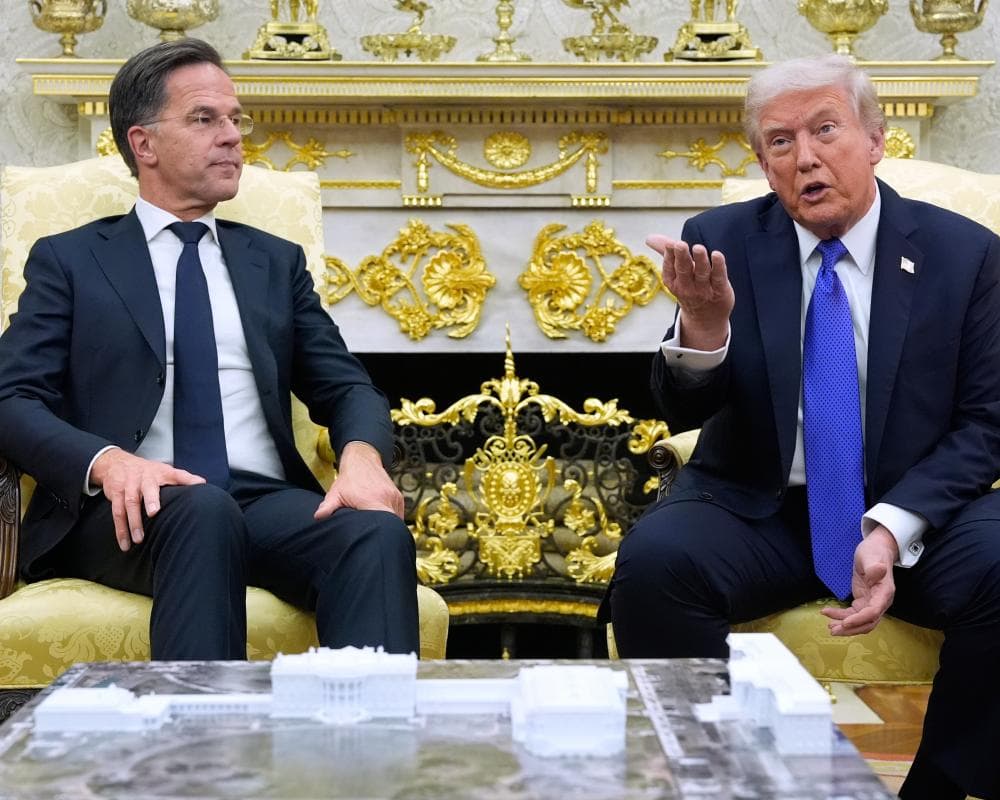
The US president, Donald Trump, has once again lashed out against Nato after a tense and lengthy meeting with the alliance’s secretary general, Mark Rutte, who admitted Trump was “clearly disappointed” with allies over their refusal to get involved in Iran.
In another angry ALL CAPS post on social media overnight, Trump said:
“NATO WASN’T THERE WHEN WE NEEDED THEM, AND THEY WON’T BE THERE IF WE NEED THEM AGAIN. REMEMBER GREENLAND, THAT BIG, POORLY RUN, PIECE OF ICE!!!”
In reality, though, the only time Nato has ever triggered its collective defence clause in Article 5 was after 9/11 in the US, and the allies, in fact, were very much there when the US needed them.
It’s quite telling that despite repeatedly being told off for this very narrative by several European leaders, Trump keeps doubling down on this (factually incorrect) claim.
From Rutte’s comments to CNN last night, it’s clear that the meeting was very tense as he pointedly did not deny that Trump threatened to pull out of the alliance, as also suggested by the White House press secretary, Karoline Leavitt.
Ever a diplomat – although his critics often say he is positioning himself too close to Trump with his over-the-top praise for his impact on the alliance – Rutte said that the president was “clearly disappointed” and made that clear in a “very frank, very open” discussion between “two good friends”.
“He clearly told me what he thought of what happened over the last couple of weeks,” he said.
“But at the same time, I was also able to point him to the fact that the large majority of European nations has been helpful with basing, with logistics, with overflights, with making sure that they live up to the[ir] commitments,” he said.
The Wall Street Journal reported (£) overnight that “the White House is considering a plan to punish some members of the Nato alliance that President Trump thinks were unhelpful to the US and Israel during the Iran war.”
Rutte in effect declined to comment on this report, saying instead that “not all European nations lived up to those commitments, and I totally understand that he is disappointed” and repeatedly praising Trump’s broader leadership (going even as far as claiming that the world is safer now than before the Iran war.)
But he still insisted it was a “nuanced” picture and “a large majority of European countries, and that’s what we discussed today, have done what they promised” they would.
It remains to be seen if he actually convinced Trump at all. We will hear from Rutte again later today as he is due to deliver a speech in Washington late afternoon.
Elsewhere, I will bring you the latest updates from Hungary, just days before a key parliamentary vote on Sunday. As the US vice-president, JD Vance, left the country after his repeated endorsement of Viktor Orbán which is obviously very much not interfering with the election, not at all, the attention turns back to domestic campaign.
It’s Thursday, 9 April 2026, it’s Jakub Krupa here, and this is Europe Live.
Good morning.