Loading...
Please wait for a bit
Please wait for a bit
Click any word to translate
Original article by Taz Ali (now) and Vivian Ho and Maya Yang (earlier)
Iran and Oman have shared cautious optimism that negotiations between Iranian and US officials will continue, after both sides gathered in the Omani captial Muscat for indirect talks.
The exact details of the negotiations remained unclear, but Iran’s foreign minister, Abbas Aragchi, said the talks were limited to Tehran’s nuclear programme. “Our discussions are focused exclusively on the nuclear issue and we are not addressing any other subject with the Americans,” Araghchi told Iranian media.
The US has been pushing for the negotiations to go beyond Iran’s nuclear programme and to cover its ballistic missiles and backing of regional militias, topics which Tehran said were off the table.
The talks were the first between the US and Iran since June 2025, when the US joined Israel’s war against Iran and bombed its nuclear and military sites.
It follows weeks of escalating tensions between Washington and Tehran, with US warships gathered near Iranian coastal waters, and nearly a month after a wave of nationwide protests swept across Iran against the clerical leadership.
We’re getting more comments from the Iranian foreign minister, Abbas Aragchi, through the newswires. He has said:
Further talks are on the cards at a time and date yet to be determined.
Talks with the US are solely about Iran’s nuclear programme and no other issues will be discussed.
Officials from both sides will return home for consultations and “the wall of mistrust” should be overcome.
“It was a good start to the negotiations. And there is an understanding on continuing the talks. Coordination on how to proceed will be decided in the capitals,” he was quoted as saying.
The foreign minister of Oman, who mediated the talks, expressed optimism that the negotiations will continue.
In a post on X, Sayyid Badr Albusaidi said:
Very serious talks mediating between Iran and the US in Muscat today. It was useful to clarify both Iranian and American thinking and identify areas for possible progress. We aim to reconvene in due course, with the results to be considered carefully in Tehran and Washington.
Iran’s foreign minister, Abbas Aragchi, said the indirect talks with US officials in Oman were “a very good start” but that negotiators must now speak with their leaders.
In comments to Iranian state media shortly after the negotiations in Muscat, Aragchi said both Tehran and Washington officials have agreed to “proceed with negotiations”, according to statements reported on the newswires.
Today’s talks were held in a “very positive atmosphere”, he added.
There were no further comments on what was discussed during the series of talks that took place over several hours.
State media is reporting that a foreign ministry spokesperson for Iran said that talks have concluded “for now” but did not elaborate any further on when they might restart, according to Reuters.
Prior to Friday’s talks, the US Virtual Embassy in Iran issued a fresh security alert warning American citizens to “leave Iran now”.
The US issued a similar alert in January as Donald Trump repeatedly made comments about coming to the aide of the Iranian people, saying the US was “locked and loaded” if Iran started to shoot at the protesters.
Since early December, Iran has been under a level 4 travel advisory, the highest US State Department warning of “Do Not Travel” due to “risk of terrorism, unrest, kidnapping, arbitrary arrest of US citizens, and wrongful detention.”
Given that airlines continue to cancel flights to and from Iran, the most recent security alert advised American citizens to consider leaving Iran by land through Armenia or Turkey.
While the talks are happening in Oman, we know US warships and aircraft have amassed near Iran’s coastal waters, with Trump threatening that “bad things” would probably happen if a deal could not be reached.
Tehran is deeply worried that Trump may still carry out his threat of striking Iran, not least because of the not-so-subtle comments made by White House press secretary Karoline Leavitt on Thursday.
“While these negotiations are taking place, I would remind the Iranian regime that the president has many options at his disposal, aside from diplomacy, as the commander-in-chief of the most powerful military in the history of the world,” she told reporters.
A military escalation is not completely beyond the realms of possibility and could serve Trump’s interest, according to Middle East expert Fawaz Gerges.
“Historically speaking, such a mobilisation of a large military force, or armada as Trump called it, means the likelihood of a military confrontation is much higher than a diplomatic breakthrough,” he said.
“Trump faces some major problems at home, and I think a calculated military confrontation against Iran could divert attention from his domestic challenges.
“Will Iran fight back? I have no doubt in my mind that the Iranian leadership means what it says, about any attack on Iran could be seen as an attack on the survival of the regime.”
At a crossroads, Iran may be willing to make tough compromises with its nuclear programme in order to win sanctions relief and ease major social unrest gripping the country, an expert has said.
It all hinges on how much the US will demand of Iran and whether those concessions will cross Tehran’s red lines, said Fawaz Gerges, professor of international relations at the London School of Economics.
The Oman-mediated talks in Muscat between Iranian and US officials are thought to be focused on reaching a deal over Tehran’s nuclear programme. But the US has pushed for the negotiations to cover Iran’s ballistic missiles, its support for regional proxies - such as Hezbollah in Lebanon and the Houthis in Yemen – and the Iranian government crackdown on nationwide protests. Iran pushed back, saying it wanted the talks to solely focus on the nuclear issue.
Iran insisted that its right to enrich uranium for peaceful ends was not negotiable and demanded the lifting of sanctions that were reimposed in 2018 when Donald Trump ditched Iran’s 2015 nuclear deal. Reports suggest Iran could agree to lower its uranium enrichment for an agreed period of time in return for access to frozen financial assets in the US.
“What we know now is that the Iranian leadership is willing to offer painful concessions … Iran seems to be willing to either shut down its nuclear programme or suspend it for a long time,” said Gerges.
“So, if the US is genuine about reaching a deal with the clerics in Tehran, I think we might really be pleasantly surprised that both sides could somehow make painful compromises.
“Iran won’t get rid of its nuclear programme without having the sanctions lifted. The American and global sanctions have broken the backbone of the Iranian economy. They have pauperised the Iranian people, and have led to very serious large-scale protests that threaten the very viability and survival of the regime.”
Iran is unlikely to budge on the US’s other demands over its ballistic missiles and support for proxies,” Gerge added. “Doing so will mean not only the surrender of Iran but it will become naked in the face of any future Israeli attacks,” he said.
“Iran’s ballistic missiles are its only deterrence at the moment, and this is a red line as many Iranian leaders from all political persuasions have made very clear.
“If the US insists on discussing not only Iran’s nuclear programme, but also its ballistic missiles and broader regional behaviour, then I think the talks will ultimately fail and I think we will see military escalation in the next few days and weeks.”
Updated
Talks are ongoing between Iranian and US officials in Muscat, Oman, which are thought to be focused on Tehran’s nuclear programme.
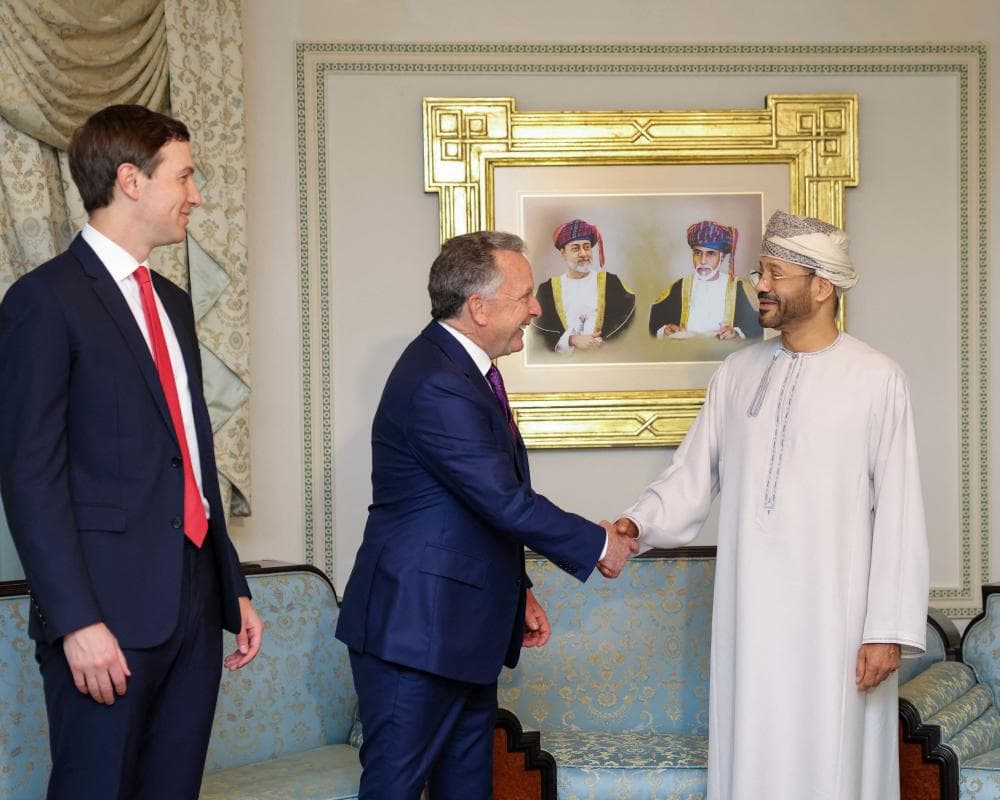
Oman’s foreign minister, Sayyid Badr Albusaidi, who is mediating the talks, held separate meetings with Iran’s top diplomat, Abbas Aragchi, and US special envoy Steve Witkoff and Donald Trump’s son-in-law, Jared Kushner.
In a statement, the Omani foreign ministry said the meetings so far have focused on preparing the conditions for “resuming diplomatic and technical negotiations”.
US officials have previously indicated that they wanted to expand the talks to cover Iran’s ballistic missiles and its support for regional proxies. Iran said it only wanted to discuss the nuclear issue.
Read our full report on this story here:
These are the first images we have seen of US special envoy Steve Witkoff and Donald Trump’s son-in-law, Jared Kushner, in Muscat for the nuclear talks. They are pictured with Oman’s foreign minister, Sayyid Badr Albusaidi.

We’re starting to get some more clarity on the flow of the talks.
Oman’s foreign minister Badr Albusaidi held separate meetings with Iran’s top diplomat Abbas Araghchi, as well as US special envoy Steve Witkoff and Jared Kushner, Trump’s son-in-law, according to a statement from the Omani foreign ministry.
That matches pictures seen outside the palace, according to AP, which showed a convoy with an American flag entering the grounds after the Iranian delegation left.
The statement read:
The consultations focused on preparing the appropriate conditions for resuming diplomatic and technical negotiations, while emphasising their importance, in light of the parties’ determination to ensure their success in achieving sustainable security and stability.
Iranian state media is now reporting that Araghchi and his team are expected to begin indirect talks with the US delegation shortly.
There are some conflicting reports over whether the talks have officially begun or not. Reuters news agency has quoted an Iranian official saying indirect negotiations may “possibly” begin after Albusaidi’s meeting with Witkoff.
Updated
While we wait for confirmation of the end of the Oman-mediated talks, Russia has released its own comments. The Kremlin said it welcomed the negotiations and hoped for a de-escalation, while also urging restraint on both sides, the Reuters news agency reported.
Russia has long been a close partner of Iran, deepening their ties last year with the signing of a 20-year strategic partnership treaty.
The Associated Press news agency has reported that a convoy believed to be carrying US officials has left the site of the talks in Muscat.
On Thursday 8 January, Iran went dark. In the midst of massive national protests, the government shut down the internet, phone calls, and almost all communication out of the country. That evening a violent crackdown began. In some cities, government forces opened fire on crowds, killing thousands – according to some estimates, possibly tens of thousands – in two days of bloodshed. The internet blackout has meant that a clearer picture of what happened – drawn from witness reports, videos, photographs and testimony from hospitals – has taken time to assemble.
When the violence began, there were demonstrations taking place in more than 200 cities, according to human rights groups. Below is the story of what unfolded in one of them:
Updated
It is the first time the US and Iran have sat down for face-to-face negotiations since June last year, when Israel launched attacks on Iran that sparked a war marked by tit-for-tat airstrikes, with the US also joining the fray. It effectively ended the US-Iran talks that were held in the weeks prior to the conflict aimed at reaching a nuclear peace agreement.
More recently, Donald Trump has been threatening to strike Iran for more than a month and just last week warned that an “armada” of US warships had reached the Persian Gulf. This recent clash began after Trump said he would strike Iran if it killed protesters during mass antigovernment demonstrations that swept the country last month. Human rights groups say thousands of people were killed during the brutal government crackdown on those protests.
It is hoped that the high-stakes negotiations in the Omani capital, Muscat, today will defuse tensions between the two countries, but Iran has stated that the talks will solely focus on its nuclear programme and it remains unclear what terms both sides are willing to negotiate on.
Updated
Iranian media are reporting that the nuclear talks between Iranian and US officials in Muscat have now begun.
Updated
Iran’s Mehr news agency has reported some comments from the pre-talks meeting between Aragchi and Albusaidi, in which the Iranian foreign minister warned against excessive demands by the US.
“Araghchi emphasised full readiness to defend the country’s sovereignty and national security against any excessive demands or acts of adventurism,” Mehr reported.
It added that the Omani foreign minister expressed hope that the nuclear talks “would pave the way for a sustainable understanding between Iran and the United States”.
Updated
Araghchi has touched down in Muscat and was welcomed by the Omani foreign minister ahead of the nuclear talks with US officials.
The pair “discussed the most important bilateral, regional, and international issues”, according to Iran’s semi-official Mehr news agency.
We have early pictures from the Iranian foreign ministry of the Iranian foreign minister, Abbas Aragchi, with the Omani foreign minister, Sayyid Badr Albusaidi, in Muscat.
Iran is betting that Donald Trump does not have a plan for regime change, writes Patrick Wintour:
When it comes to Iran and Donald Trump, there is so much bluff, backed by military hardware, that the truth rarely makes an appearance.
It appears that a bullish Iran is going into negotiations with the US on Friday adopting maximalist positions that do not seem greatly different to those it adopted in the five rounds of talks before the negotiations were abruptly halted by the surprise Israeli attack on Iran last June.
Given how much Iran has been weakened in the intervening eight months, Tehran’s refusal to change its negotiating position is at one level surprising.
For the full analysis, click here:
Here are some of the latest images coming through the newswires ahead of the US-Iran talks:
Updated
Patrick Wintour and Andrew Roth:
Iran’s foreign minister said late on Wednesday that the talks would proceed in Oman after reports of a last-minute effort by Arab states to convince the White House not to walk away from negotiations.
“Nuclear talks with the United States are scheduled to be held in Muscat on about 10am Friday,” wrote the Iranian foreign minister, Abbas Araghchi. “I’m grateful to our Omani brothers for making all necessary arrangements.”
US officials have also indicated the talks in Oman will go forward. They will take place amid a massive buildup of US naval and airpower in the region and appear to be a last chance for Tehran to avert a US strike against the country’s leadership and nuclear programme.
The talks had collapsed earlier on Wednesday as Iran vowed they would be confined to its nuclear programme only. The US had demanded the talks also address Tehran’s ballistic missile programme, which Iran had ruled out.
For the full story, click here:
Ahead of the talks in Muscat, Iran’s foreign minister Abbas Araghchi took to X on Friday morning and said that ‘Iran enters diplomacy with open eyes and a steady memory of the past year.”
He went on to add: “We engage in good faith and stand firm on our rights. Commitments need to be honored. Equal standing, mutual respect and mutual interest are not rhetoric—they are a must and the pillars of a durable agreement.”
Updated
Hello and welcome to our live coverage of the upcoming nuclear talks between senior US and Iranian officials taking place on Friday in Oman.
Earlier this week, Iran’s president Masoud Pezeshkian announced that he had instructed his foreign minister to “pursue fair and equitable negotiations” with the US, which has in recent days built up a heavy military presence in the region, including an aircraft carrier strike group.
On Tuesday, the US military said that it had shot down an Iranian Shahed-139 drone after it “aggressively” approached the Abraham Lincoln aircraft carrier in the Arabian Sea. Despite the US military saying that it had shot the drone down “in self-defense and to protect the aircraft carrier and personnel on board,” Iran’s semi-official news agency Fars said the drone was on a “surveillance mission in international waters.”
With growing tensions between the US and Iran, particularly amid the recent anti-government protests where thousands are reported to have been killed by Iranian authorities, US president Donald Trump claimed last weekend the US “armada” near Iran was bigger than the taskforce deployed to topple Venezuela’s leader.
Trump added that he believes Iran wants to make a deal, saying: “If we do make a deal, that’s good. If we don’t make a deal, we’ll see what happens.”
Despite both sides signalling their readiness to negotiate, the agenda for Friday’s talks remains to be determined.
The US has requested the talks to be all-encompassing, with secretary of state Marco Rubio saying on Wednesday: “That includes their sponsorship of terrorist organizations across the region. That includes the nuclear program, and that includes the treatment of their own people.”
Meanwhile, Iran has insisted that it wants the talks to cover only nuclear issues.
We will bring you the latest, as it happens.