Loading...
Please wait for a bit
Please wait for a bit
Click any word to translate
Original article by Lucy Campbell (now); Yohannes Lowe, Taz Ali and Fran Singh (earlier)
Israel’s far-right national security minister, Itamar Ben-Gvir, sparked a diplomatic crisis on Wednesday after publishing footage of Israeli security forces abusing international activists who were detained as they tried to sail to Gaza with aid.
There was a rapid and furious response from countries whose citizens were on board the boats, including the UK, Canada, Germany, the Netherlands, Spain and Ireland, in many cases delivered in person from the top of government. Several nations have summoned their Israeli diplomats over the appalling incident.
Benjamin Netanyahu moved to quell the furore, criticising Ben-Gvir’s actions as “not in line with Israel’s values and norms” and saying he had instructed the activists to be deported from Israel as soon as possible. And even the US ambassador to Israel, Mike Huckabee, one of the country’s staunchest allies, described Ben-Gvir’s behaviour as “despicable” and said the minister “betrayed the dignity of his nation”.
Here’s my colleague Emma Graham-Harrison’s report:
Meanwhile on Iran, as a peace deal remains elusive and Donald Trump weighs resuming military action, he said the only question now is whether the United States goes back to finish the job or if Tehran will sign a document. The US president told cadets in his US Coast Guard Academy commencement address: “We will not let Iran have a nuclear weapon. It’s very simple. We will not let that happen. We’ll see what happens. We hit them very hard. We may have to hit them even harder – but maybe not.”
Trump had earlier told reporters he was in no rush to end the war and that achieving the mission’s objectives was more important than setting a timeline for its conclusion.
Mohammad Bagher Ghalibaf, the speaker of Iran’s parliament, meanwhile, accused the US of “seeking a new round of war” as he vowed Tehran “will not bow down to force”. In a statement on his Telegram channel, Ghalibaf said: “The enemy has imposed a difficult war on our beloved Iran, and today, more than ever, it is clear that we are in a war of wills, and whoever wins this war of wills will write Iran’s history and determine Iran’s future.”
US Marines boarded Iranian-flagged commercial oil tanker M/T Celestial Sea in the Gulf of Oman after suspecting it had violated a US blockade, US Central Command said in a statement. US forces released the ship, which was headed toward an Iranian port, after searching it and directing its crew to alter course, the statement said. There has been no immediate comment from Iran.
Updated
US ambassador to Israel Mike Huckabee has dismissed the Gaza-bound flotilla as a “stupid stunt” – but said Israel’s far-right national security minister Itamar Ben-Gvir “betrayed dignity of his nation” by publishing the video he posted on social media showing him mocking the detained activists.
Huckabee, a staunch Christian-Zionist, wrote on X:
Universal outrage & condemnation from every high-ranking Israeli official from @IsraeliPM @IsraelMFA @gidonsaar @IsraelPresident @yechielleiter @IsraelinUSA for despicable actions by Ben Gvir. Flotilla was stupid stunt, but Ben Gvir betrayed dignity of his nation.
Huckabee’s intervention is particularly striking given his longtime ardent and unwavering support of Israel, including during its genocide in Gaza. He has previously drawn widespread condemnation after suggesting that Israel would be justified in taking over much of the Middle East on biblical grounds – in remarks that sparked alarm even from inside the White House - and is also a fierce advocate for full Israeli annexation of the occupied West Bank.
Israel’s treatment of the detained Gaza flotilla activists is “abominable”, Canadian prime minister Mark Carney said Wednesday.
Ottawa earlier said it would summon the Israeli ambassador to protest after national Ssecurity minister Itamar Ben-Gvir shared a video in which he taunted the activists, who were forced to kneel on the ground in rows with their hands tied behind their backs.
“The abominable treatment of civilians aboard the flotilla, including that which is documented in footage shared by Itamar Ben-Gvir, is unacceptable,” Carney said in a social media post, using unusually harsh language to condemn a close ally.
“Canada has already imposed strict sanctions on Mr. Ben-Gvir, including asset freezes and a travel ban, in response to his repeated incitement of violence.”
Spain is the latest nation to summon Israeli diplomats over Israel’s treatment of the detained Gaza flotilla activists.
In a post on X, Spanish foreign minister José Manuel Albares said the move is “in response to the monstrous, undignified, and humiliating treatment by an Israeli minister toward the Spaniards and the rest of the flotilla members”.
He also demanded the immediate release of the activists and an apology from the Israeli government.
Earlier on Wednesday, Benjamin Netanyahu criticised his national security minister Itamar Ben-Gvir over a widely-condemned video he posted on social media showing him mocking detained activists from the Gaza flotilla, saying this was “not in line with Israel’s values and norms”.
The Israeli prime minister said he instructed the activists to be deported from Israel as soon as possible.
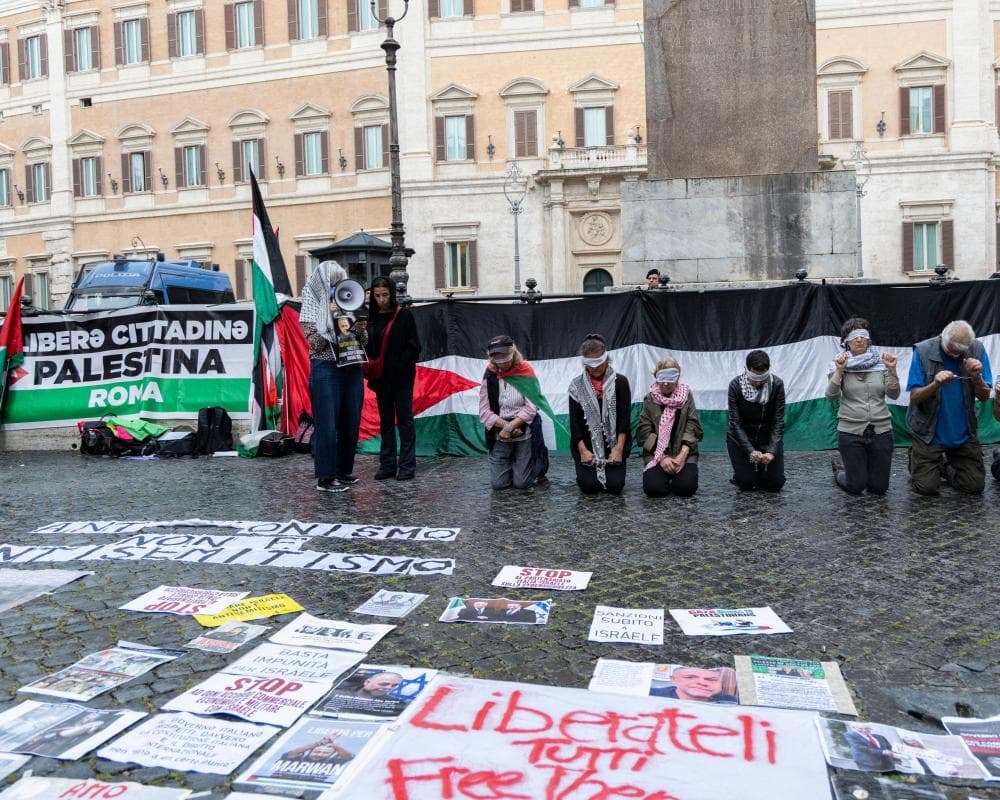
Israeli police on Wednesday forced activists who were aboard the Gaza-bound aid flotilla to kneel on the ground in rows with their hands tied behind their backs while a minister looked on, drawing criticism from foreign leaders and even from inside Israel’s own government.
They were detained after their flotilla was intercepted by Israeli forces in international waters on Tuesday and later taken to an Israeli port.
The flotilla had set sail from southern Turkey and was making a renewed attempt to deliver aid to war-devastated Gaza after earlier missions were also intercepted by Israel.
US Marines boarded Iranian-flagged commercial oil tanker M/T Celestial Sea in the Gulf of Oman on Wednesday after suspecting it had violated a US blockade, US Central Command said in a statement.
US forces released the ship, which was headed toward an Iranian port, after searching it and directing its crew to alter course, the statement said.
There has been no immediate comment from Iran.
Updated
Trump also again touted the US naval blockade of Iranian ports as “successful”.
They call it the wall of steel, nobody goes through it … We have ships that tried to go through it … and they say DO NOT PROCEED FURTHER OR WE WILL SHOOT.
After painting an image of “a young handsome captain” telling ships not to proceed via “the greatest loudspeaker system”, Trump then impersonated an Iranian man after his ship was hit by US forces, whilst mispronouncing “Iran”, and said the ship turned around. “Nobody violates it, nobody,” Trump went on.
It’s unclear what incident Trump was referring to in these surreal remarks.
While the US Central Command has successfully intercepted and redirected dozens of ships during the blockade, several Iranian-linked and dark fleet vessels have slipped through.
In further remarks on Iran, Trump told cadets he thought Tehran “so badly” wanted to make a deal, but added:
We will not let Iran have a nuclear weapon. It’s very simple. We will not let that happen.
We’ll see what happens. We hit them very hard. We may have to hit them even harder – but maybe not.
Donald Trump has been briefly speaking about Iran during a commencement address at the US Coast Guard Academy. His comments come as a durable peace deal seems increasingly elusive and amid warnings that the US is weighing up restarting military attacks. This is from my colleague Lucy Campbell:
Alongside his usual boastful claims that Iran’s navy and air force are “gone”, Donald Trump said the only question now is whether the United States goes back to finish the job or if Iran will sign a document.
Everything’s gone. Their navy’s gone. Their air force is gone. Just about everything. The only question is, do we go and finish it up? Are they going to be signing a document? Let’s see what happens.
Updated
The Turkish foreign ministry has strongly condemned the treatment of activists who were on board the Gaza-bound aid flotilla intercepted by Israeli naval forces earlier.
The ministry said Turkey is helping to try to secure the immediate and safe release of the detained Turkish nationals and other activists who were on the flotilla.
It said the Global Sumud Flotilla was unlawfully intercepted by Israel while attempting to deliver aid to Gaza. More than 50 boats taking part in the flotilla set sail from Turkey last week.
Updated
In response to a question on Wednesday morning about how long Benjamin Netanyahu, the prime minister of Israel, will hold on before re-starting strikes on Iran, Trump said: “He’s fine. He’ll do whatever I want him to do.”
Trump also cited a poll that gave him 99% approval in Israel. Guardian US has not yet verified this poll.
“I could run for prime minister, so maybe after I do this, I’ll go to Israel and run for prime minister,” he said. You can keep up with all the latest developments from the US here:
Iran’s Revolutionary Guards navy have said they allowed 26 vessels to transit the strait of Hormuz over the last day.
“Over the past 24 hours, 26 vessels – including oil tankers, container ships and other commercial vessels – transited the strait of Hormuz,” the Guards’ navy said in a social media post. It added that the ships passed after “coordination and security provided by the IRGC navy”.
About a fifth of the world’s oil and liquefied natural gas usually passes through the strait. But Iran closed the shipping route to so-called “hostile” countries in response to being attacked by Israel and the US on 28 February, causing global energy prices to surge.
Iran effectively closed the strait by attacking – or just threatening to attack – some ships and told others not affiliated with the US or Israel that they could pass through it if they paid a toll.
Donald Trump imposed a counter-blockade of ships using Iranian ports on 13 April to try to pressure Tehran into accepting concessions to bring an end to the war – but this has ultimately failed as the strait is Iran’s biggest leverage point.
Updated
Fresh questions have been raised over the US and Israeli effort to depose the Iranian regime after it was claimed that Israel wanted to put the populist Mahmoud Ahmadinejad in power.
Ahmadinejad’s turbulent presidency from 2005 to 2013 was marked by incendiary attacks on Israel but he recast himself as a critic of the regime and champion of the poor after falling out with the supreme leader Ali Khamenei.
It is claimed that Israel bombed a security building close to his Tehran home to help him escape house arrest but he became uneasy about the operation.
The plans reported by the New York Times, were widely seen as implausible or disinformation put out by Ahmadinejad’s supporters or the Israeli intelligence services.
However, the episode shows that the US and Israel overestimated opposition to the regime and their own ability to bring it down it with airstrikes. You can read the full story here:
The Irish foreign minister, Helen McEntee, has joined in the condemnation of the footage showing detained Gaza-bound activists from the Global Sumud Flotilla with their hands tied behind their back kneeling as their heads touch the floor (see post at 14.11 for more details).
McEntee demanded the immediate release of the “illegally detained” activists, among whom is the sister of Irish President Catherine Connolly. McEntee said she was “appalled and shocked” by the video, which was shared on X by far-right national security minister Itamar Ben Gvir.
It was published after Israeli forces intercepted the flotilla’s vessels at sea and began detaining hundreds of foreign activists at the southern port of Ashdod. The Global Sumud Flotilla was attempting to deliver much needed aid to Gaza, which is under an Israeli maritime blockade.
Mohammad Bagher Ghalibaf, the speaker of Iran’s parliament, has accused the US of “seeking a new round of war” as he vowed his country “will not bow down to force”.
In a statement on his Telegram channel, Ghalibaf said: “The enemy has imposed a difficult war on our beloved Iran, and today, more than ever, it is clear that we are in a war of wills, and whoever wins this war of wills will write Iran’s history and determine Iran’s future.”
His remarks came as US president Donald Trump threatened Iran with renewed military action, saying he has given Tehran “two to three days” to reach a deal to end the conflict.
Ghalibaf said the US was still hoping Iran would surrender and respond favourably to Washington’s demands.
“We must strengthen our readiness to respond powerfully and effectively to possible attacks,” he said, adding the US will “regret attacking Iran again”.
According to the Reuters news agency, Donald Trump has told reporters he was in no rush to bring his war on Iran to an end. The US president said achieving the mission’s objectives was more important than setting a timeline for its conclusion.
The White House said in early April Trump’s objectives in Iran was to “obliterate Iran’s ballistic missile arsenal and production capability, annihilate its navy, sever its support for terrorist proxies, and ensure the world’s leading state sponsor of terrorism never acquires a nuclear weapon.”
While there is little doubt that waves of US and Israeli airstrikes heavily degraded Iran’s military capabilities, many of Trump’s core objectives remain unfulfilled and he is now essentially trying to get back to the status quo of the strait of Hormuz being freely open to international vessels.
A stockpile of highly enriched uranium is also still believed to remain buried following US and Israeli airstrikes last June, Iran still supports proxy militant groups such as Lebanon’s Hezbollah and Yemen’s Houthis and Iran reportedly retains much of its pre-war missile stockpile despite US-Israeli attacks.
Updated
The Israeli prime minister, Benjamin Netanyahu, has criticised national security minister Itamar Ben-Gvir over a video he posted on social media showing him mocking detained activists from the Gaza flotilla.
Netanyahu said he instructed the activists to be deported from Israel as soon as possible.
“Israel has every right to prevent provocative flotillas of Hamas terrorist supporters from entering our territorial waters and reaching Gaza. However, the way that minister Ben Gvir dealt with the flotilla activists is not in line with Israel’s values and norms,” Netanyahu said in a statement.
“I have instructed the relevant authorities to deport the provocateurs as soon as possible.”
Updated
Adding to the growing criticism against Ben-Gvir is Hamas, which said the footage released by Israel’s far-right national security minister was evidence of Israeli leaders’ “moral depravity”.
“We, in the Hamas movement affirm that the scenes of torture and humiliation orchestrated by the criminal, fascist Zionist minister, Ben-Gvir, during the arrest of activists from the Global Sumud Flotilla, are an expression of the moral depravity and sadism that govern the mentality of the leaders of the criminal enemy entity,” the group said in a statement, according to AFP.
Shortly after Meloni’s statement, the Israeli foreign minister, Gideon Saar, also slammed Ben-Gvir for sharing the video, saying he is “not the face of Israel”.
In a post on X, Saar said: “You knowingly caused harm to our state in this disgraceful display – and not for the first time.
“You have undone tremendous, professional, and successful efforts made by so many people – from IDF soldiers to foreign ministry staff and many others.
“No, you are not the face of Israel.”
Ben-Gvir, who visited the port of Ashdod where he was filmed mocking the flotilla activists, hit back, saying “anyone who comes to our territory to support terrorism and identify with Hamas will get slapped”.
The Global Sumud Flotilla that attempted to deliver aid to Gaza, which is under an Israeli maritime blockade, was intercepted by Israeli forces in international waters off the coast of Cyprus on Monday.
The Italian prime minister, Giorgia Meloni, and foreign minister, Antonio Tajani, have condemned the “unacceptable” treatment of Gaza flotilla activists detained by Israel, after an Israeli minister posted a video of them bound and forced to kneel.
“It is unacceptable that these protesters, including many Italian citizens, are subjected to this treatment that is detrimental to human dignity,’ they said in a statement, according to the Italian Ansa news agency.
“The Italian government is immediately taking all necessary steps at the highest institutional levels to secure the immediate release of the Italian citizens involved. Italy also demands an apology for the treatment of these protesters and for the total disregard shown for the Italian government’s explicit requests.”
They said the government would summon the Israeli ambassador for an explanation.
Their comments followed a video shared on social media by the Israeli far-right national security minister, Itamar Ben-Gvir, showing activists kneeling with their hands tied behind their backs and foreheads on the ground. “Welcome to Israel,” he wrote in an accompanying message.
The Global Sumud Flotilla set sail from Turkey last week in the latest attempt by activists to breach Israel’s blockade of the Palestinian territory. Israeli authorities said 430 activists aboard the flotilla were taken to Israel after their vessels were intercepted in international waters near Cyprus.
Updated
Gaza’s health ministry said in its latest update that at least one person has been killed and 16 others injured in Israeli attacks across the territory over the past day.
The health ministry says 881 people have been killed in Israeli attacks since the ceasefire in October 2025.
It says that 72,773 people have been killed in Israeli attacks across Gaza since October 2023, when Isreal launched its assault on the territory following the Hamas-led attack on southern Israel on 7 October 2023, in which about 1,200 people were killed.
The UAE’s foreign ministry has condemned what it described as “ terrorist attacks” launched by drones from Iraq, days after a drone attack on the Barakah nuclear energy Plant in Abu Dhabi.
As the Guardian’s defence and security editor, Dan Sabbagh, notes in this analysis piece, Reactor no 3 at the Barakah nuclear plant lost vital off-site power for about 24 hours after the attack on Sunday, forcing it to rely on emergency diesel generators.
The UAE’s defence ministry said on Tuesday that three drones targeting the plant had originated from Iraqi territory, suggesting a pro-Iranian proxy group was most likely to have been behind the strike.
No group has claimed responsibility for the attack but Tehran and its proxies have launched drone attacks targeting Gulf Arab states since the US-Israeli war started their war on Iran on 28 February.
In a post on X published on Wednesday, the UAE’s foreign ministry wrote:
In a statement, the ministry of foreign affairs affirmed the UAE’s strongest condemnation and absolute rejection of the heinous terrorist attacks launched from Iraqi territory targeting vital civilian infrastructure in the Gulf Cooperation Council (GCC) countries, in flagrant violation of their sovereignty and airspace, and a clear breach of international law, international humanitarian law, and the UN charter.
The ministry stressed the necessity for the government of the Republic of Iraq to urgently and unconditionally prevent all hostile acts originating from its territory, and to address these threats urgently, immediately, and responsibly in accordance with relevant international and regional laws and conventions.
Updated
Iran’s supreme leader, Mojtaba Khamenei, has issued a written statement on the second anniversary of the death of former president Ebrahim Raisi, who was killed in a helicopter crash.
Khamenei said Iran is mounting a “unique historical resistance against two global terrorist armies”, referring to the US and Israel. “This makes the burden of the Islamic Republic’s officials – from the leadership and heads of forces to all levels of managers – heavier than in the past,” he added, according to a statement published by the semi-official Tasnim news agency.
Khamenei has yet to appear in public since becoming the supreme leader of Iran after the killing of his father and predecessor, Ali Khamenei, on the first day of the war.
Updated
Gaza is in a grim limbo more than seven months after Donald Trump brokered a ceasefire deal: no reconstruction is under way, the so-called Board of Peace is struggling with funding and Palestinian technocrats chosen to run the strip are sidelined in Egypt.
In a 15 May submission to the UN security council, the Board of Peace said the “principal obstacle” to realising Trump’s plan for Gaza was Hamas’s refusal to hand over its weapons and cede control of the strip – but several people familiar with the body said funding shortfalls could jeopardise the effort.
Nine countries pledged $7bn (£5bn) to a “Gaza relief” package at the inaugural meeting of the Board of Peace, which Trump chaired. But only the United Arab Emirates and Morocco have sent funds, according to a person familiar with its operations.
The group has received $23m to fund its operations, as well as an injection of $100m to fund a future Palestinian police force, the person said. In sum, that amounts to $1.75 for every $100 pledged.
The UN has estimated the total cost of rebuilding Gaza to be upward of $70bn over decades.
Several countries that initially pledged funds to the Board of Peace (BoP) are now reluctant to pay, after months of stalled diplomacy and no progress on the ground, according to five people familiar with the organisation.
“Countries are hesitant to pay their portions,” said one diplomat familiar with international negotiations about Gaza, who was not authorised to speak publicly. The Iran war has provided cover for delays to payments, another source said.
Read more here:
Activists who were onboard a Gaza-bound aid flotilla that was intercepted by Israeli naval forces are being detained at an Israeli port before being taken to prison, an Israeli rights group and the flotilla’s organisers said on Wednesday.
The flotilla was making a renewed attempt to deliver aid to war-shattered Gaza after earlier missions were also intercepted by Israel in international waters. Video footage showed Israeli forces opening fire on at least two flotilla vessels on Tuesday, with Israel saying those were warning shots.
Organisers say they aim to break Israel’s blockade of Gaza by delivering humanitarian assistance, something aid bodies say is still in short supply despite a U.S.-brokered ceasefire between Israel and Hamas in place since October 2025 that includes guarantees of increased aid.
Activists aboard past flotillas that were intercepted by Israel were deported after being detained. Ships from the flotilla had set sail for a third time on Thursday from southern Turkey.
Israel’s Knesset have advanced a bill to dissolve parliament. Lawmakers on Wednesday voted to advance a bill submitted by the ruling coalition of prime minister Benjamin Netanyahu which would dissolve parliament and pave the way for early elections.
In a preliminary reading, 110 out of the parliament’s 120 lawmakers voted in favour and 0 against the bill, which will now pass to a committee before three more parliamentary readings.
The vote comes at a pivotal time for Netanyahu, Israel’s longest-serving prime minister. Israel has been at war with Hamas in Gaza, Hezbollah in Lebanon and Iran, fronts that remain volatile and could have an impact on the election.
Netanyahu still faces a long-running corruption trial. Israel’s President Isaac Herzog is mediating talks to broker a plea deal in the case, which could see the 76-year-old Netanyahu retiring from politics as part of the deal.
Netanyahu’s health could also be an issue. He recently disclosed that he was successfully treated for prostate cancer and in 2023 he was fitted with a pacemaker.
Updated
The Jordanian military announced it had shot down a drone of unknown origin in its airspace on Wednesday, AFP reports.
No casualties were reported.
“This morning, the Jordanian Armed Forces engaged with a drone of unknown origin that entered Jordanian airspace and was brought down in Jerash Governorate, without any injuries,” the military said of an area located around 50 kilometres (30 miles) north of the capital Amman.
Updated
Mohsin Naqvi, Pakistan’s interior minister, is on his way to Tehran to meet officials, Iran’s Tasnim news agency is reporting.
This will be the second trip to Tehran in a week for Naqvi, as Islamabad continues to lead mediation efforts between Washington and Tehran.
Updated
The defacto blockade in the strait of Hormuz is having a knock on effect in Europe where it was today announced that the UK has relaxed strict sanctions on Russian crude due to soaring oil costs.
The relaxed sanctions will allow for the import of jet fuel and diesel refined in third countries amid surging costs.
A trade licence that came into effect on Wednesday permits the imports indefinitely and will be reviewed periodically. It comes at a time of growing concerns over the supply of certain fuels owing to the de facto blockade of the strait of Hormuz since the start of the US-Israeli war with Iran.
For years the UK has led international efforts to put economic pressure on Russia over its war on Ukraine. On Tuesday it signed a G7 statement reaffirming its “unwavering commitment” to imposing “severe costs” on Russia. It had previously announced it would block Russian oil refined in other countries to “further restrict the flow of funds to the Kremlin”.
This week the US treasury secretary, Scott Bessent, extended a 30-day sanctions waiver allowing the purchase of Russian oil shipments already at sea, saying in a post on X that the extension would “provide additional flexibility, and we will work with these nations to provide specific licences as needed”.
New figures show petrol prices have eclipsed the high set during the Iran oil crisis. Relaxing sanctions will allow imports of jet fuel from India, which was previously a key supplier to the UK and Europe. Russian crude is also refined in big quantities in Turkey.
Israeli warplanes have struck the Lebanese town of Jibchit overnight, despite an ongoing fragile ceasefire, the country’s state news agency has said.
An additional strike reportedly targeted the vicinity of an international school in Habboush, it said.
Israeli aircraft also struck the town of Kherbet Silem earlier today, while two separate raids targeted Kfara in Bint Jbeil district.
National News Agency (NNA) said another Israeli airstrike hit a house in the town of Toura, though no casualties were reported.
Israeli airstrikes on southern Lebanon on Tuesday killed at least 19 people, including four women and three children, Lebanon’s health ministry said, the latest in near-daily attacks from both sides that have not stopped despite a fragile, US-brokered ceasefire.
Israel’s military did not immediately comment on the casualties or specific incidents, but said that between Monday afternoon and Tuesday afternoon, it had targeted more than 25 sites of Hezbollah infrastructure in southern Lebanon.
Updated
In the latest of our On the ground series, which highlights in-depth Guardian video journalism from around the world, we have a video on Lebanon.
The Guardian travels across Lebanon to find out how the conflict is widening divisions and affecting life across the country.
Watch here:
Meanwhile, in Israel, the Knesset (Israeli parliament) is due to vote on a bill to dissolve itself, potentially triggering earlier elections which polls predict prime minister Benjamin Netanyahu will lose.
The last election was in November 2022 and the next ballot is due at the latest on 27 October. If lawmakers vote to dissolve the Knesset, elections must be held within five months of the vote passing. Political pundits in Israel say elections could happen in the first half of September.
The Chinese president, Xi Jinping, has held talks with Russia’s Vladimir Putin in Beijing today, where the leaders discussed conflict in the Middle East.
Russia has sought to cash in on the global energy crisis and soaring gas prices triggered by the Iran war and the effective closure of the strait of Hormuz.
Russia’s foreign minister, Sergei Lavrov, said in April after a meeting with Xi that Moscow could “compensate” for China’s energy shortages, but Beijing has publicly called for an end to hostilities.
“A comprehensive ceasefire is of utmost urgency, resuming hostilities is even more inadvisable and maintaining negotiations is particularly important,” Xi told Putin during talks today, according to Chinese state media.
Putin highlighted the economic ties between Russia and China, saying: “The driving force behind economic cooperation is Russian-Chinese collaboration in the energy sector.
“Amid the crisis in the Middle East, Russia continues to maintain its role as a reliable supplier of resources, while China remains a responsible consumer of these resources.”
Updated
Iran’s Islamic Revolutionary Guard Corps (IRGC) has threatened to extend a renewed war beyond the Middle East if the US resumes attacks against Tehran.
The warning came after US president Donald Trump threatened to strike Iran again if it did not accept a deal to end the conflict.
In a statement carried by the semi-official Tasnim news agency in Iran, the IRGC said: “Should aggression against Iran be repeated, the regional war that was promised will this time extend beyond the region, and our crushing blows in places you can scarcely imagine will reduce you to ashes.”
Trump said a new US attack would deliver “a big hit” in the coming days if no deal on a lasting settlement is reached.
Updated
A South Korean oil tanker is passing through the strait of Hormuz, marking the first such case involving a Korea-managed ship since the Iran war began.
“Consultations with Iranian authorities were completed, and the vessel began sailing yesterday. It is passing through the strait very cautiously,” South Korea’s foreign minister, Cho Hyun, said, according to the Seoul-based Yonhap news agency.
He added that the vessel was carrying 2m barrels of crude oil.
Yonhap reported that the tanker began sailing in waters near Qatar yesterday after receiving passage approval from Iran a day earlier. Citing officials, the news agency said no transit fees were paid to Iran for the safe transit of the vessel.
The passage came nearly two weeks after the South Korean-operated HMM Namu was struck by “two unidentified aircraft” in the strait, causing a fire and leaving one of the vessel’s 24 crew members with minor injuries.
The Panama-flagged cargo vessel, operated by South Korean shipping firm HMM Co, arrived in Dubai after the incident for investigation.
Iran has denied responsibility, with its embassy in Seoul saying it “firmly rejects and categorically denies any allegations regarding the involvement” of its forces. Seoul strongly condemned the attack and said it hoped to identify those behind it through an investigation.
Welcome to our live coverage of events in the Middle East.
Donald Trump warned the US may strike Iran again – a day after he said he had held off a major assault in hopes of a peace deal – but Tehran’s army threatened to open “new fronts” if he went ahead.
Trump told reporters at the White House that he had been just “an hour away” from relaunching Washington’s attacks on Iran before postponing the order, after weeks of a fragile ceasefire and talks to end the war, which began on 28 February.
The decision apparently followed a further peace proposal submitted by Tehran via Pakistan, which has mediated, and may have been motivated by the reluctance of allies, including Saudi Arabia, Qatar and the United Arab Emirates, to see hostilities resume.
“You know how it is to negotiate with a country where you’re beating them badly. They come to the table, they’re begging to make a deal,” Trump said. “I hope we don’t have to do the war, but we may have to give them another big hit. I’m not sure yet.”
Oil prices eased on the apparent positive signals from the White House, with Brent crude falling to $110 a barrel, before regaining much of its losses.
In response to Trump, Iran’s army spokesperson Mohammad Akraminia warned the Islamic republic would “open new fronts against” the US if it resumed its attacks.
He added that Iran’s military had used the ceasefire as an opportunity “to strengthen its combat capabilities”.
Here are the other main developments:
The US Senate has advanced a war-powers resolution that would end the Iran war unless Trump obtains Congress’ authorisation. The vote on a procedural measure to advance the resolution was 50 to 47, as four of Trump’s fellow Republicans voted with every Democrat but one in favour. Three Republicans missed the vote.
The Israeli military launched a series of strikes across Lebanon, killing 19 people, according to the Lebanese health ministry. One strike, in the town of Deir Qanun al-Nahr in the Tyre district, killed 10 people including three children and three women, the ministry said.
The Israeli army in turn said that it intercepted a drone fired from Lebanon. Israel and Lebanon’s central government have twice extended a US-brokered ceasefire, but Israel says it does not apply to its attacks on Hezbollah.
Israeli authorities said 430 activists aboard a Gaza-bound aid flotilla were taken to Israel after their vessels were intercepted in international waters near Cyprus. Sailing from Turkey last week, the Global Sumud Flotilla is the latest in a string of attempts by activists to breach Israel’s blockade of the Palestinian territory, with the last convoy intercepted by Israeli forces last month.
Russia’s deputy foreign minister, Sergei Ryabkov, said Moscow was ready to help with talks between the US and Iran to end the war, according to the Russian Tass news agency. His remarks came as the Russian president, Vladimir Putin, held talks with Chinese leader Xi Jinping in Beijing.
The United Arab Emirates was rattled by a drone attack on its Barakah nuclear power plant last week. On Tuesday the UAE said it originated from Iraqi territory, where Iran backs groups accused of launching attacks on Gulf nations in the war. The UN Security Council on Tuesday condemned the attack. Russia, which often defends Iran, joined the other members.
Two Chinese tankers laden with oil exited the strait of Hormuz on Wednesday, according to shipping data.