Loading...
Please wait for a bit
Please wait for a bit
Click any word to translate
Original article by Jakub Krupa (now and earlier) and Martin Belam (earlier)
And, on that note, we will be closing the blog for today.
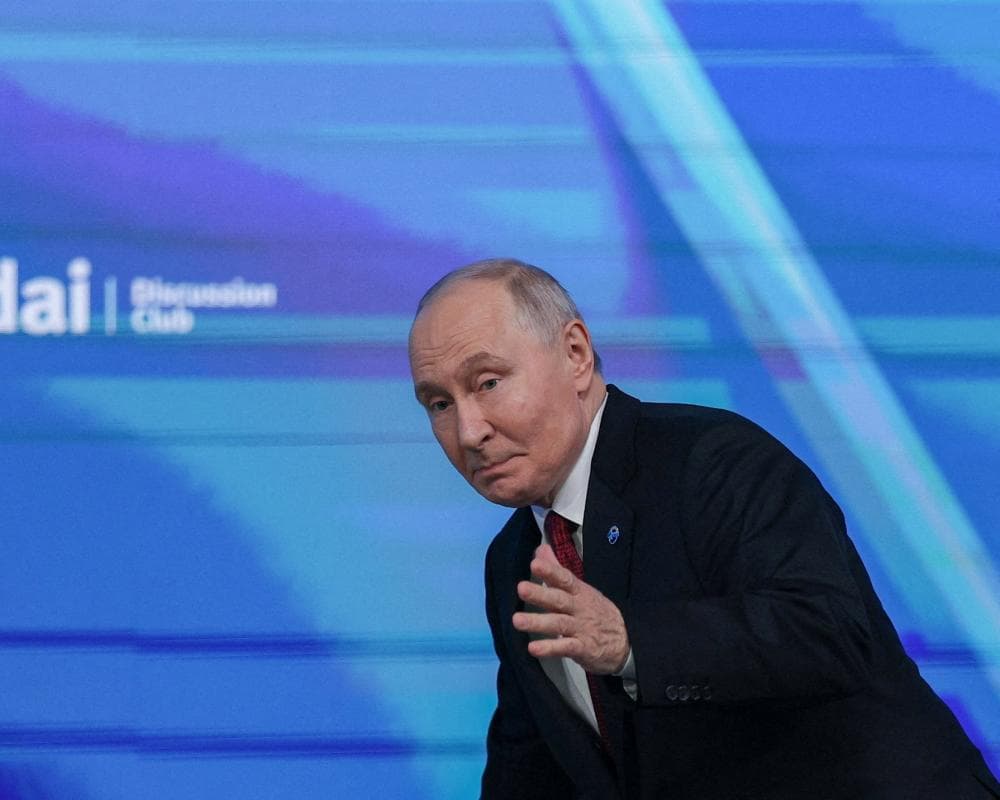
Russian president Vladimir Putin repeated his threat of using “all weapons at disposal” against any perceived aggression against Russia, as he falsely insisted that Russia was “forced” to attack Ukraine and faces further provocation from Nato (18:05, 18:25).
Nato’s secretary general Mark Rutte has warned that “Europe is not at peace today,” as it faces a “full-blown war” in Ukraine and “growing” list of Russian malign hybrid attacks on the continent (17:44).
German chancellor Friedrich Merz has said Germany is “preparing for major hybrid attacks, including severe ones,” and would respond “swiftly and very clearly,” as he repeated his warning that “the coming months will be momentous for the fate of Ukraine and for the security of Europe.” (17:35).
Separately, Finnish authorities are investigating a slew of suspected break-ins at the homes of members of parliament, which the prime minister said could “very likely” be linked to a foreign power (14:45).
Elsewhere,
France’s prime minister convened a crisis meeting on Thursday and cancelled ministers’ trips to focus on the nationwide spread of protests, some violent, by high school students venting against under-resourced schools (16:20, 16:32, 16:47).
If you have any tips, comments or suggestions, email me at jakub.krupa@theguardian.com.
I am also on Bluesky at @jakubkrupa.bsky.social and on X at @jakubkrupa.
In the Q&A after his speech, Russia’s Putin also got asked about Moscow’s widely reported nuclear threat over Kaliningrad (Europe Live, yesterday).
Putin confirms that Russia issued a statement and letters to some embassies on this point.
But he claims:
“This is not us threatening, but this is a response to attempts to threaten us.”
He continues:
“These statements, statements by the western politicians and European politicians about the need and possibility and preparation for the war with Russia in 2029 and 2030.
It’s not us saying these words, but we hear it from the other side, constantly.”
He eventually confirms that “if it comes to a direct attack on the Russian Federation – in this case we mean Kaliningrad, but may be some other territories as well – of course, naturally, immediately what will be on the agenda is the use … of all weapons that we are the disposal of our country.”
He says that with Nato a potential adversary “exceeding us,” Russia would not have “many means to counter such a threat,” and would need to use its “competitive advantages.”
But Putin says that the risk of using nuclear weapons is only serious if Nato’s threats against Russia are serious.
And then he goes on a rant about taking his words out of context, so let’s quote him in full:
“I think that this constant increased tension by many European countries; it has to do with a great deterioration of economic and domestic political situation in the countries. Look at their economy, what’s happening in terms of social policy and living standards of citizens in major European countries. Amid such conditions, they have to shift the focus of attention of their citizens from domestic issues towards outside issues.
Now, I have to respond to the questions that you asked me, and I think that they were waiting for us to respond.
Right now, they will cut it out of context, and they will abuse and exploit this notion that Russia is threatening us with nuclear weapons to distract the attention of their citizens from the fact that they are conducting their own aggressive policy against Russia, that they’re pushing their citizens towards a dangerous line towards confrontation against Russia.
We’re not threatening anyone. We do not intend to attack anyone in 2029, in 2030, in 2050, but if we come across an aggression, we will have to respond.
The citizens of the European countries should be fully aware of that and make the distinction between our position and the position of incumbent governments of their countries.”
Curiously, a moment later, he also appears to play down tensions a bit as he says “I do not think we are going to conduct strikes on the territory of countries procuring weapons for Ukraine, but this is a threat, and we are monitoring it closely.”
Updated
Meanwhile, Russia’s Vladimir Putin warned that international conflicts were highly likely to continue as the world changed, but that the situation would get better as what he called western hegemony waned, Reuters reported.
“Regardless of which scenario unfolds globally in the coming years, the continuation of international conflicts is, unfortunately, highly likely. This is due in part to the fact that ongoing fundamental shifts – and the opportunities they present – fuel ambitions and a willingness to take risks for the sake of a seemingly massive payoff,” he said.
During his speech Putin also repeatedly denied any responsibility for starting the war in Ukraine, saying it was “started against us,” with “aggressive nationalism and Russophobia“ and Nato’s expansion eastwards into “our historic territories.”
“Russia was simply forced to respond to this apparent aggression,” he falsely claimed.
Putin also lamented “the logic of escalating mutual, tough responses” turning into “a fatal inevitability” of “devastating consequences.”
“Leading countries of the world have their disposal armaments that can wipe away all life, or at least push the earth to catastrophic consequences. Can we be certain that this weapons will never be used? Unfortunately, we cannot be sure.
There’s this famous statement: if there is a gun hanging on the stage at the beginning of a show, it’ll certainly fire by the end.”
Nato’s Mark Rutte warned that “Europe is not at peace today,” as it faces a “full-blown war” in Ukraine and “growing” list of Russian malign hybrid attacks on the continent.
In his acceptance speech at the 2026 International Westphalian Peace Prize Award Ceremony, he said:
“Despite those heavy losses, Putin shows no willingness to bring the war to an end. If anything, at the moment he is intensifying it.
And let’s be clear: our own nations are targets. The list of Russia’s malign hybrid attacks across Europe grows longer every day.
Cyber-attacks, sabotage, arson, airspace violations, drone incidents – indeed, at Leipzig Airport, a drone with explosives attempted to blow up cargo planes.
We know these attacks are a sign of desperation in Russia. Putin is not getting his way in Ukraine and wants to make us pay for it.
…
Putin wants to intimidate and divide us, but he will fail. And our response to his hostile actions is to support Ukraine even more.”
Rutte hailed Merz’s decision to ramp up defence spending last year, saying historians would be kind to his determination to make it happen.
But Nato chief also warned that European leaders are “in for a long journey,” as “Russia’s well-oiled war machine is not going to turn rusty anytime soon, and … China’s military modernisation and technological development are not about to slow down.”
He added:
“Peace is precarious. We do not know, with certainty, what tomorrow will bring. But we do know we will defend one another, and attack against one is an attack against all. This credo and our steadfast resolve to live by it, has preserved peace for over 75 years.”
German chancellor Friedrich Merz has said Germany is “preparing for major hybrid attacks, including severe ones,” and would respond “swiftly and very clearly.”
The embattled chancellor said the growing number of incidents came amid Russia’s “growing perplexity” at its “unsuccessful conduct of the war in Ukraine.”
He said it’s “important that we refuse to be intimidated by cyberattacks, drones, and online propaganda.”
Merz repeated his warning that “the coming months will be momentous for the fate of Ukraine and for the security of Europe.”
Two things are happening at the same time now: over in Münster, Germany’s Friedrich Merz is presenting Nato – embodied by its secretary general Mark Rutte – with the 2026 International Award Ceremony of the Peace of Westphalia. We will hear from both of them.
Meanwhile, Vladimir Putin is speaking about Russia’s foreign policy aims at the Valdai Discussion Club.
I will bring you key lines from all three speeches.
Updated
AFP reported that some 340 demonstrations were underway late morning, with police forces deployed to several schools.
University students joined in on Thursday, blocking physical access to around 30 campuses, including in Paris and the southern city of Marseille, a student union said.
In the northeastern city of Strasbourg, authorities ordered trams to grind to a halt to “restrict the movements of rioters and demonstrators”, the regional prefect said.
In the northern city of Lille, AFP reporters saw young people wearing black hoodies destroy the glass of a bus stop. Firefighters intervened to put out the flames on upturned dustbins set on fire.
What started as a nationwide student protest over the state of the French education system has now descended into full-blown “urban violence”, according to government officials, who briefered the media, including BFMTV and Le Figaro.
The authorities believe the protests and riots are supported by far-left groups, who seek to sow discord.
In public comments, education minister Édouard Geffray called the reported violence “extremely serious,” and saying they cannot be justified in any way.
Justice minister Gérald Darmanin has called a meeting with all regional prosecutors for later this evening to discuss their response.
But the far-left France Unbowed party’s coordinator, Manuel Bompard, rejected the accusations as “conspiracy theories.”
France‘s prime minister convened a crisis meeting on Thursday and cancelled ministers’ trips to focus on the nationwide spread of protests, some violent, by high school students venting against under-resourced schools, long hours and other complaints, AP reported.
The demonstrations erupted in Paris-region schools last week and have snowballed, with police making hundreds of arrests in clashes with the young protesters.
Authorities have reported many dozens of injuries, including from hurled objects but also, in some suspected cases, from police riot-control projectiles.
The protests are quickly blowing up as a hot topic in the election campaign to replace president Emmanuel Macron next May and heightening pressure on the government also beset by France‘s growing financial problems.
The office of prime minister Sébastien Lecornu said he asked ministers to cancel any planned official trips in the coming days, to enable authorities and police to focus on dealing with the demonstrations.
After France’s Emmanuel Macron and Spain’s Pedro Sánchez yesterday, Poland’s foreign minister Radosław Sikorski is the latest EU leader to offer his take on Britain’s renewed push to reset its relationship with the European Union, a decade on from Brexit.
In a post on X aimed partially at his domestic opponents ahead of Poland’s 2027 parliamentary election, he said:
“If [Britain] were to apply for a return to [the EU], which Poland would welcome with open arms, it would mean that after a decade of analyses, London has concluded that membership is the optimal form of participation in the single market.
Let us not be swayed by the Europhobes into believing that a better alternative exists.”
Ukrainian troops have regained ground in a counteroffensive in the Donetsk region, according to an AFP analysis of data from the Institute for the Study of War (ISW).
Operation “Vivaldi” was launched in September with the aim of pushing Russian forces back from the cities of Sloviansk and Kramatorsk.
The Ukrainian military has retaken small patches of territory from Russia, for total gains in the Donetsk region of 172 square kilometres (66 square miles), an area more than 1.5 times the size of Paris.
Elsewhere, Ukraine retake small areas in the regions of Kharkiv in the north (seven square km) and the eastern regions of Dnipropetrovsk (12 square km) and Luhansk (13 square km).
By contrast, Russian offensives in Zaporizhzhia (south) and Sumy (north) enabled Kremlin forces to seize 104.5 square km and 20 square km respectively.
Overall, Ukraine made a net territorial gain of 80 square km in September, according to the data.
Updated
The European Commision and Ukraine have said in a joint statement they had “identified the means” to cover Kyiv’s budget and defence needs for this year. It read:
Today through coordinated joint efforts, we have identified the means to cover Ukraine’s budget and defence needs for 2026. We have also reconfirmed the steps needed to ensure their timely release.
While that press conference was going on, AFP have reported that Finnish authorities are investigating a slew of suspected break-ins at the homes of members of parliament, which the prime minister said could “very likely” be linked to a foreign power.
Petteri Orpo said “If someone tries to destabilise Finland, our sense of security, or our support for example for Ukraine, it has the opposite effect. It strengthens our unity.”
Speaker of parliament Jussi Halla-aho confirmed that parliament had been made aware of a “significant” number of break-ins and signs of attempted intrusions at the homes of several politicians.
It’s a determined show of unity from Nato’s Rutte, the Netherlands’s Jetten, and Germany’s Merz.
The signal is clear and in line with the warnings of recent weeks: while there is no imminent threat of a military attack from Russia, Moscow’s “campaign of hostile actions” against allies would persist over the winter.
And the three leaders reiterated the urgency in accelerating defence planning, and the importance of supporting Ukraine as the situation there worsens.
Nato’s Rutte thanks Germany and the Netherlands for increased defence spending.
He says:
“I hope Putin gets the message. It’s not just Ukrainians who are suffering. The whole of Russia is paying a huge price for his war of choice.
Putin is sending tens of thousands of young Russians to their death each month, and for nothing. He is failing on a battlefield and he is failing to intimidate us.”
The three leaders take no questions after their statements.
Updated
Nato’s Rutte is speaking now.
He says the three leaders just met the soldiers of the 1st German-Netherlands Corps, and thanks them for their service.
He also thanks for the 2026 International Westphalian Peace Prize that he will pick up later today on behalf of the alliance. He credits all soldiers and people working for Nato.
He then turns to Russia as he says:
“We see Russia testing us across Europe, airspace violations, arson, sabotage, and of course, the Russian hybrid attack at Leipzig airport in August.
But while we see no imminent military attack against Nato, we must be prepared for Russia’s campaign of hostile actions against allies to continue.
We must all remain vigilant.”
He repeats his regular warning that the Kremlin “is trying to divide us and to push us back from helping Ukraine.”
“My message is clear and our message is clear: keep calm, carry on and continue the support for Ukraine.”
Dutch PM Jetten is next.
He says the message of deterrence is “more vital than ever”, as Russia “poses a rapidly increasingly threat to the Nato alliance,” whether in the Baltics or in Germany, as he points to a recent drone incident in Leipzig.
“Europe needs to show what it’s made of, show that we are prepared to do whatever it takes to protect our security,” he says.
He says Europeans are “ramping up our intelligence cooperation to an unprecedented level so we can combat hybrid threats,” and “reaffirming and stepping up our support for Ukraine.”
He says the Netherlands is increasing its defence spending, too.
Germany’s Merz begins by stressing the importance of Nato, as “our continental peace order is being challenged by violent revisionism emanating from Russia.”
He says the Russian aggression on Ukraine was “unleashed by Moscow in utter disregard and contempt for law and order,” causing direct threat to Europe.
Merz says the focus remains on finding “a diplomatic solution,” even as “Moscow has so far shown no willingness to come to the negotiating table.”
He adds that Europe’s support for Ukraine will continue as “we refuse to be deterred by Moscow’s hybrid attack.”
He says the work is under way to “ensure credible deterrence” against Russia, pointing to Germany’s “determined investments” in its military and general resilience.
“We know that a good future for our country is only possible within a free, secure, and united Europe,” he says.
He also repeats his lines that Europe needs to “make Nato more European so it can remain transatlantic.”
He also stresses the importance of military cooperation between Nato member states, specifically in this context with the Netherlands.
Updated
Meanwhile, a Russian drone hit the grounds of a nuclear research facility in Kyiv, causing a fire but leaving the facility’s test reactor undamaged, Ukraine’s nuclear safety watchdog said, and AFP reported.
The regulator did not say where the drone landed or provide imagery of the attack, which happened on Wednesday.
Several of Ukraine’s nuclear sites have come under fire since Russia invaded in February 2022, raising fears of a nuclear accident.
The research reactor at the site has the capacity to generate around 10 Megawatts, around a hundredth of the generating capacity of a conventional nuclear reactor. There are four nuclear power plants in Ukraine, the largest of which was seized by Russian forces in 2022.
Nato’s Mark Rutte, Germany’s Friedrich Merz, and the Netherlands’s Rob Jetten are about to speak on a visit to see the 1st German-Netherlands Corps in Münster, Germany.
I will bring you all the key lines here, or you can watch along:
Updated
in Berlin
In other news, Jürgen Klopp has reacted with disgust to a social media debate questioning whether the Germany team he is in the process of forming are “white enough”.
Klopp said he believed there was no point in giving room to “such people and their utterances”, dismissing them as “complete nonsense”.
Asked to respond to the debate as to whether the national team were “not German enough” or “not white enough”, he said: “There is absolutely no reason to pay attention to these people. You won’t get my thoughts on this. I have little time in everyday life for idiocy – and even less on social media.”
“The great crux of our lives is that everyone is allowed to express their opinion … it’s insane when something like that exists.”
Klopp said watching sportspeople interact with each other was proof to him that mutual respect was still possible. “The world could learn a thing or two from a sports changing room … There, everyone is respected based on the facts and not discredited based on false opinions.”
Klopp, whose plans for Germany since he took over as coach in the summer have attracted huge attention, said the players he had gathered at the national team camp, including several players with a migrant background, “could not be better united than they are”.
The barrage of racist and generally offensive commentaries on social media followed Germany’s 1-0 defeat by Greece last Sunday, in the Nations League, marking the first time Greece had beaten Germany.
It is also reflective of plenty of utterances from MPs of the far-right Alternative für Deutschland (AfD), the largest opposition party in the Bundestag, who have repeatedly and consistently criticised the diversity and ethnic makeup of the national team, often referring to the squad in derogatory terms such as a “politically correct mercenary force”.
The EU Commission, France, Italy, Ireland and Britain are holding a call on the possible need to release diesel stocks, an EU official said, as reported by Reuters.
A Commission spokesperson had earlier declined direct comment on reports that the Trump administration has told Germany and France to draw down emergency diesel inventories to help to ease global fuel prices or face a potential US diesel export ban.
Updated
in Kyiv
Readers of Ukraine’s leading English news site “really want Russia to suffer” but that should not lead the title to downplay the military and political problems facing Kyiv, its editor has said.
Speaking to the Guardian before an event to London, Olga Rudenko said many of the Kyiv Independent’s most-read stories described Ukrainian deep strike attacks into Russia, potentially distorting its coverage.
The Kyiv Independent, however, cannot afford to become propagandistic, she argued, and marginalise Russian military successes or reduce reporting on Ukrainian corruption because the subjects are not so well read.
“We had a conversation in the newsroom when somebody raised that our website, in the mornings, is all about Ukrainian attacks on Russian Wildberries warehouses and so on,” Rudenko said.
“But it’s misrepresenting the full picture when you don’t balance it out with enough stories about attacks on Ukraine, which are, by the way, far less popular with our readers.”
The challenge is that “people really want Russia to suffer”, and read about “something going boom” but it was the Kyiv Independent’s duty to “not just to feed them more of what they like”.
The Kyiv metro and public transport services across the Dnipro river have been suspended this morning after two Russian drones hit the support structure of the Pivdennyi Bridge in the Ukrainian capital.
“Metro and surface public transport traffic across the bridge have been suspended. Specialists … are inspecting the structure’s condition following the strikes,” Kyiv mayor Vitaly Klitschko said.
Updated
Meanwhile, Russia has summoned the top Hungarian diplomat in the country and told him that “a group of employees” of the Hungarian embassy in Moscow and its consulates in St. Petersburg and Kazan must leave within two weeks.
The Russian foreign ministry’s move seeks to retaliate for a recent Hungarian decision to expel 10 Russian diplomats “for conducting activities incompatible with their status under the Vienna Convention” (Europe Live, 8 September).
Hungary’s prime minister Péter Magyar said at the time that the 10 Russian diplomats “carried out activities in Hungary that are unacceptable for diplomats.” “We will defend our country’s sovereignty,” he added.
Updated
The UK has adopted 31 new measures sanctioning LNG shadow fleet vessels, Kremlin disinformation networks and alleged perpetrators of civilian torture and child indoctrination, the foreign ministry said.
“Following sham elections in temporarily occupied territories of Ukraine earlier this month, the UK is now taking firm action against people and entities found to have undermined Ukraine’s territorial integrity through human rights abuses,” the FCDO said.
The new listings include eight people alleged to be involved in the arbitrary detention, torture and ill-treatment of Ukrainian civilians as part of a broader system of repression.
Seven people are targeted “for their role in the indoctrination and militarisation od Ukrainian children.”
The individuals will be subjected to asset freezes, trust services sanctions, and travel bans.
The package also hits new vessels involved in Russia’s shadow fleet.
“We are targeting both the revenues that help sustain Russia’s aggression and perpetrators of horrendous crimes against Ukrainian civilians, including children. The UK will not flinch in our support for Ukraine,” Europe minister Steward Wood said.
“While the UK does not seek confrontation with Russia, until Putin chooses to end his senseless and barbaric war, the UK’s support for Ukraine will remain unshakeable,” the ministry added in the statement.
The full list is here.
A Russian drone hit a school in Ukraine’s capital, authorities said, the latest in a spate of worsening air attacks on Kyiv, Reuters reported.
Mayor Vitali Klitschko said children had been in the shelter at the moment of the strike, which sparked a fire. He reported no injuries.
The State Emergency Service released images of rescue workers picking through debris and dousing the charred building, whose windows were shattered.
Reuters noted that the morning attack came amid intensifying, around-the-clock strikes on Kyiv and other cities with jet-powered drones which Ukraine’s military has struggled to shoot down.
Back to Ukraine, Volodymyr Zelenskyy said the Ukrainian army struck a Russian oil facility in the Samara region, days after US president Donald Trump sought to put pressure on Kyiv to stop hitting energy targets in Russia.
“I thank all our defenders who are working to send Russia’s sick war back to where it came from,” Zelenskyy said.
He continued:
“Today, we also have important results from our deep strikes. A target in the Black Sea was hit, as was a site in the Oryol region used to launch and store attack drones.
Sanctions were also applied to an oil facility in the Samara region and a supply depot for the occupiers in the Bryansk region.
These are exactly the kind of just responses we need right now. We will continue to deprive Russia of the ability to keep this war going.”
In other news, Italy has decided to extend the suspension of the European Union’s border-free arrangement with Spain for another 15 days.
The decision was taken due to “the current situation in the Spanish exclave of Ceuta and, in particular, on the persistence of the critical issues already identified,” the ministry said.
The move – made in the immediate aftermath of a mass influx of migrants into Ceuta in late July – remains a source of tension between Rome and Madrid.
Separately, Poland also extended its border controls with Germany and Lithuania by six months until 30 March, saying it was needed to curb irregular migration.
Since the reintroduction of border controls, entry into the country has been denied to nearly 1,300 people at the Lithuanian border and nearly 1,200 at the German border, Reuters reported.
Meanwhile, Estonia has banned the transit of Russian and Belarusian grain through its territory, Estonian foreign minister Margus Tsahkna said.
Sources last month said Russian companies are repurposing fertiliser, coal, and other cargo terminals at Ukraine’s Baltic and Arctic ports to handle grain exports after Ukrainian drone attacks disrupted shipments through the Black Sea.
He said on X:
“I warned already in September: do not make plans to transport Russian grain through Estonia. Today, we turned that warning into law.
Together with Latvia and Lithuania, we are working to ensure that Baltic ports do not become a transit route for Russia.
Russia cannot wage a war of aggression and expect us to help keep its trade flowing. We will not help finance its war or make its aggression easier to sustain."
Russia has continued its attacks on Ukraine overnight, with infrastructure damage reported in Kyiv and Odesa, among others.
The latest attacks come as part of an air campaign against Ukraine’s energy grid, hitting power facilities and infrastructure around Kyiv and other regions in the heaviest combined attack on energy sites in months.
Menawhile, president Volodymyr Zelenskyy visited a post near the frontline.
“This is where independence is won. And the path to peace runs through these very labyrinths, these very corridors,” he said in a video published on his social media channels, walking in the trenches.
“When we say, ‘Ukraine is holding on,’ this resilience begins right here at the front, in command posts like this and at every one of our positions because Ukraine has defenders,” he said.
Elsewhere, Nato’s Mark Rutte will travel to Münster in Germany today to meet with the 1st German-Netherlands Corps and meet with chancellor Friedrich Merz and prime minister Rob Jetten.
The trio will speak at a joint press conference early afternoon, and Merz is later expected to deliver a major speech on Ukraine as he presents the 2026 International Award Ceremony of the Peace of Westphalia to Rutte in early evening.
I will bring you all the updates here throughout the day.
It’s Wednesday, 1 October 2026, it’s Jakub Krupa here, and this is Europe Live.
Good morning.