‘Embodying the zeitgeist more than ever’: German sitcom character Stromberg revived for Merz era
Click any word to translate
Original article by Philip Oltermann European culture editor
He’s the middle-manager who talks as if he’s the CEO, a beacon of workplace inclusivity in his own head but a bigoted chauvinist as soon as he opens his mouth. And listening to him creates a mix of familiarity and embarrassment-by-proxy that turns out to be surprisingly pleasurable.
Ricky Gervais’s cringe-making general manager of a soul-destroyingly dull Slough-based paper merchant stopped being a regular presence on British TV over two decades ago, but the many comedic characters that he spawned across the globe have outlived him.
In Germany, where a feature film based on a German sitcom inspired by The Office opens in cinemas on Thursday, some are even starting to suspect that their own David Brent is now leading the country.
The mockumentary sitcom Stromberg launched on German TV in 2004, three years after the start of the British series; its makers denied it was based on the British show until the BBC threatened legal action. It ran for eight years, and the self-aggrandising wisdom of its titular character, Bernd “Let papa sort it” Stromberg, has proven inescapable on social media.
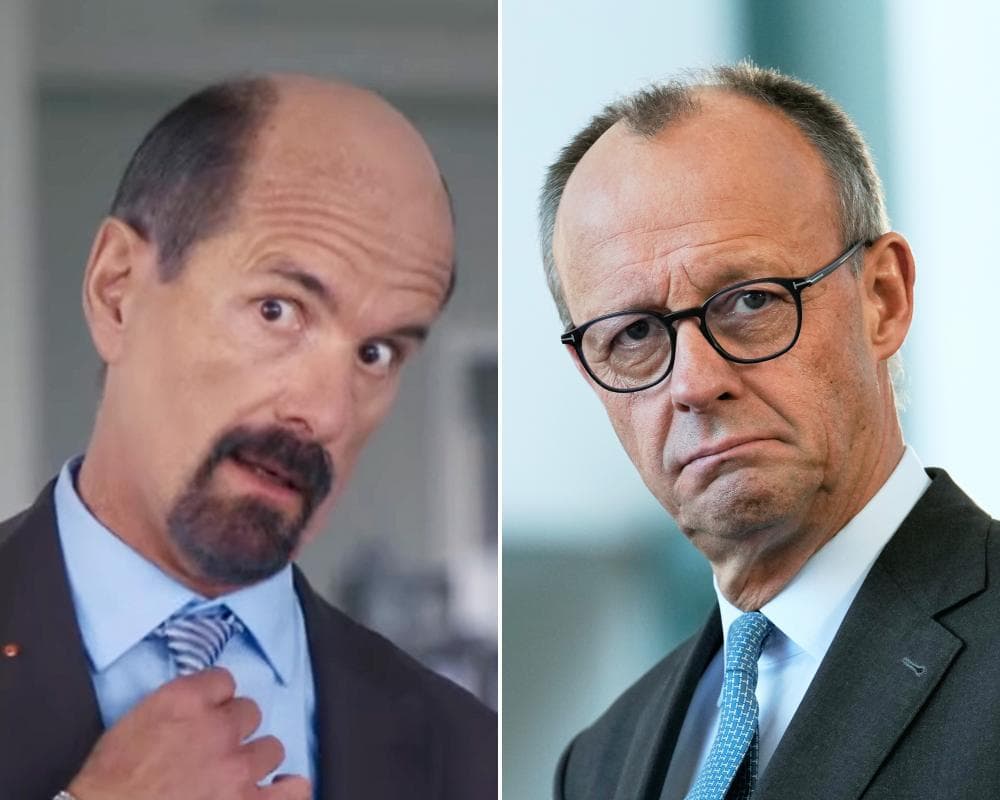
German federal elections at the start of this year gave Stromberg meme culture a new lease of life, and not just because the slender physique and partial baldness of the chancellor, Friedrich Merz, resembles that of the office authoritarian played by the comedian Christoph Maria Herbst.
“They are both boomers to the core and seem to lack any sensitivity to social cues,” said Lukas Lohmer, a German comedy writer for television. “The only difference is that Stromberg realises when he makes a faux pas and often corrects himself.”
In recent weeks, Merz elicited fremdschämen (“vicarious embarrassment”), especially among younger Germans, when proclaiming during a trip to Angola how much he missed German bread, or when he asserted upon returning from Belém, Brazil, that “everyone was delighted to be back in Germany and to have left that place”.
Like Stromberg, Merz is adamant that he treats women as equals, but cannot stop himself from making comments that seem to suggest otherwise. The Christian Democrat politician, whose cabinet’s top roles are all held by men, told a party conference in 2021: “If I really had a problem with women, then my daughters would have shown me a yellow card by now – and my wife wouldn’t have married me 40 years ago.”
That remark formed part of a “Who said it: Merz or Stromberg?” quiz in the Frankfurter Rundschau newspaper earlier this year. Other comments included: “It’s all about equal rights until the ship starts sinking, and then it’s ‘women and children first’” (Stromberg) and “sheer coincidence that all the [meteorological] lows carry female names at the moment” (Merz).
On Instagram and TikTok, accounts hashtagged #Strommerz have taken clips of Merz and dubbed them with the TV show’s theme tune, a jazz cover of Aphex Twin’s Flim. In one of them, the veteran conservative is joined in the Bundestag’s lift by a female politician from the Green party. “With us, things are moving upwards,” he greets her. “And now I’m joining you,” she responds. “That makes the lift a bit heavier,” says Merz, to awkward laughter from his entourage.
As Herbst said this week: “Stromberg couldn’t have come up with a better line than that.”
In this week’s episode of the podcast Schlag und Fertig, the comedian Fabian Köster could not contain his mirth as he presented his latest assortment of the chancellor’s Stromberg-isms: Merz playing to the camera as he waltzes into the chancellory for the first time, announcing: “Right, let’s take up the challenge”; Merz dressing down his social media team for making spelling mistakes on his teleprompter; Merz greeting the European parliament’s president, Roberta Metsola, with a flamboyant “Robertaaa”.
“You have to say, it’s a completely different vibe than what we had with Olaf Scholz,” said Köster.
Merz’s own spokesperson has conceded that at least in terms of his hairstyle, “the chancellor can presumably not reject the comparison”. In all other aspects, he insisted, “the office culture and conversational tone inside the chancellory are clearly different to that in the series”.
While Stromberg takes the same workplace mockumentary format as the BBC show, the comedic tone and character traits of the protagonists differ in significant ways. “David Brent is at heart an entertainer who is desperate for applause,” said Lohmer. “Stromberg is an opportunist who yearns for an enviable career.”
Whereas The Office is set inside a dead-end business, Stromberg plays out inside a more aspirational insurance firm, Capitol Versicherung AG. The German show is played more as a straight-up comedy and does not stray as far into kitchen-sink realism as Gervais’s and Stephen Merchant’s creation. Yet its plot lines are arguably bleaker, involving a suicide attempt and the death of a main character.
“Out of the British, American and German versions of The Office, Stromberg is probably the darkest,” said Kai Hanno Schwind, an associate professor at Kristiania University College, Oslo, who wrote his doctorate on a comparison of the German and the British takes on the theme.
“The Office is essentially about failure, and in the British context the biggest failure a character can experience is social embarrassment. In the German context, the biggest failure is not playing to the rules but not being able to subvert them properly either.”
This predicament meant that while embarrassing, Stromberg was not always an entirely unsympathetic character, Schwind added. In the German show, there were moments when the audience was laughing not just at but with him.
The new film, Stromberg – Wieder Alles Wie Immer (Everything as Usual Again), plays with this double-bind. Set on the eve of a televised reunion of the original cast of the documentary, it has Stromberg super-fans with glued-on goatees gather outside the TV studio and quote his most sexist lines at feminist protesters.
Bernd Stromberg appears at first to have found a job at a modern company with shiny offices, though his role emerges as being little more than a marketing gimmick to teach employees about outmoded workplace practices. Yet when he suffers a breakdown on live TV, Herbst’s character is rehabilitated in the public eye.
In one sequence, the film’s makers have secured the real-life general secretary of Merz’s CDU to endorse their protagonist with all his dinosaur attitudes. “He doesn’t get everything right, but at least he does it,” says Carsten Linnemann.
“The joke about Stromberg was that he was past his his sell-by date even 20 years ago,” said Lohmer. “The scary thing now is that that means he is now embodying the zeitgeist more than ever.”