The Right Rev Thomas McMahon obituary
Click any word to translate
Original article by Peter Stanford
Catholicism does not fall quite so neatly into conservative and liberal factions as is sometimes supposed. Thomas McMahon, the former RC bishop of Brentwood, who has died aged 89, was a case in point.
So traditional in his liturgical tastes that he spent millions commissioning the architect Quinlan Terry to give his undistinguished cathedral in Essex a neoclassical makeover, McMahon also led anti-nuclear prayer vigils and supported street demonstrators against American foreign policy.
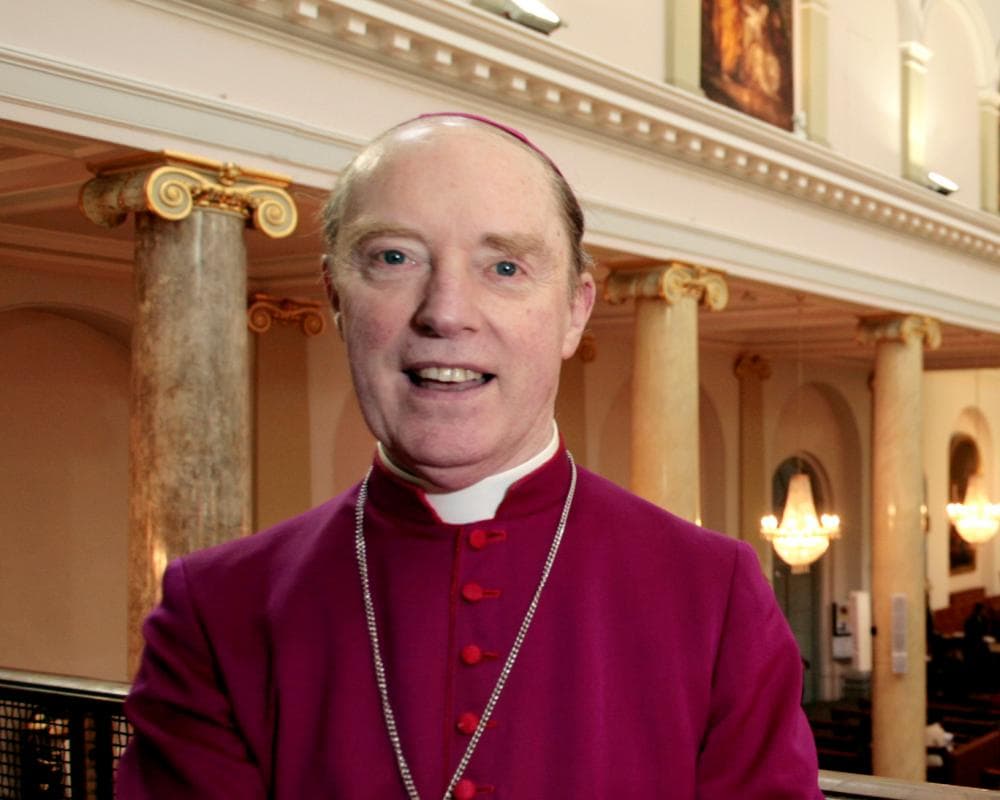
It was in this later role that McMahon made his most lasting mark on the usually cautious, low-profile English Catholic church. A vice-president since 1989 of the Catholic peace organisation Pax Christi, the tall bishop, with his distinctive Bobby Charlton combover and high-pitched voice, participated in full clerical garb at protests outside international arms fairs at the Docklands Arena in east London, and at the then US embassy in Mayfair.
He was an unswerving opponent of nuclear weapons – in contrast to most of his fellow English and Welsh bishops, who followed the more ambiguous line of, first, Cardinal Basil Hume and then his successors Cormac Murphy-O’Connor and Vincent Nichols.
In 1999, McMahon was prominent in exposing the gap between the foreign secretary Robin Cook’s public commitment to an ethical foreign policy and his government’s decision to sell arms to Indonesia. And in 2006 the bishop lent his name to those opposed to Labour’s plans to replace the Trident missile system.
Such an outspoken stance should, if Catholicism divided easily into left and right wings, have made him the cheerleader for many other liberal causes, but elsewhere McMahon followed to the letter traditional Catholic teaching. In 2004 he joined the US-based anti-abortion movement Helpers of God’s Precious Infants in their picket of a Marie Stopes abortion clinic in Buckhurst Hill, Essex. English and Welsh bishops, though firmly anti-abortion in their teaching, had previously been reluctant to join such protests.
It was, however, McMahon’s expensive remodelling of the Cathedral Church of St Mary and St Helen in Brentwood between 1989 and 1991 that brought him the most criticism. Protesters argued that the existing Victorian gothic structure, with its bland 1960s extension, was perfectly adequate for congregations in a small Essex town and that the money being spent on the project would be better directed towards tackling poverty and injustice.
McMahon, however, maintained that the funds came from an anonymous donation made specifically for the rebuilding project, but refused to give any further details.
His highly individual choice of architect – the neoclassicist Terry – did not help ease tensions. Terry mixed Italian Renaissance and English baroque styles, with one portico based on Christopher Wren’s designs for St Paul’s. It was claimed that Brentwood Cathedral was the first classical cathedral erected in Britain since St Paul’s. To some it was a masterpiece, to others a white elephant.
Thomas was born into a middle-class home in Dorking, Surrey. His parents had come from Ireland, and his father was chief consultant civil engineer to Harlow New Town, in Essex. He was one of twins, but his brother, John, a barrister, died in 1969. Educated as a boarder at St Bede’s Catholic grammar in Manchester (which also ran as a junior seminary), Thomas took the unusual – among English clergy – step of training for the priesthood at Saint-Sulpice in Paris.
Following his ordination in 1959, he served in a number of Essex parishes before being named in 1972 chaplain to Essex University. His patron at the time was the deeply conservative Cambridge University chaplain Mgr Alfred Gilbey, who was later rumoured to have been the anonymous funder of the Brentwood Cathedral makeover (being a member of the Gilbey’s gin dynasty).
McMahon’s work as Essex University chaplain caught the attention of others in the hierarchy and in 1980, at the early age of 44, he was named bishop of Brentwood. His diocesan boundaries stretched deep into east London and increasingly McMahon was involved in multifaith initiatives there with Muslim clerics and community leaders. He enjoyed a close working relationship with his Anglican counterparts as bishops of Chelmsford. The two would meet once a month for joint prayer and their commitment to ecumenism saw them set up five shared churches and two shared schools.
Never lacking in the courage of his convictions, McMahon matched his candour in speaking out in public with a colourful personality in private. He chose not to live in the traditional bishop’s residence on the London side of his diocese, but remained in the picture-postcard cottage in the village of Stock, near Billericay, which he had first occupied as university chaplain. He filled it with antiques and would entertain his priests there for dinner in batches of 10.
Tipped in his early days as a bishop for further promotions, he was never one for the machinations of the national bishops’ conference and left too vivid an impression to fit neatly into the Vatican’s blueprint for a loyal cardinal. He served as bishop of Brentwood until 2014, staying on for three years after he had submitted his resignation to Rome on reaching 75, as is required, before retreating to his beloved Stock where he served as its parish priest until the end of his life.
• Thomas McMahon, priest, born 17 June 1936; died 24 November 2025