New Israeli barrier will slice through precious West Bank farmland
Click any word to translate
Original article by Julian Borger and Quique Kierszenbaum in Atouf, West Bank
The death knell for the Palestinian village of Atouf, on the western slopes of the Jordan valley, arrived in the form of a trail of paper, a series of eviction notices taped to homes, greenhouses and wells, marking a straight line across the open fields.
The notices, which appeared overnight, informed the local farmers that their land would be confiscated and that they had seven days from the date of their delivery, 4 December, to vacate their properties. A military road and accompanying barrier was to be built by Israel right through the area.
Lawyers for the Atouf village council have lodged an appeal, but long and bitter experience has taught Palestinians here to have low expectations of Israeli courts.
“The Israeli military can do anything they like. They don’t care about the law or anything else,” said Ismael Bsharat, a local farmer.
Similar eviction notices had been delivered on the same day all along an almost 14-mile (22km) strip of Palestinian farmland running north to south through Atouf, tracing out the route of the planned road and fence. And this week it became clear that this abrupt gash across Palestinian land was the first section of a new line of division that would redraw the map of the West Bank.
This week, Israel’s defence ministry made clear that this would mark only the first section of a new 5.5bn-shekel (£1.3bn) barrier that will eventually run 300 miles, from the Golan Heights on the Syrian border to the north all the way down to the Red Sea near Eilat. Labelled “Crimson Thread” by the Israeli military, the barrier will split countless Palestinian communities along its route.
The army says the barrier is being built for security reasons, but human rights activists say there has been only one lethal incident anywhere near Atouf in recent years in which an Israeli was killed. They argue the real motive is land seizure and the further strangling of Palestine’s prospects as a viable state.
“It is happening all through the Jordan valley, especially in the north. Israel is pushing forward, and accelerating the ethnic cleansing of this area,” said Dror Etkes, an Israeli activist who is the founder of the Kerem Navot organisation, which monitors Israeli land policy in occupied Palestine.
Israel has consistently rejected accusations of ethnic cleansing from Israeli and international human rights organisations, including UN rapporteurs, dismissing them as fabricated propaganda. It also denies the colonisation of occupied territory by settlers is illegal under international law.
Etkes said almost all (85%) of the 1,000 dunams (100 hectares) subjected to the initial round of eviction orders around Atouf were privately owned. These fields are among the most fertile in the West Bank, their rich dark-brown soil built up over millennia by tributaries flowing east to the River Jordan. The area has long been one of Palestine’s breadbaskets.
Most of the affected families had farmed the land for generations, and some had bought new parcels at high prices in recent years. All held title deeds, but none of that is likely to alter the outcome of the looming land grab.
Lawyers for the local Palestinian municipality lodged an appeal against the eviction in an Israeli court but had received no response by the end of this week. The expectation is that Israeli settlers will take over the excised land. A new settlement is planned just west of the new military road.
Across the West Bank, settlements are being planned and built at an unprecedented rate. According to the Peace Now advocacy group, tenders have been published for more than 5,600 housing units so far this year – an all-time record and 50% more than the previous peak in 2018.
Those are only the officially endorsed settlements. New settler outposts (often just a small cluster of huts or portable buildings) are springing up along the valley at an accelerating pace. Though officially unauthorised, they are enabled in practice by the army and police, backed by far-right members of the governing coalition.
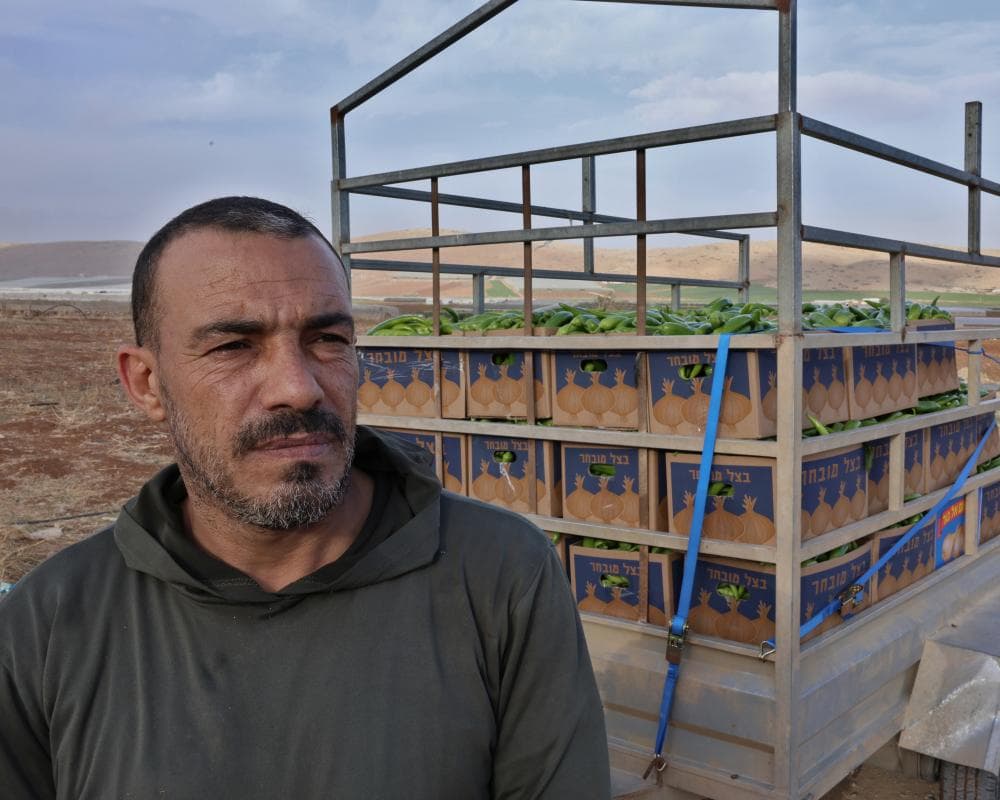
At least one Palestinian farmer in Atouf has already begun moving his livestock in anticipation of eviction, but Bsharat said he would stay put and see what happens. He has little choice. On a winter evening this week, he was going to market with boxes of fresh green peppers grown in his plastic-sheet greenhouses. All his 12 dunams (1.2 hectares) of land lie east of the proposed military road and barrier, and are fed by water pipes running from the hilltops to the west. Those will all be severed when the army arrives to build the road and the barrier.
“What can I do? I can’t farm without water,” Bsharat said.
Abdullah Bsharat, the village council leader (who is from the same extended family as Ismael) predicted that up to 40 families from Atouf would be cut off from the village and their water supply.
“All these families have title deeds,” he said. “They grow grapes, peppers, tomatoes, potatoes, bananas, za’atar and olives. This land is very rich and that is the reason it is being taken. The whole aim is to take it over for settlers to use it.”
The council leader said he had been told by Israeli officers that the road and barrier would together be 50 metres wide, but Palestinian buildings or farmwork would not be allowed along a 200-metre cordon on either side. There was no official confirmation from the army of such a wide exclusion zone, but if true it would greatly increase the economic damage inflicted on Atouf.
At one point along its course the planned barrier will loop around and completely enclose a Palestinian sheep herding community at Khirbet Yarza, who have so far resisted increasing pressure from settlers and the army to move off their 400 dunams of land,. It is not clear if they will be left any means to get in and out of the fence that will be built around them.
The “Crimson Thread” plan put forward this week by Israel’s defence ministry presented the current barrier as just the first part of a vast undertaking, walling off the Jordan valley from the rest of the West Bank, to “strengthen national security and strategic control of the eastern border”.
Maj Gen Eran Ofir, the senior defence ministry official responsible for building walls and barriers, said: “The security barrier whose construction we began today will extend over approximately 500km along the entire eastern border of the state of Israel.”
He added: “It will be a smart border, which will include a physical fence and a collection tool with intelligence sensors, radars, cameras, and advanced technologies.” Ofir said work had begun on two sections of the overall scheme, without giving details. The other section could be a military road started last year further north along the Jordan valley, around the villages of Bardala and Kardala.
Israel’s defence minister, Israel Katz, said: “The new barrier will strengthen settlement along the border, significantly reduce arms smuggling into the hands of terrorists in Judea and Samaria, and will deal a severe blow to the efforts of Iran and its proxies to establish an eastern front against the state of Israel.”
According to the Times of Israel, citing Israel Defense Forces sources, the initial project around Atouf was conceived after a single security incident: the killing in August 2024 of a 23-year-old Israeli, Yonatan Deutsch, in a drive-by shooting by Palestinian militants along Route 90, which runs along the Jordan valley floor.
Etkes said there had been more Palestinian militant attacks in other areas of the West Bank. What distinguished the area around Atouf was not the security risk but the quality of its farmland, he added.
He said: “They are using this incident as a pretext in order to take over tens of thousands of dunams of land, and to push Palestinian communities further out of the Jordan valley.”