Loading...
Please wait for a bit
Please wait for a bit
Click any word to translate
Original article by Hannah Ellis-Petersen in Delhi and Shaikh Azizur Rahman in West Bengal
India’s political opposition has warned that democracy is under threat amid a controversial exercise to revise the voter register across the country, which critics say will disenfranchise minority voters and entrench the power of the ruling Narendra Modi government.
An debate erupted in India’s parliament last week over the special intensive revision (SIR) process, which is taking place in nine states and three union territories, in one of the biggest revisions of the country’s electoral roll in decades.
Ostensibly a bureaucratic exercise to update the lists of citizens eligible to vote, India’s opposition leaders have instead alleged the SIR is being used by the ruling Bharatiya Janata party (BJP) as an underhand “citizenship survey”. State leaders have claimed it is being used to disenfranchise poor and minority voters – particularly Muslims – as “illegal immigrants” and manipulate the electoral roll to benefit the Modi government.
The BJP openly embraces a Hindu nationalist ideology seeking to reshape India from a secular state into a Hindu rashtra, or Hindu nation. During the party’s 11 years in power, its policies and discourse have sharply polarised the nation along religious lines fuelling a surge in anti-Muslim hostility. The BJP has gained unprecedented power over state institutions and its ruling alliance governs 21 out of 28 states.
In states such as West Bengal, critics have alleged that it is primarily Muslims facing the threat of being disenfranchised and deported by SIR, while Bangladeshi Hindus living illegally in India say they are being assured of citizenship.
Speaking in parliament last week, Rahul Gandhi, a leader of Congress, India’s largest opposition party, alleged that SIR was part of a wider project by the BJP to conduct “vote chori [theft]” and destroy the longstanding integrity of India’s democratic elections, which have been held since independence.
“When you destroy the vote, you destroy the fabric of this country, you destroy modern India, you destroy the idea of India,” said Gandhi, who in recent months has claimed to have substantial evidence of foul play among the voting processes in multiple state elections, which has been repeatedly denied by the BJP.
The opposition has alleged SIR is being used as a covert national register of citizens (NRC), similar to what took place in the north Indian state of Assam a few years ago. There, NRC led to hundreds of thousands, primarily Muslims, being rounded up and detained in detention centres or forced to face citizenship tribunals, with some deported to Bangladesh.
The BJP has denied any irregularities in the SIR process, calling it a routine administrative exercise to “cleanse” the electoral roll of “infiltrators”, a term mostly referring to Muslims coming illegally from neighbouring Bangladesh.
Responding to Gandhi in parliament, the home minister, Amit Shah, said the BJP was protecting India’s democracy with a policy of “detect, delete and deport”. “Can a country’s democracy be safe when the prime minister and chief minister are decided by illegal immigrants?” he added.
The electoral commission (EC), the government body conducting the survey, has said SIR is a means to ensure that deceased, illegitimate and duplicate voters are removed from the voter register. However, in parliament Gandhi accused the EC of being controlled by the BJP and “colluding with those in power to shape elections”.
SIR already provoked a significant backlash and a slew of legal challenges when it was carried out in Bihar, a state of 130 million people, earlier this year. More than 6.5 million people were removed from the voter list as a result. The EC had claimed it was because they were dead or had moved away, but many turned out to be alive, and it resulted in millions of complaints.
Opposition parties alleged that many of those removed were Muslims or belonged to communities that do not form the vote bank of the Hindu nationalist BJP, while other names were added erroneously, a claim the EC has denied. In the Bihar state election that took place in November after the SIR process was completed, the BJP won by a historic landslide.
Nowhere has SIR been more controversial than in West Bengal, the state neighbouring Bangladesh, which has a high number of Muslims.
The ruling Trinamool Congress party (TMC) government, led by the chief minister, Mamata Banerjee, has described SIR as a “politically motivated” process to “capture West Bengal by trickery”. West Bengal is one of the few states where the BJP has so far failed to gain political traction but state elections are due next year.
Banerjee also alleged that the “shadow of fear and uncertainty” being created by SIR has led to panic and distress among the people, creating a widespread fear among the state’s Muslims that they will lose their citizenship. TMC has linked the stress of SIR to multiple deaths and suicides that have taken place in the state in recent weeks, and Banerjee wrote to the EC to intervene and halt the process.
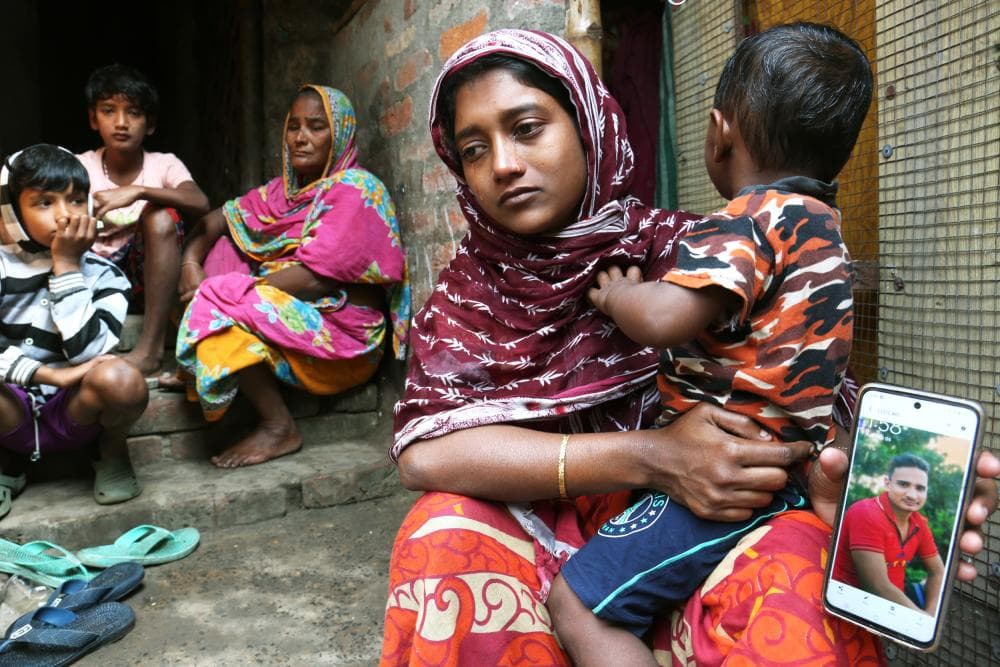
Among those left in extreme stress was Jahir Mal, who lived in a mud-walled, plastic-roofed shack in Khalisani, 25 miles (40km) west of Kolkata with his wife and children. After news of the electoral revision exercise spread, his family recounted how he began watching SIR-related videos on Facebook warning of mass expulsion and then stopped going to work and isolated himself from family and neighbours.
An illiterate Muslim labourer, he feared that as he was not on the electoral list, he would immediately be deemed an illegal citizen by SIR – despite being born in India.
“He kept asking, ‘What will I do if they send me to Bangladesh? I have no connection there’,” recounted his wife, Rejina. “I begged him to calm down and assured him nothing would happen … But he wouldn’t listen.
“On November 4, the SIR officials were scheduled to arrive at 10am to check the documents. At 9am, when no one else was home, my husband took his life.” Now Rejina is left alone with their three young children, the family’s sole breadwinner gone. “I don’t know how we will survive. I am broken,” she said.
The government has denied that the SIR discriminates against Muslims. But critics have pointed to inflammatory comments made by local BJP leaders such as Suvendu Adhikari, who said Hindus who fled persecution in Bangladesh were “welcome” and would receive citizenship under a controversial act passed by the BJP in 2019, whereas Muslims from the same country were “infiltrators” whose names would be detected and deleted.
Bangladeshi Hindus living in India without documents confirmed to the Guardian they had been given assurances by local BJP leaders that SIR would not result in them being detained or deported as infiltrators, despite their illegal status.
Bikash Das, a Hindu from Bangladesh, said he had come to India 10 years ago, and despite not being an official citizen had managed to obtain an Indian ID and vote in the past two elections. He said SIR had initially caused him concern that he and his family would be deported. “Then, some local BJP leaders reassured us that we would definitely be granted Indian citizenship,” he said.
The SIR process has also sparked anger and protest in the southern states of Tamil Nadu and Kerala, which have been ruled by opposition parties for decades and where the BJP has been attempting to make electoral inroads.
In Tamil Nadu, the ruling Dravida Munnetra Kazhagam party has formally opposed the exercise. In Kerala, the Communist party of India (Marxist)-led government passed a resolution against SIR, condemning it as a “citizenship survey” by the backdoor.
Though it was due to be completed by early December, the SIR deadline for many states has been pushed back by several weeks. The final voter lists are due to be published in February 2026.
The best public interest journalism relies on first-hand accounts from people in the know.
If you have something to share on this subject, you can contact us confidentially using the following methods.
Secure Messaging in the Guardian app
The Guardian app has a tool to send tips about stories. Messages are end to end encrypted and concealed within the routine activity that every Guardian mobile app performs. This prevents an observer from knowing that you are communicating with us at all, let alone what is being said.
If you don't already have the Guardian app, download it (iOS/Android) and go to the menu. Select ‘Secure Messaging’.
SecureDrop, instant messengers, email, telephone and post
If you can safely use the Tor network without being observed or monitored, you can send messages and documents to the Guardian via our SecureDrop platform.
Finally, our guide at theguardian.com/tips lists several ways to contact us securely, and discusses the pros and cons of each.