Loading...
Please wait for a bit
Please wait for a bit
Click any word to translate
Original article by Angela Giuffrida in Pagliara dei Marsi
In Pagliara dei Marsi, an ancient rural village on the slopes of Mount Girifalco in Italy’s Abruzzo region, cats vastly outnumber people.
They weave through the narrow streets, wander in and out of homes, and stretch out on walls overlooking the mountains. Their purrs are a consistent hum in the quiet that has come with decades of population decline.
But less so since March, when rapturous celebrations marked a rare occurrence: the birth of a child.
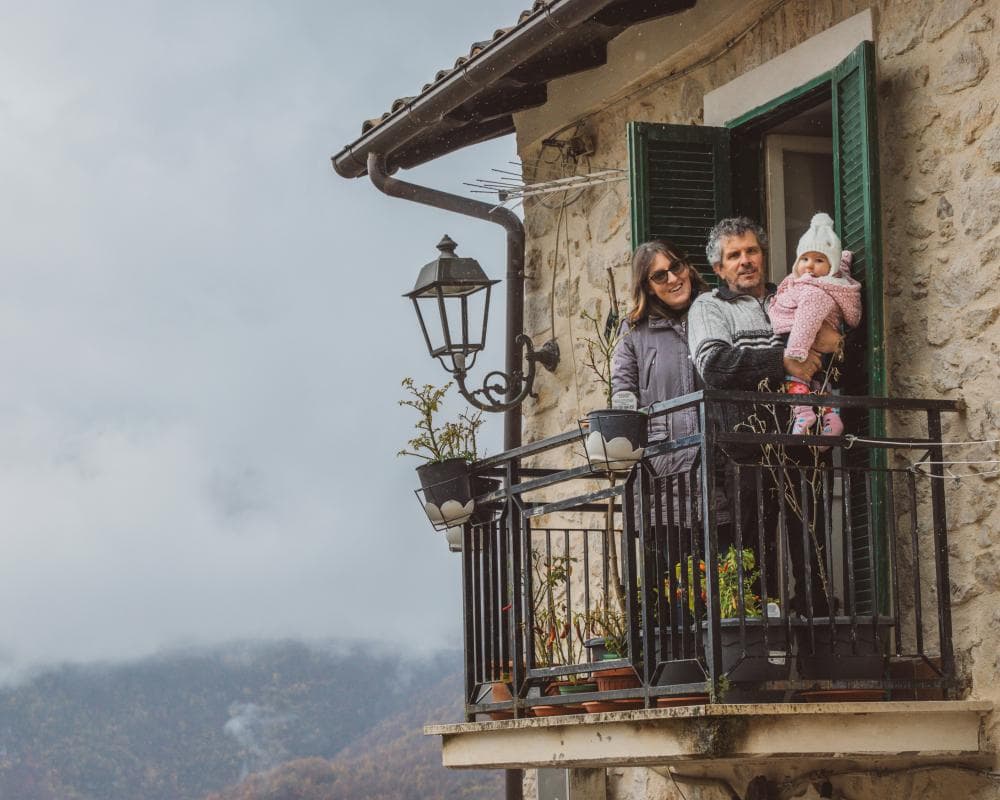
Lara Bussi Trabucco is the first baby to have been born in Pagliara dei Marsi in almost 30 years, bringing the village’s population to roughly 20.
Her christening in the church opposite her home was attended by the entire community – including the cats – and such is the novelty of having a baby in the village, she is now the main tourist attraction.
“People who didn’t even know Pagliara dei Marsi existed have come, only because they had heard about Lara,” said her mother, Cinzia Trabucco. “At just nine months old, she’s famous.”
Lara’s arrival is a symbol of hope, but also a sobering reminder of Italy’s worsening demographic crisis.
In 2024, births in the country reached a historic low of 369,944, continuing a 16-year negative trend, according to figures from Istat, the national statistics agency. The fertility rate also fell to a record low, with an average 1.18 children born to women of child-bearing age in 2024 – one of the lowest in the EU.
Reasons for the decline are myriad, from job insecurity and the huge wave of youth emigration to inadequate support for working mothers and, as in other countries, the rise in male infertility. Furthermore, an increasing number of people are simply choosing to not have children.
Istat’s preliminary data for the first seven months of 2025 points to a further decrease, and of Italy’s 20 administrative regions, nowhere has it been more acute than in the already sparsely populated Abruzzo, which between January and July had a 10.2% drop in the number of births compared with the same period in 2024.
Pagliara dei Marsi is tiny, but it is emblematic of a country-wide landscape that is becoming dominated by ageing populations and emptying schools, putting pressure on public finances and presenting daunting economic and social challenges for leaders at local, regional and national levels.
“Pagliara dei Marsi has been suffering from drastic depopulation, exacerbated by the loss of many elderly people, without any generational turnover,” said the local mayor, Giuseppina Perozzi.
Perozzi, who lives a few doors away from baby Lara, said she was grateful to Trabucco, 42, and her partner, Paolo Bussi, 56, for starting a family and hopes it will inspire others to do the same.
Their situation is uncommon. Trabucco, a music teacher, was born in Frascati, close to Rome, and worked in the Italian capital for years before deciding to move to the village where her grandfather was born because she had always wanted to raise a family far from the chaos of a city. She met Bussi, a construction worker from the area, a few years ago.
The couple benefited from a €1,000 “baby bonus” after Lara’s birth, a one-time payment for each child born or adopted since January 2025, introduced by Giorgia Meloni’s far-right government as part of its pledge to tackle what the prime minister has called Italy’s “demographic winter”. They also receive a child benefit payment of about €370 a month.
But their main struggle is juggling childcare around work. Italy’s childcare support system is chronically insufficient and Meloni’s administration, despite depicting the birthrate crisis as a battle for national survival, has so far fallen short in its promise to boost the number of nurseries. Many women who become pregnant are forced to leave the workforce and later struggle to re-enter.
The couple worry about Lara’s future schooling, too. The last time Pagliara dei Marsi had a teacher – whose home doubled-up as the school – was decades ago. There is an infant and primary school in nearby Castellafiume, but given the school closures across Italy due to the birthrate decline, it remains to be seen whether there will be enough children to sustain the facility over the long term.
Trabucco said financial incentives were not enough to stymie the trend. “The entire system needs to be revolutionised,” she added. “We’re a country of high taxes but this does not translate into a good quality of life or good social services.”
About an hour’s drive from Pagliara dei Marsi is Sulmona, a once-thriving city where the hastened pace of depopulation over the past decade has led to a battle to save its maternity unit, located at Annunziata hospital, from closure.
The unit, which serves the city and nearby towns, delivered 120 babies in 2024, well below the 500 required for maternity units to maintain funding. If it closes, pregnant women would need to travel to L’Aquila, the regional capital, about an hour’s drive away, posing risks in emergency situations.
“The region is vast and especially in winter, travel conditions can be treacherous,” said Gianluca Di Luigi, a gynaecologist at the hospital who recalled a woman in labour who got stuck in a snow storm for eight hours. “By the time we got her to the hospital, we had to do an emergency caesarean. This was her first child and she was traumatised by the whole experience.”
Those fighting to keep the unit open argue that the figure of 500 births a year, established in 2010, is no longer realistic. “We never did reach the magic 500 here,” said Berta Gambina, a midwife who has worked in the unit for 39 years. “Even in the best of times, we averaged about 380 births a year. But I will do all I can to keep it open – my biggest fear is abandoning pregnant women.”
Ornella La Civita, a city councillor with the centre-left Democratic party, said financial incentives to encourage births were welcome. “But how can you give women money to have babies but not guarantee them a safe and secure place to give birth?”
One often overlooked topic in Italy’s birthrate debate is preserving fertility, said Di Luigi, through means such as freezing eggs. “Ideological thinking in Italy has always been a block,” he added. “But if we want newborns, then we need enlightenment too – yes, provide young people with dignified jobs but let’s start teaching them about preserving fertility.”