Loading...
Please wait for a bit
Please wait for a bit
Click any word to translate
Original article by Pjotr Sauer in Berehove
Across much of Ukraine, Sunday’s parliamentary election in Hungary is being followed with a singular hope: that Viktor Orbán, the Kremlin-friendly leader who has made opposition to Kyiv a centrepiece of his campaign, will be voted out after 16 years in office.
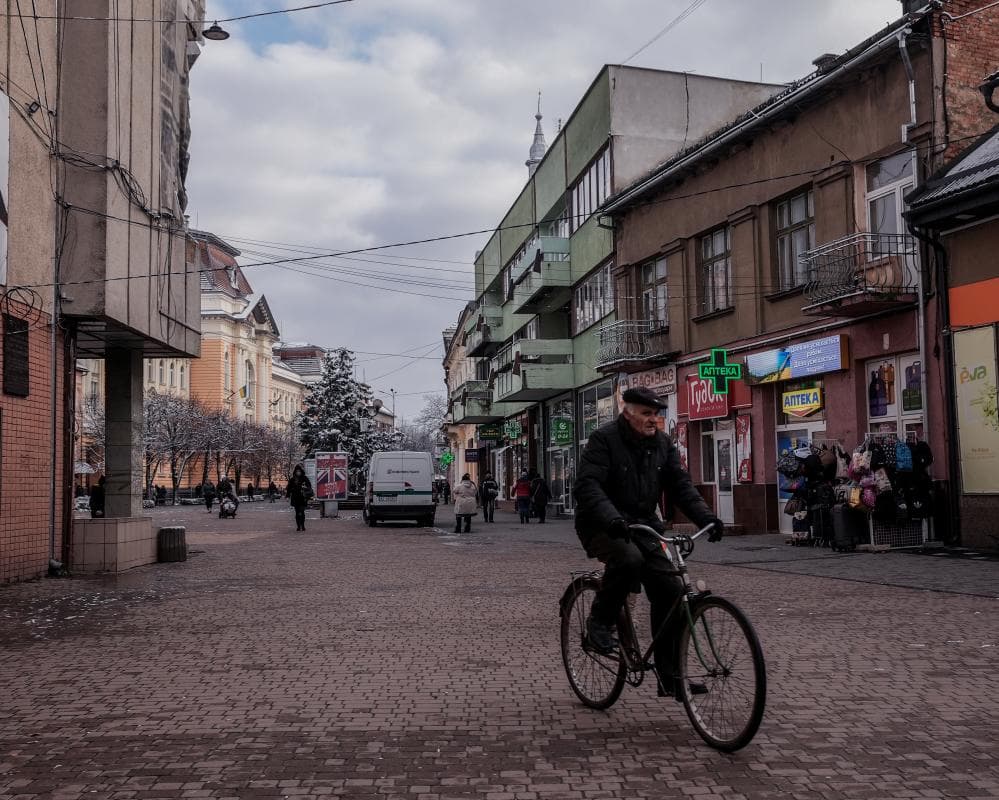
But in Berehove, the mood is more complicated.
In this small town of about 30,000 in Ukraine’s hilly Zakarpattia region, ethnic Hungarians form a majority, and Hungarian is heard as often as Ukrainian. Daily life – from schooling to the television channels watched at home – remains closely tethered to neighbouring Hungary.
Some residents admit, often quietly, that they are rooting for Orbán’s Fidesz party.
“Orbán is not perfect, but he cares about Hungarians everywhere,” said László, speaking outside the Hungarian consulate on Friday morning as he collected documents to cast his vote on Sunday.
Like others interviewed, he asked for his surname to be withheld, saying he did not feel comfortable speaking publicly about the subject.
László said he was upset with the deteriorating relations between Hungary and Ukraine but praised Orbán for providing passports to ethnic Hungarians, financial assistance, and standing up for what he described as the community’s language rights. While it is technically illegal in Ukraine, many in Berehove have a second Hungarian passport, and Budapest has set up several voting stations at consulates in the region.
Orbán has long portrayed himself as a defender of ethnic Hungarians abroad – about 60,000 of whom live in Zakarpattia – claiming they face widespread discrimination in Ukraine and are being forced to assimilate into Ukrainian society.
His critics, both in Hungary and within Ukraine, say he has exaggerated – and at times distorted – those grievances to justify a hostile stance towards Kyiv and its western allies.
“Hungarian voters are sensitive to the issue of ethnic Hungarians living beyond Hungary’s borders,” said András Rácz, a senior research fellow at the German Council on Foreign Relations.
“Orbán’s rhetoric made the situation seem much worse, and with that, he turned domestic Hungarians against Ukraine,” he added.
Tensions between Budapest and Kyiv have reached a critical point in the run-up to the election, with Hungary continuing to block a €90bn EU financial package for Ukraine, delaying critical funding needed to sustain Kyiv’s war effort.
Orbán’s government has also sought to use the plight of ethnic Hungarians in Ukraine to hinder Kyiv’s longstanding bid to join the EU.
In a leaked phone call reported this week by the investigative outlet VSquare, Hungary’s foreign minister, Péter Szijjártó, told his Russian counterpart, Sergei Lavrov, that the persecution of Hungarian rights in Ukraine had played a key role in Budapest’s continued opposition to Ukraine’s EU accession.
Yet in Berehove, many residents insist the picture is more nuanced.
Some voiced concerns over Ukraine’s language policies affecting Hungarians, most notably a law that would phase out minority languages in schools before it was suspended in 2023.
But many said Orbán’s claims of discrimination were not reflected in everyday life.
“We live alongside Ukrainians like brothers and sisters,” said Erika, who works at the Hungarian theatre in the centre of town, where clocks display both Hungarian and Ukrainian time.
“There is no discrimination here at all.”
She added that while she was following the election with interest, she had not voted. “I only have one president, and that is Volodymyr Zelenskyy.”
Outside a Catholic church flying a Hungarian flag, where services are held in Hungarian, Natália had just returned from morning mass.
“Hungarians and Ukrainians live together and pray together,” she said.
“We celebrate both Orthodox and Catholic Easter, and we like it this way.”
She said she was frustrated by the way Ukraine had become a political talking point in Hungary. “Politics are heated, but here in Berehove we live together.”
Others compared the mood in Berehove to the divisions seen inside Hungary itself.
“Just like over there, you have people who want Orbán to win and people who want the opposition to replace him,” said Artúr, who said he wanted the Orbán government to lose, citing corruption issues and its stance towards Ukraine.
Hungarian community leaders and analysts have sought to explain Orbán’s support in the towns and villages of Zakapattia in two ways.
Known also by its Hungarian name, Beregszász, the town has long existed at the shifting edges of empires.
It was part of Hungary for centuries before passing to Czechoslovakia after the first world war, then briefly returning to Hungarian control on the eve of the second. Incorporated into Soviet Ukraine in 1945, it became part of an independent Ukraine in 1991. But no matter who governed it, it has remained relatively poor and underdeveloped.
“Orbán’s government has invested in schools, community centres and helped farmers,” said Boris Vashkeba, a lawyer and the head of a Hungarian community organisation based in the neighbouring town of Vynohradiv. Vashkeba said he initially supported Orbán but has been disappointed by his turn towards Moscow.
“People see tangible results from him, and that’s why they tell me he has their vote,” he added.
Timbur Tomba, who heads the Hungarian community in Kyiv and is a vocal critic of the current government in Budapest, blamed Orbán’s popularity on Hungarian state media
“Most Hungarians in Ukraine still watch state propaganda. These people are just being fed lies from the television. They get a distorted picture of reality,” he said.
Orbán has also played on the region’s sometimes complicated wartime sentiments.
Tucked against the Hungarian border, Berehove can feel far removed from the war. The town has sent relatively few men to the front compared with other parts of Ukraine, and daily life has largely been undisturbed by air raid sirens or missile strikes.
“The war feels distant in Zakarpattia, so people don’t always understand what the rest of Ukraine is going through,” Tomba said, adding he organised what he described as educational trips for Hungarians to the capital.
Orbán has in the past accused Ukraine of sending ethnic Hungarians “to the slaughterhouse” and bloating their military casualties.
But both Vashkeba and Tomba strongly pushed back against the notion that ethnic Hungarians were unwilling to serve or were “unpatriotic” towards Ukraine.
Tomba said several thousand had fought in Ukraine’s armed forces since the full-scale invasion, with around a hundred killed in the fighting. Like in any other town, Berehove has a memorial to fallen Ukrainian soldiers in its central square.
Kyiv, meanwhile, has sought to project cohesion.
In a symbolic trip clearly tied to the Hungarian elections, this week Zelenskyy travelled to the region, where he met leaders from the Hungarian community and thanked them for their unity.
For Vashkeba, the hope is that the election could offer a reset in ties between Kyiv and Budapest.
“We need a restart in relations; it can’t go on like this,” he said.
“When Ukraine and Hungary, two nations that have both suffered at the hands of Russia, are set against each other, it is Moscow that ultimately benefits.”
Additional reporting by Artem Mazhulin and Flora Garamvolgyi