Loading...
Please wait for a bit
Please wait for a bit
Click any word to translate
Original article by Michael Safi and Melvyn Ingleby
A Syrian former regime official suspected of leading a notorious civilian massacre revealed by the Guardian – and who became one of the country’s most-wanted fugitives after the fall of Bashar al-Assad – has been arrested by security forces, Syria’s interior ministry announced.
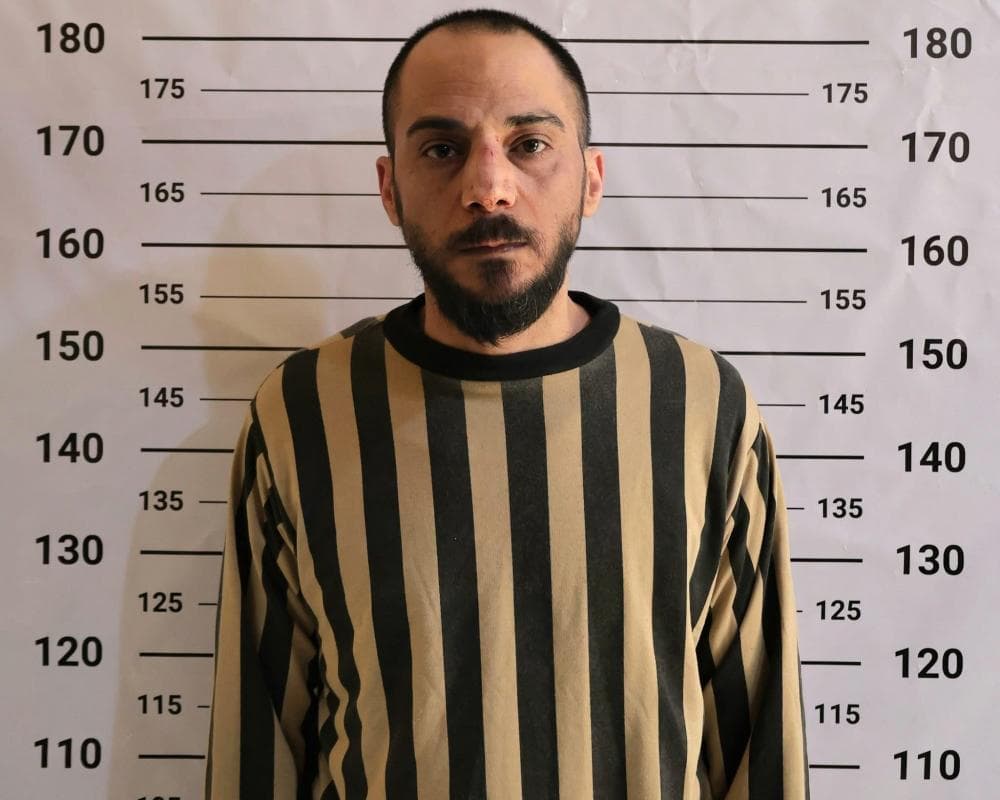
Amjad Youssef was captured in the Ghab plain area about 30 miles (50km) outside the city of Hama and had “been taken into custody following a carefully executed security operation”, the interior minister, Anas Khattab, said in a social media post on Friday.
Mugshots released by the ministry showed Youssef, 40, in a striped prison uniform, while videos circulated on social media showing the former military intelligence officer in custody in a vehicle, his face bloodied, being sworn at and slapped by uniformed men.
Youssef had been hiding in the Ghab plain area since the overthrow of Assad at the end of 2024, a security source told Reuters.
He is one of the most prominent suspects in what has become known as the Tadamon massacre, the slaughter of an estimated 288 civilians, including 12 children, in a southern Damascus neighbourhood in 2013. It was documented in a series of videos taken by the killers themselves and leaked to researchers in Europe, excerpts of which were published by the Guardian in 2022.
• Warning: contains graphic images
More than two dozen videos showed uniformed Syrian army officials working with pro-government militiamen to lead groups of blindfolded civilians to the edge of a pit, forcing them inside and then shooting them dead. Their bodies were burned and buried using a bulldozer, all of it captured in detail by the perpetrators.
The footage offered an as yet unseen glimpse into the brutal treatment of civilians by Assad government forces in disputed areas across Syria, but was also extraordinary for the manner in which it emerged.
A whistleblower discovered the videos on a government laptop and secretly passed them to activists in Paris, who sent them to a pair of researchers based in the Netherlands, Annsar Shahhoud and Prof Uğur Ümit Üngör, from the University of Amsterdam and the NIOD Institute for War, Holocaust and Genocide Studies.
Over the next two years, Shahhoud and Üngör worked to identify the location of the killings and the identities of the victims as well as the perpetrators, including their alleged ringleader, a young man with a distinctive scar on his left eyebrow whom they called “the shadow man”.
Shahhoud eventually found a Facebook page, the profile image of which bore a resemblance to the man, which belonged to a Syrian intelligence official named Amjad Youssef. She posed as a pro-Assad researcher based in Europe and spent the next year conducting interviews with Youssef that she secretly filmed.
After the Guardian revealed the massacre in text and published excerpts of Shahhoud’s secret interviews in a two-part podcast miniseries, the US state department and the EU announced sanctions against Youssef, and France said it was commencing a war crimes investigation.
News of Youssef’s arrest was greeted with joy in Tadamon, where mass celebrations were expected after Friday prayers. “I don’t know what to say, I am so happy,” said Maher Rahima, a young man who lived through the era of the killings. “At the same time, I cannot forget the images of the children and women who were killed and burned. They must never be forgotten.”
Residents have said the atrocities in Tadamon continued until at least 2015, with the true death toll likely to exceed 1,000 people, many of whom were interred in mass graves around the area.
Tadamon became a symbol of the crimes committed against Syrian civilians. After Assad’s fall, media outlets, human rights groups and people from across the country rushed to the area to find the burial sites of victims and to interview witnesses. The area depicted in the leaked footage has been labelled on Google Maps as “the site of the Tadamon massacre”. Residents refer to the site as “Amjad Youssef’s pit”.
Ahmed Adra, a Tadamon resident and a member of the neighbourhood committee, told Reuters that victims’ families had been celebrating in the streets since morning. “We will take white roses and plant them at the site of the massacre and tell the victims that their memory is alive and that justice is being served,” he said.
Youssef’s capture is a major symbolic arrest for the Syrian government headed by Ahmed al-Sharaa, who swept to power 18 months ago promising to hold Assad-era officials and supporters responsible for their crimes.
But progress towards accountability has been uneven, with some powerful figures under Assad striking deals with the new government to provide information, negotiate the handover of weapons or hostages, and negotiate peace deals in apparent exchange for immunity from prosecution.
They include Fadi Saqr, a former commander of the National Defence Forces (NDF), a pro-Assad militia which took part in the mass killing of civilians in Tadamon. Saqr has denied any involvement in the massacre, claiming he was appointed as NDF commander afterwards.
Shahhoud told the Guardian: “I am extremely happy for the families. However, it remains to be seen what shape the trial of Amjad Youssef will now take, and whether we will get a transparent account of what he has to say. After all, this may incriminate many other perpetrators, including those who currently made a settlement with the new government, such as Fadi Saqr.
“While Youssef is the most famous perpetrator, the NDF and many other actors also participated in the mass killing of civilians in Tadamon. Without a fair and transparent trial it is unlikely justice will be served.”
After feeling for years that Youssef was trying to track her in retribution for her work, Shahhoud said: “I feel safe now.”
Rumours of Youssef’s whereabouts had circulated for years after Assad’s government fell in December 2024, including reports he had fled to Lebanon or to Europe and had undergone plastic surgery to change his appearance.
Syrian security forces finally arrested him about 125 miles from Tadamon looking much the same as he had in 2022, with the same scar on his left eyebrow, but older, frightened and bruised in the custody of a new, rebel-led government.